Two companies made dried milk powder linked to botulism in ByHeart baby
formula
[January 30, 2026]
By JONEL ALECCIA
Two companies processed and supplied dried milk powder that could be a
culprit in the outbreak of botulism tied to ByHeart infant formula that
has sickened dozens of babies, The Associated Press has learned.
Organic whole milk powder that tested positive for the type of bacteria
that causes botulism was made from milk provided by Organic West Milk
Inc., a California company, and processed at a Dairy Farmers of America
plant in Fallon, Nevada, company officials said.
The source of the contamination, however, is not yet known. Both
companies and the U.S. Food and Drug Administration emphasized that the
investigation into the unprecedented outbreak that has sickened 51
babies in 19 states is ongoing.
Bill Van Ryn, an owner of Organic West Milk, said he learned last week
that a sample of his company’s milk powder collected by the FDA had
tested positive for the germ that causes botulism.
But that doesn’t mean his product is the source of the outbreak, Van Ryn
stressed.
“Nothing has been proven about our milk yet,” he said, adding:
“Something happened in the process of converting the milk to powder and
then in converting it to baby formula.”
Organic West, which supplies milk from 55 farmers, didn’t sell organic
whole milk powder to any infant formula maker besides ByHeart, Van Ryn
said. The milk company has halted sales of the powder used in any
product intended for babies and children until more is known about the
source of the outbreak, he added.

Powdered milk is made by pasteurizing liquid milk, concentrating it
through evaporation and spraying it into a hot chamber, which causes the
water to evaporate and leave behind fine, dry milk particles.
The Dairy Farmers of America is a global dairy cooperative. Its plant in
Nevada processes about 1.5 million pounds of raw milk daily into 250,000
pounds of whole milk powder.
The Dairy Farmers of America said in a statement that Organic West was
the source of milk for the sample that FDA collected that tested
positive for botulism bacteria. The milk was processed into powder that
met all required tests, the company said. Organic West subsequently sold
the milk powder to ByHeart.
[to top of second column]
|
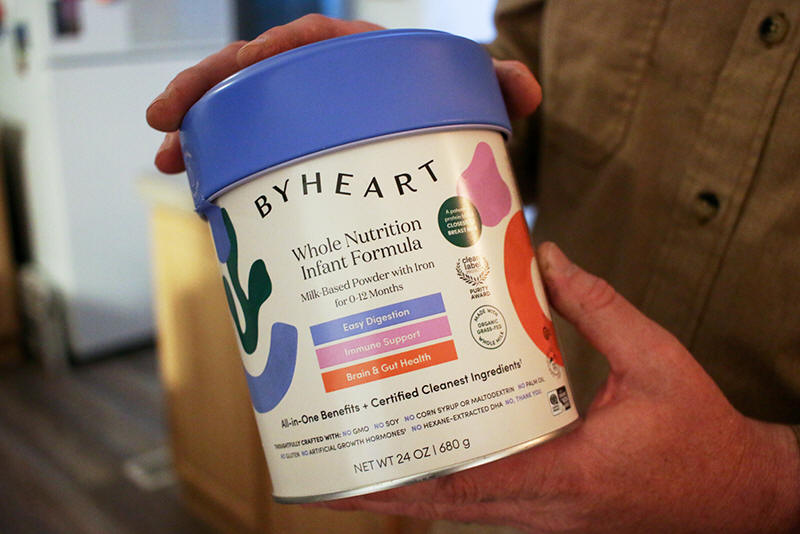
A container of ByHeart baby formula, which was recently recalled by
ByHeart, in Flagstaff, Ariz., on Wednesday, Nov. 12, 2025. (AP
Photo/Cheyanne Mumphrey, File)
 “Manufacturers of end-use consumer
products have a responsibility to properly process ingredients to
ensure product safety,” the statement read.
FDA officials said on Jan. 23 that a sample of organic whole milk
powder collected from a supplier had tested positive for the
botulism bacteria, though the agency didn't identify the supplier.
Tests showed that sample was a genetic match to a sample taken from
a finished can of ByHeart formula.
The agency also found the bacteria in an unopened can of formula
matched a sample from a sick baby — and it also matched
contamination detected in samples of milk powder used to make
ByHeart formula and collected and tested by the company.
ByHeart officials declined to identify the source of those milk
powder samples. The infant formula company has recalled all its
products.
Botulism spores are common in the environment and can be found in
most foods at very low levels, said Kristin Schill, a botulism
expert at the University of Wisconsin-Madison.
Healthy adults consume Clostridium botulinum spores every day
without becoming sick. But babies have immature guts that may not be
able to prevent the spores from germinating and growing. Once they
do, the spores produce a toxin that can cause paralysis and death.
Spores can be found everywhere, including in milk, though typically
at low levels, Schill said. Pasteurization doesn't kill the germs.
They can be present in the processing environment, too.
Botulism spores have been found in infant formula in the past, but
this is the first large outbreak linked to the product. The risk has
been considered so low that testing for botulism in infant formula
is not required, though some formula makers voluntarily screen for
microbiological signals that could indicate contamination.
All contents © copyright 2026 Associated Press. All rights reserved |