US appeals court says Noem's decision to end protections for Venezuelans
in US was illegal
[January 29, 2026]
By SUDHIN THANAWALA
A federal appeals court ruled late Wednesday that the Trump
administration acted illegally when it ended legal protections that gave
hundreds of thousands of people from Venezuela permission to live and
work in the United States.
A three-judge panel of the 9th U.S. Circuit Court of Appeals upheld a
lower court ruling that found Homeland Security Secretary Kristi Noem
exceeded her authority when she ended temporary protected status for
Venezuelans.
The decision, however, will not have any immediate practical effect
after the U.S. Supreme Court in October allowed Noem's decision to take
effect pending a final decision by the justices.
An email late Wednesday night to the Department of Homeland Security was
not immediately returned.
The 9th Circuit panel also upheld the lower court's finding that Noem
exceeded her authority when she decided to end TPS early for hundreds of
thousands of people from Haiti.
A federal judge in Washington is expected to rule any day now on a
request to pause the termination of TPS for Haiti while a separate
lawsuit challenging it proceeds. The country’s TPS designation is
scheduled to end on February 3.
Ninth Circuit Judges Kim Wardlaw, Salvador Mendoza, Jr. and Anthony
Johnstone said in Wednesday's ruling that the TPS legislation passed by
Congress did not give the secretary the power to vacate an existing TPS
designation. All three judges were nominated by Democratic presidents.

“The statute contains numerous procedural safeguards that ensure
individuals with TPS enjoy predictability and stability during periods
of extraordinary and temporary conditions in their home country,”
Wardlaw, who was nominated by President Bill Clinton, wrote for the
panel.
Wardlaw said Noem's “unlawful actions have had real and significant
consequences” for Venezuelans and Haitians in the United States who rely
on TPS.
“The record is replete with examples of hard-working, contributing
members of society — who are mothers, fathers, wives, husbands, and
partners of U.S. citizens, pay taxes, and have no criminal records — who
have been deported or detained after losing their TPS,” she wrote.
Temporary Protected Status, or TPS, authorized by Congress as part of
the Immigration Act of 1990, allows the Homeland Security secretary to
grant legal immigration status to people fleeing countries experiencing
civil strife, environmental disaster or other “extraordinary and
temporary conditions” that prevent a safe return to that home country.
[to top of second column]
|
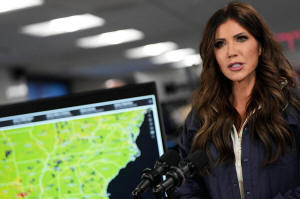
Homeland Security Secretary Kristi Noem speaks about the impending
winter weather during a news conference at Federal Emergency
Management Agency headquarters, Saturday, Jan. 24, 2026, in
Washington. (AP Photo/Julia Demaree Nikhinson)

Designations are granted for terms of six, 12 or 18 months, and
extensions can be granted so long as conditions remain dire. The status
prevents holders from being deported and allows them to work, but it
does not give them a path to citizenship.
In ending the protections, Noem said that conditions in both Haiti and
Venezuela had improved and that it was not in the national interest to
allow immigrants from the two countries to stay on for what is a
temporary program.
Millions of Venezuelans have fled political unrest, mass unemployment
and hunger. The country is mired in a prolonged crisis brought on by
years of hyperinflation, political corruption, economic mismanagement
and an ineffectual government.
Haiti was first designated for TPS in 2010 after a catastrophic
magnitude 7.0 earthquake killed and wounded hundreds of thousands of
people, and left more than 1 million homeless. Haitians face widespread
hunger and gang violence.
Mendoza wrote separately that there was “ample evidence of racial and
national origin animus” that reinforced the lower court's conclusion
that Noem's decisions were “preordained and her reasoning pretextual.”
“It is clear that the Secretary’s vacatur actions were not actually
grounded in substantive policy considerations or genuine differences
with respect to the prior administration’s TPS procedures, but were
instead rooted in a stereotype-based diagnosis of immigrants from
Venezuela and Haiti as dangerous criminals or mentally unwell,” he
wrote.
Attorneys for the government have argued the secretary has clear and
broad authority to make determinations related to the TPS program and
those decisions are not subject to judicial review. They have also
denied that her actions were motived by racial animus.
All contents © copyright 2026 Associated Press. All rights reserved
 |