Venezuela’s acting president signs oil industry overhaul, easing state
control to lure investors
[January 30, 2026] By
REGINA GARCIA CANO
CARACAS, Venezuela (AP) — Venezuela’s acting President Delcy Rodríguez
on Thursday signed a law that opens the nation’s oil sector to
privatization, reversing a tenet of the self-proclaimed socialist
movement that has ruled the country for more than two decades.
The reform will undoubtedly be her government’s signature policy as it
positions the oil sector – Venezuela’s engine – to lure the foreign
investment needed to revamp a long-crippled industry. Rodríguez enacted
the measure less than a month after the brazen seizure of then-President
Nicolás Maduro in a U.S. military attack in Venezuela’s capital,
Caracas.
Rodríguez, facing oil workers and ruling-party supporters, signed the
bill less than two hours after the National Assembly approved it. At the
same time, the U.S. Department of Treasury officially began to ease
punishing economic sanctions on Venezuelan oil, which were imposed by
the first Trump administration, and expanded the ability of U.S. energy
companies to operate in the South American nation.
Rodríguez on Thursday also spoke with U.S. President Donald Trump and
Secretary of State Marco Rubio, who a day earlier explained to U.S.
senators in a hearing how the administration is planning to handle the
sale of tens of millions of barrels of oil from Venezuela and oversee
where the money flows. Venezuela has the largest proven reserves of
crude in the world.
The moves by both governments are paving the way for yet another radical
geopolitical and economic shift in Venezuela.

“We’re talking about the future. We are talking about the country that
we are going to give to our children,” Rodríguez said of the reform.
Rodríguez proposed the changes earlier this month, after Trump said his
administration would take control of Venezuela’s oil exports and
revitalize the ailing industry by luring foreign investment.
Private companies to control oil production
The legislation promises to give private companies control over the
production and sale of oil, ending the state-owned Petróleos de
Venezuela SA’s monopoly over those activities as well as pricing.
A private company “will assume full management of the activities at its
own expense, account, and risk, after demonstrating its financial and
technical capacity through a business plan approved by” the nation’s Oil
Ministry, according to the law. The legislation provides that ownership
of the hydrocarbon reservoirs on which a company will carry out
activities remains vested in the state.
The new law also allows for independent arbitration of disputes,
removing a mandate for disagreements to be settled only in Venezuelan
courts, which are controlled by the ruling party. Foreign investors view
the involvement of independent arbitrators as crucial to guard against
future expropriation.
Rodríguez’s government expects the changes to serve as assurances for
major U.S. oil companies that have so far hesitated about returning to
the volatile country. Some of those companies lost investments when the
ruling party enacted the existing law two decades ago to favor
Venezuela’s state-run oil company, PDVSA.
Additionally, the revised law modifies extraction taxes, setting a
royalty cap rate of 30% and allowing the executive branch to set
percentages for every project based on capital investment needs,
competitiveness and other factors.
[to top of second column] |
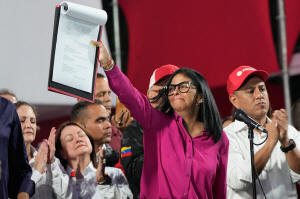
Venezuela's acting President Delcy Rodriguez takes part in a rally
holding up a copy of a new law after lawmakers approved legislation
opening the nation's oil sector to privatization, at the Miraflores
Palace in Caracas, Venezuela, Thursday, Jan. 29, 2026. (AP Photo/Ariana
Cubillos)
 Potential economic improvements
Ruling-party lawmaker Orlando Camacho, head of the assembly’s oil
committee, said the reform “will change the country’s economy.”
Meanwhile, opposition lawmaker Antonio Ecarri urged the assembly to
add transparency and accountability provisions to the law, including
the creation of a website to make funding and other information
public. He noted that the current lack of oversight has led to
systemic corruption and argued that these provisions can also be
considered judicial guarantees.
Those guarantees are among the key changes foreign investors are
looking for as they weigh entering the Venezuelan market.
“Let the light shine on in the oil industry,” Ecarri said.
Oil workers dressed in red jumpsuits and hard hats celebrated the
bill’s approval, waving a Venezuelan flag inside the legislative
palace and then joining lawmakers in a demonstration with
ruling-party supporters.
A reversal of policies
The law was last altered two decades ago as Maduro’s mentor and
predecessor, the late Hugo Chávez, made heavy state control over the
oil industry a pillar of his socialist-inspired revolution.
Chávez, elected in 1998, expanded social services, including housing
and education, thanks to the country’s oil bonanza which generated
revenues estimated at some $981 billion between 1999 and 2011 as
crude prices soared. His 2006 changes to the oil industry law
required PDVSA to be the principal stakeholder in all major oil
projects.
In tearing up the contracts that foreign companies signed in the
1990s, Chávez nationalized huge assets belonging to American and
other Western firms that refused to comply, including ExxonMobil and
ConocoPhillips. They are still waiting to receive billions of
dollars in arbitration awards.
From those heady days of lavish state spending, PDVSA’s fortunes
turned — along with the country’s — as a drop in oil prices,
corruption and mismanagement eroded profits and hurt production,
first under Chávez, then Maduro. By 2013, the fell into the dire
economic crisis that has driven more than 7.7 million Venezuelans to
migrate.
Sanctions imposed by successive U.S. administrations further
crippled the oil industry.
All contents © copyright 2026 Associated Press. All rights reserved
 |