EU lists Iran's paramilitary Revolutionary Guard as terrorist
organization over protest crackdown
[January 30, 2026]
By SAM McNEIL and JON GAMBRELL
BRUSSELS (AP) — The European Union agreed Thursday to list Iran’s
paramilitary Revolutionary Guard as a terrorist organization over
Tehran’s bloody crackdown on nationwide protests, the bloc’s top
diplomat said, in a largely symbolic move that adds to pressure on the
Islamic Republic.
The EU’s foreign policy chief, Kaja Kallas, said foreign ministers in
the 27-nation bloc unanimously agreed on the designation, which she said
will put the regime “on the same footing" with al-Qaida, Hamas and the
Islamic State group.
“Those who operate through terror must be treated as terrorists," Kallas
said.
Economic woes sparked the protests before they broadened into a
challenge to the theocracy before the crackdown, which activists say has
killed at least 6,479 people.
“Any regime that kills thousands of its own people is working toward its
own demise,” Kallas said.
Other countries, including the U.S. and Canada, have previously
designated the Guard as a terrorist organization.
Iran also faces the threat of U.S. military action in response to the
killing of peaceful demonstrators and over possible mass executions. The
American military has moved the USS Abraham Lincoln and several
guided-missile destroyers into the Mideast. It remains unclear whether
President Donald Trump will decide to use force.
Iran issued a warning to ships at sea Thursday that it planned to run a
drill next week that would include live firing in the Strait of Hormuz,
potentially disrupting traffic through a waterway that sees 20% of all
the world's oil pass through it.

Terrorist group label a ‘symbolic act’
Iranian Foreign Minister Abbas Araghchi dismissed the designation as a
“PR stunt” and said Europe would be affected if energy prices surge as a
result of the sanctions.
“Several countries are presently attempting to avert the eruption of
all-out war in our region. None of them are European,” he wrote on X.
Kristina Kausch, a deputy director at the German Marshall Fund, said the
listing was “a symbolic act” showing that for the EU “the dialogue path
hasn’t led anywhere, and now it’s about isolation and containment as a
priority.”
“The designation of a state military arm, of an official pillar of the
Iranian state, as a terrorist organization, is one step short of cutting
diplomatic ties," she said.
The Revolutionary Guard now has time to comment before the listing is
formally adopted, said Edouard Gergondet, a lawyer focused on sanctions
with the firm Mayer Brown.
The EU on Thursday also sanctioned 15 top officials and six
organizations in Iran, including those involved in monitoring online
content, as the country remains gripped by a three-week internet
blackout by authorities.
The sanctions mean that affected officials and organizations will have
their assets frozen, and they will be banned from traveling to Europe,
French Foreign Minister Jean-Noël Barrot said.
The Revolutionary Guard holds vast business interest across Iran, and
sanctions could allow its assets in Europe to be seized.
Iran already struggles under the weight of international sanctions from
multiple countries, including the U.S. and Britain.
Guard emerged from 1979 revolution
The Guard emerged from Iran’s 1979 Islamic Revolution as a force meant
to protect its Shiite cleric-overseen government and was later enshrined
in its constitution. It operated in parallel with the country’s regular
armed forces, growing in prominence and power during a long and ruinous
war with Iraq in the 1980s. Though it faced possible disbandment after
the war, Supreme Leader Ayatollah Ali Khamenei granted it powers to
expand into private enterprise, allowing it to thrive.
[to top of second column]
|
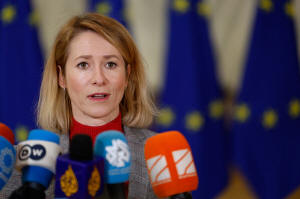
European Union foreign policy chief Kaja Kallas speaks with the
media as she arrives for a meeting of EU foreign ministers at the
European Council building in Brussels, Thursday, Jan. 29, 2026. (AP
Photo/Geert Vanden Wijngaert)

The Guard's Basij force likely was key in putting down the
demonstrations, starting in earnest from Jan. 8, when authorities
cut off the internet and international telephone calls for the
nation of 85 million people. Videos that have come out of Iran via
Starlink satellite dishes and other means show men likely belonging
to its forces shooting and beating protesters.
Once they reach the age of 18, Iranian men are required to do up to
two years of military service, and many find themselves conscripted
into the Guard despite their own politics.
Strait of Hormuz drill planned
Meanwhile, a notice to mariners sent Thursday by radio warned that
Iran planned to conduct “naval shooting” in the Strait of Hormuz on
Sunday and Monday. Two Pakistani security officials, speaking on
condition of anonymity because they were not authorized to talk to
journalists, also confirmed the warning had been sent.
Iran did not immediately acknowledge the drill. The hard-line Keyhan
newspaper raised the specter that Tehran could try to close the
strait by force.
“Today, Iran and its allies have their finger on a trigger that, at
the first enemy mistake, will sever the world’s energy artery in the
Strait of Hormuz and bury the hollow prestige of billion-dollar
Yankee warships in the depths of the Persian Gulf,” the newspaper
said.
Such a move would likely invite U.S. military intervention. American
military officials did not respond to a request for comment.
Elsewhere, Iranian opposition leader Mir Hossein Mousavi, whose
Green Movement rose to challenge Iran’s disputed 2009 presidential
election, again called for a constitutional referendum to change the
country’s government. A previous call failed to take hold.
The World Health Organization also said at least five doctors have
been detained and multiple health workers assaulted while treating
injured patients in Iran since the protests began.

Death toll stands at over 6,400
The U.S.-based Human Rights Activists News Agency reported that the
violence in Iran has killed at least 6,479 people in recent weeks,
with many more feared dead. Its count included at least 6,092
protesters, 214 government-affiliated forces, 118 children and 55
civilians who were not demonstrating. More than 47,200 have been
arrested, it added.
The group verifies each death and arrest with a network of activists
on the ground, and it has been accurate in multiple rounds of
previous unrest in Iran. The Associated Press has been unable to
independently assess the death toll.
As of Jan. 21, Iran’s government put the death toll at a far lower
3,117, saying 2,427 were civilians and security forces and labeling
the rest “terrorists.” In the past, Iran’s theocracy has
undercounted or not reported fatalities from unrest.
That death toll exceeds that of any other round of protest or unrest
in Iran in decades and recalls the chaos surrounding the 1979
revolution.
___
Gambrell reported from Dubai, United Arab Emirates. Associated Press
writers Munir Ahmed in Islamabad and Jamey Keaten in Geneva
contributed to this report.
All contents © copyright 2026 Associated Press. All rights reserved |