Pushed by Trump, US allies are resetting relations with China
[January 31, 2026] By
DIDI TANG and SAM McNEIL
BRUSSELS (AP) — Chinese President Xi Jinping has had a busy few weeks
receiving Western allies seeking warmer ties with the world's
second-largest economy.
Canadian Prime Minister Mark Carney struck a trade deal slashing tariffs
on Chinese electric vehicles and Canadian canola oil.
U.K. Prime Minister Keir Starmer landed in Beijing this week to repair
ties that have been strained for years, and German Chancellor Friedrich
Merz is expected there next month. Finnish Prime Minister Petteri Orpo
also was among the latest leaders from Europe to shake hands with Xi.
In a major shift to the world order since President Donald Trump took
office again, America’s closest partners are exploring opportunities
with China following clashes with Trump over tariffs and his demands to
take over Greenland from NATO ally Denmark. Despite the risk of irking
Trump, they are resetting relations with a country long seen as a top
adversary to many Western allies and the top economic rival to the U.S.
“We’re engaging broadly, strategically with open eyes,” Carney said at
the World Economic Forum meeting last week in Davos, Switzerland,
shortly after he returned from Beijing. “We actively take on the world
as it is, not wait around for a world we wish to be.”
Some leaders, lawmakers and experts lament a shift that could tip the
balance in Beijing's favor at Washington's expense, while others say
China is as much of a challenge as the U.S. because both exert pressure
for their own interests. Either way, how countries are aligning
themselves with the world's two superpowers is changing.
"Instead of creating a united front against China, we’re pushing our
closest allies into their arms,” U.S. Sen. Jeanne Shaheen, the top
Democrat on the Senate Foreign Relations Committee, told a hearing this
week.
When asked by a reporter about Starmer's Beijing visit, Trump said it
was “very dangerous for them to do that.”

“And it’s even more dangerous, I think, for Canada to get into business
with China,” said Trump, who himself is expected to visit Beijing in
April. "Canada is not doing well. They’re doing very poorly. And you
can’t look at China as the answer.”
European Union foreign policy chief Kaja Kallas acknowledged that China
poses a long-term challenge because of its “economic coercive
practices,” but added, “like I say, reach out to different partnerships,
with different countries across the world.”
While Europe is reconsidering its strategic playbook, “it's not a China
pivot,” said Una Aleksandra Bērziņa-Čerenkova, deputy director of the
Latvian Institute of International Affairs in Riga. ”It's a pivot
towards sort of fending for Europe as a bloc.”
Europe's quandary with the US and China
With a desire to bypass EU leadership in Brussels, Beijing is engaging
one-on-one with European capitals, said Alicia Garcia Herrero, an
Asia-Pacific economist at the French investment bank Natixis and an
expert on Europe’s relations with China.
China wants to keep the status quo with Europe: easy access to affluent
consumers while offering few concessions to European businesses in the
Chinese market, she said.
“They need Europe, but they don’t need to fight for Europe," Garcia
Herrero said.
Tim Rühlig, senior analyst at the European Union Institute for Security
Studies in Paris, sees an irreversible shift in Europe's relations with
the world's two largest economies.
“For the U.S., it has been Greenland. For China, it has been the October
rare earth export controls,” he said. “Both of these developments have,
in my view, substantially contributed to a European understanding that
we face two major powers that are not shy to bully the EU.”
European leaders are visiting China for largely the same reasons Trump
will: China’s sizable economy, its role in global affairs and a need to
establish reliable communication channels.

[to top of second column] |
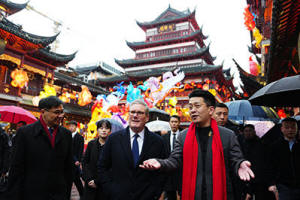
British Prime Minister Keir Starmer, center, is shown around Yuyuan
Garden by Vice President of Yuyuan Garden Junjie Hu, on Friday, Jan.
30, 2026 in Shanghai, China. (Carl Court/Pool Photo via AP)
 “Everyone goes to Beijing, including
the guy who doesn’t want us to go to China,” said Joerg Wuttke,
former president of the EU Chamber of Commerce in China and now
partner of the consultancy DGA Group.
Canada leads the way
In 2024, Justin Trudeau, then Canada's prime minister, acted in
lockstep with the Biden administration to levy a 100% tariff on
Chinese electric vehicles to protect the U.S. auto industry.
On Carney's highly watched visit to Beijing this month — the first
by a Canadian prime minister in eight years — he slashed the tariff
in return for lower import rates on Canadian farm products. Carney
called the Canada-China trade relationship “more predictable," a
swipe at Trump's tariff threats on Canada.
After Carney's return, Trump threatened to impose a 100% tariff on
Canada over its China trade deal. Carney called it a bluster.
In Davos, Carney condemned coercion by great powers on smaller
countries without naming Trump. “Middle powers must act together,
because if we’re not at the table, we’re on the menu,” he said.
Those words have resonated across Europe.
European nations are recalibrating ties with Beijing
Starmer took a big step this week, becoming the first British prime
minister to visit China in eight years. The countries have been at
odds on issues including security, Chinese technology and Beijing's
crackdown on pro-democracy protests in the former British colony of
Hong Kong.
But this week, Starmer and Xi called for a strategic partnership.
“Working together on issues like climate change, global stability
during challenging times for the world is precisely what we should
be doing as we build this relationship in the way that I’ve
described,” Starmer told Xi in Beijing.
The trip has yielded a raft of business announcements and government
agreements, including lower Chinese tariffs on Scotch whisky and
30-day visa-free travel to China for British tourists and business
visitors.

Days earlier, Orpo, the Finnish prime minster, sat down with Chinese
Premier Li Qiang and signed a deal to cooperate on sustainable
construction, energy and animal disease management.
A Finnish government statement said Orpo also called on China to
help achieve a lasting peace in Ukraine, noted the trade imbalance
and called attention to human rights issues.
French President Emmanuel Macron, Irish Prime Minister Micheál
Martin and South Korean President Lee Jae Myung also visited in past
weeks.
Now, Merz is set to visit Beijing for the first time as Germany's
chancellor. He has taken a tougher stance on China than his
predecessors and is expected to reset relations while addressing
some of his country's concerns: the trade deficit and dependence on
China for critical minerals.
As Europe and other U.S. allies inch closer to Beijing, some
analysts warned of dangerous divisions in the West.
“It will be impossible for the U.S. and Western countries to unite
to, as appropriate, either isolate China or set and enforce
conditions for connectivity and cooperation,” said Scott Kennedy,
senior adviser for Chinese business and economics at the Center for
Strategic and International Studies.
___
Tang reported from Washington.
All contents © copyright 2026 Associated Press. All rights reserved |