Judge hears testimony from DNA expert as man convicted of killing Laken
Riley seeks new trial
[January 31, 2026]
By SUDHIN THANAWALA
ATHENS, Ga. (AP) — A judge considering whether to grant a new trial to
the Venezuelan man convicted of killing Georgia nursing student Laken
Riley heard testimony Friday from a DNA expert retained by his attorneys
to analyze evidence in his murder case.
Jose Ibarra's trial attorneys had asked the judge to delay a hearing set
a few weeks before his November trial after the expert told them she
would need six weeks to review the data and complete a report.
The move would have pushed back the trial. Clarke County Superior Court
Judge H. Patrick Haggard ultimately proceeded with the trial as
scheduled.
The expert, Ruth Ballard, said during Friday's hearing that she could
not rule out the possibility that Ibarra's DNA was transferred onto a
jacket and other evidence she reviewed indirectly.
Under questioning by a prosecutor, Ballard acknowledged she had not
finished a complete review of the case. She also acknowledged writing
that a “reasonable explanation” for the crime lab findings in the case
was that Ibarra's DNA got onto the evidence when he killed Riley.
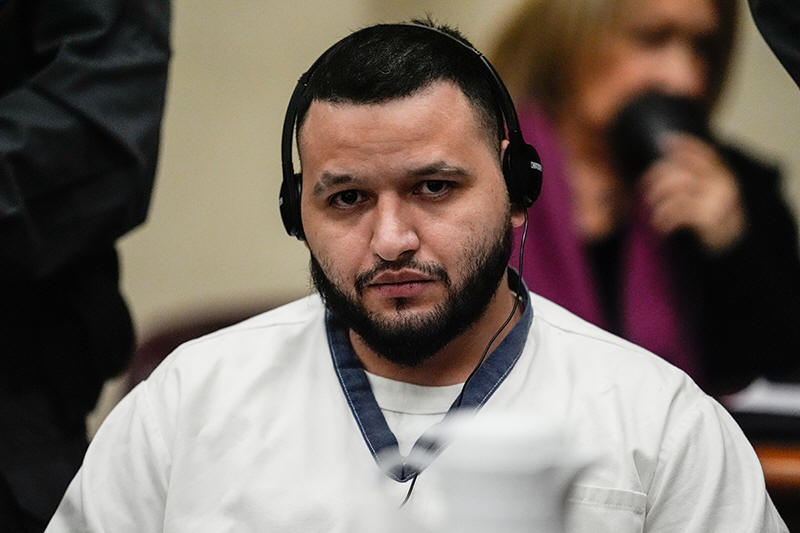
Ibarra, dressed in a white jumpsuit, sat at a table with his attorneys.
Haggard did not rule immediately on Ibarra's request to vacate his
guilty verdict and life sentence and grant him a new trial. He gave
attorneys another month to file legal arguments.
Haggard found Ibarra guilty of murder and other charges in November
after Ibarra waived his right to a jury trial. He sentenced Ibarra to
life in prison without the possibility of parole.
Prosecutors decided before trial not to seek the death penalty.
Ibarra, 28, had entered the U.S. illegally in 2022 and was allowed to
stay while he pursued his immigration case. Riley’s killing in February
2024 heightened tensions in the national debate over immigration.

The first bill President Donald Trump signed upon taking office last
year, the Laken Riley Act, was inspired by the 22-year-old's killing. It
requires the detention of people who are in the country without
authorization and are accused of theft and violent crimes.
[to top of second column]
|

Jose Ibarra appears in a Athens-Clark County courtroom, Friday, Jan.
30, 2026, in Athens, Ga. A judge found Ibarra guilty of murder and
other crimes in Laken Riley's 2024 murder. (AP Photo/Mike Stewart,
Pool)

Prosecutors said Ibarra encountered Riley while she was running on
the University of Georgia campus in Athens on Feb. 22, 2024, and
killed her during a struggle. Riley was a student at Augusta
University College of Nursing, which has a campus in Athens, about
70 miles (115 kilometers) east of Atlanta.
Ibarra's lawyers argue that his constitutional rights were violated
by the judge's denial of the request for a delay and by the
admission of cellphone evidence the defense sought to exclude.
Under Georgia law, a notice of appeal must be filed within 30 days
of a conviction becoming final, which is the date of sentencing or
the date of the denial of a motion for a new trial, whichever is
later. The filing of a motion for a new trial effectively extends
the deadline to file an appeal.
Ibarra's trial attorneys filed a motion for a new trial within weeks
of his conviction. New lawyers have since taken over his case and
filed an amended motion for a new trial earlier this month.
Before trial, Ibarra's lawyers had asked the judge not to allow
evidence stemming from the search of two cellphones the state
believed belonged to Ibarra. They argued that the search warrants
used to seize and search the phones were not valid because police
lacked probable cause to obtain the warrants. Haggard rejected those
arguments.
Ibarra's trial attorneys had also asked the judge to exclude
evidence and expert testimony based on the use of TrueAllele
Casework, software that is used to analyze DNA.
___
Associated Press writer Kate Brumback in Atlanta contributed to this
report.
All contents © copyright 2026 Associated Press. All rights reserved |