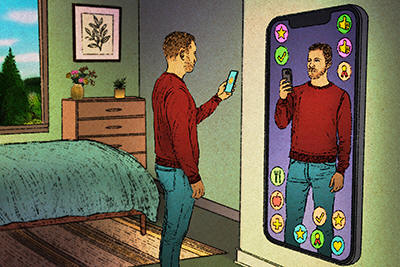
Nutrition apps can help build healthy habits. For some users, their
gaming features carry risks
[July 01, 2026]
By ALBERT STUMM
Green means go, red means stop. Trophies or confetti come with good
performance, and people who fall behind get nudged to do better.
Those brightly colored engagement tactics long ago jumped from
smartphone games to everything from online shopping to sports betting
and classrooms. So it should come as no surprise that many
nutrition-tracking apps like MyFitnessPal and Noom also use gaming
features to keep users coming back.
But as nutrition apps proliferate, some researchers are raising alarms
that gamification features may do more harm than good for some people.
Isabella Anderberg, a psychologist researching digital dieting behavior
at Flinders University in Adelaide, Australia, said calorie tracking can
reinforce behaviors associated with body dysmorphia and disordered
eating.
“We do know that not everyone’s going to experience harm from using the
apps, but there are certainly factors that might increase risk,”
Anderberg said. “Approach with caution.”
The case for nutrition tracking apps
Anderberg said there is certainly a place for the apps. Health
professionals she interviewed during her research reported that apps can
be especially helpful as meal-planning tools for people managing chronic
conditions such as heart disease and diabetes. And physical activity
apps remind people to move their bodies.

Many users report enjoying them, finding tactics like streak
notifications to be motivating.
Angela Drury, an English professor in Woodstock, Georgia, began using
MyFitnessPal more than 10 years ago to track protein, fat, carbohydrate
and calorie intake when she started CrossFit. She has since cycled
through several other apps, including Weight Watchers, Lose It and now
Nourish, which is paid for by her insurance and includes blood work and
weekly meetings with a dietitian.
Drury said the apps have helped her stay on track with fitness goals and
have sometimes steered her away from high-calorie foods when she
uploaded photos of meals she was considering eating. She feels a little
boost when she gets a badge for continuing a streak for logging meals,
but a notification that says she hasn’t entered lunch has the opposite
effect.
“Then it felt like it was scolding me,” she said.
Be wary of what the app tells you
The way most apps work, users enter height, weight, age and other
information and then set a goal. The app says how many calories or
macronutrients are needed to reach that goal, using gamelike elements
such as badges, streaks, rewards, points and notifications to encourage
user engagement.
Many nutrition tracking apps are free but offer premium versions that
users must pay for.
[to top of second column]
|
(AP Illustration / Peter Hamlin)
 The Centers for Disease Control and
others say that how many calories you need depends on factors
including your age, sex and level of physical activity. The CDC
provides a tool to calculate how many calories an individual needs.
Critics warn that food databases are often inaccurate, with
estimated portion sizes and calorie counts that vary widely.
Courtney Simpson, a behavioral psychologist and director of eating
disorders at the Evidence-Based Treatment Centers of Seattle, said
some apps encourage people to set calorie goals that are far too low
for any adult. That's not only unhealthy but can set people up for
failure.
The gaming features keep people coming back to unrealistic goals,
creating shame that may contribute to binge eating or other
behaviors people are trying to change, Simpson said.
“It’s not that gamification itself is bad. It’s about what it is
promoting,” she said. “Is that actually going to be beneficial?”
MyFitnessPal and Noom did not respond to several requests for
comment.
Listen to your body
Anderberg said people who already believe that thinner is better are
more likely to misuse the apps. Calorie and macronutrient tracking
can then become obsessional, which creates more negative feelings
when daily goals aren’t met.
She urged users to be skeptical of what the apps tell them to do and
instead rely on their own intuition. If you feel the need to rest,
nurse an injury or treat yourself to something delicious, do so.
“We are sort of losing that ability to read our body cues,” she
said.
Simpson noted that focusing on weight as a measure of overall
health, besides being inaccurate, makes it more likely to lose and
regain weight. Such cycling is linked to worse health outcomes over
time.
“If you really want lasting change, then you need to be doing
behaviors that are feasible and sustainable for you over time,” she
said.

Drury could see how the apps could be harmful for people predisposed
to disordered eating, but she said the most important consideration
for her is to set realistic goals and listen to your body.
“I’ve ultimately learned that you cannot starve yourself into being
in the shape you want to be in,” she said.
All contents © copyright 2026 Associated Press. All rights reserved |