Medicare is now covering some GLP-1 weight loss drugs for $50. Here’s
what to know
[July 02, 2026]
By ALI SWENSON
NEW YORK (AP) — Popular — and expensive — GLP-1 weight loss drugs just
got a lot cheaper for many older Americans.
Starting Wednesday, the federal government is offering a selection of
the brand name medications to certain Medicare and Medicare Advantage
beneficiaries for $50 a month through a new trial called Medicare GLP-1
Bridge.
The temporary program, which runs until the end of 2027, is the first
opportunity for most older adults to get GLP-1s, short for glucagon-like
peptide-1 receptor agonists, covered by insurance when used strictly for
weight loss. But there are weight and health requirements, and those who
already get GLP-1s covered for diseases like diabetes and sleep apnea
won’t qualify.
Dr. Mehmet Oz, the administrator of the Centers for Medicare & Medicaid
Services, said he hopes the program can help his agency collect data to
potentially work toward longer-term coverage, while providing immediate
relief to cash-strapped older Americans.
“The sheer cost of these medications is a huge barrier to access,” he
said in a call with reporters. “That ends today.”
Eligibility is based on BMI and other conditions
Of the more than 70 million Americans enrolled in Medicare, at least 10
million are overweight or obese, said Juliette Cubanski, vice president
and director of the program on Medicare policy at the healthcare
research nonprofit KFF. But, she said, a narrower slice of that group
will have access to this program.
There's no good data on how many people it can benefit — and Oz declined
to speculate on the number with reporters. He said data from the program
will reveal how many eligible beneficiaries choose to take the drugs, a
number his team is keen to learn.

To qualify, besides having Medicare drug coverage, you must have a body
mass index of 35 or higher, or a BMI of 27 or higher alongside another
health condition, such as a past heart attack or stroke, prediabetes or
another from a list on the CMS website. BMI measurements are counted at
the start of GLP-1 therapy — so even people who fall below the threshold
now can qualify if they can show they had a high enough BMI when they
began taking the drugs.
Medicare beneficiaries who have sleep apnea, diabetes or fatty liver
disease can’t access the program, but their Medicare Part D insurance
might cover their GLP-1s separately based on those diagnoses.
If you think you might qualify, the first step is to contact your health
care provider, CMS says on its website. The provider must send a
prescription for one of the covered GLP-1 drugs to a pharmacy and fill
out a prior authorization form.
Only some GLP-1s are included
The covered medications include drugmaker Eli Lilly’s Foundayo tablets
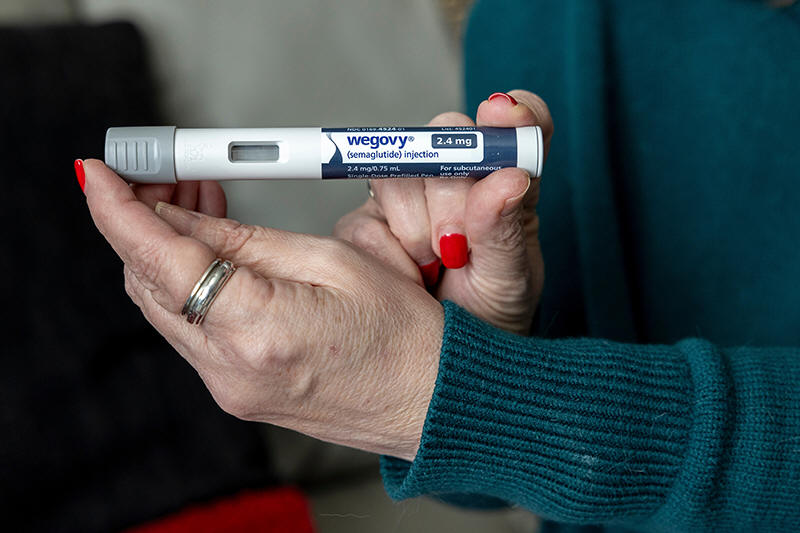
and Zepbound KwikPens and Novo Nordisk’s Wegovy injections and tablets.
Those GLP-1s have been approved by the Food and Drug Administration for
weight loss, Cubanski said.
For those in the program, the cost is $50 per month, regardless of
dosage. But those payments won’t contribute to their insurance
deductibles or out-of-pocket maximums. That’s because Medicare, rather
than the Part D insurer, is subsidizing the prescription.
[to top of second column]
|
A dose of Wegovy, a drug used for weight loss, is displayed on March
1, 2024, in Front Royal, Va. (AP Photo/Amanda Andrade-Rhoades, File)
 Longer-term coverage of GLP-1s
remains uncertain
The program is scheduled to sunset after Dec. 31, 2027. And since
Congress hasn’t authorized Medicare to cover weight loss drugs
permanently, the federal government is limited in its options to
keep the access flowing.
Congress could pass a law to allow the drugs to be covered. CMS also
could move forward with a different, voluntary pilot program for
covering the drugs called BALANCE, which the agency indefinitely
delayed earlier this year when many Part D insurers were reluctant
to sign up.
Oz told reporters that CMS plans to “carefully track participation
and outcomes” to see whether an extension of the Bridge program or
another solution is the best way to move forward. He told The
Associated Press a federal law permanently allowing the coverage is
“not essential right now” but something “for Congress to debate
amongst themselves.”
“We can’t decide what’s going to happen long term with Bridge until
we see some of the data,” he said, noting that other negotiations
with drug companies to lower costs are ongoing.
Program is life-changing for some, frustrating for others
GLP-1s have soared in popularity in recent years, and they've
spurred dramatic weight loss in many patients. But their cost —
sometimes hundreds of dollars a month for higher doses — has been a
barrier.
For 78-year-old California resident Gloria Dralla, who told the AP
she’s lost some 40 pounds after buying lower-cost Wegovy in Europe,
the Bridge program means being able to continue a treatment that has
improved her life.
“This drug should be made available at a reasonable price for
everybody who’s got weight loss problems,” she said.
But not everyone will have access to the drugs at an affordable
price. Katie Smith, 71, in Virginia isn’t so sure she will be
eligible for the program. She has a BMI of 33 but doesn't know yet
if she has another health condition that would allow her to meet the
requirements.
Smith, whose mobility and ability to exercise were severely limited
by a spinal cord injury in her 20s, said she has looked into getting
the medications but was quoted $700 a month, a price she can't
afford.
“I cannot tell you how frustrated I am,” she said. “I have the drive
and I have the willingness and I have the motivation, but I have not
been able to lose weight in all the conventional ways.”
All contents © copyright 2026 Associated Press. All rights reserved
 |