New Jersey is set to charge companies with workers on Medicaid. Other
states may follow
[July 02, 2026]
By GEOFF MULVIHILL
New Jersey is launching a new fee on companies whose workers have
Medicaid health coverage instead of being covered by their employers.
Other states are considering it, too.
Democratic lawmakers and governors see it as a way to help pay for the
joint federal and state insurance program that covers low-income
residents as federal policy changes are expected to make the program
more expensive for states and may lead to a reduction in the number of
people with coverage.
Proponents also say it's about fairness because employers benefit from
having some lower-income workers with taxpayer-funded health coverage.
Business groups object. So do some liberal policy organizations.
New Jersey is putting the fee in place
New Jersey Gov. Mikie Sherrill signed a measure Tuesday night to charge
employers that have at least 50 workers covered by Medicaid, and the
state budget she approved earlier in the week counts on raising $145
million this year from the program.
Under the plan, companies will be billed for each employee and
employees' dependent receiving Medicaid, the joint state-federal
insurance program.
The fees per person would start at $325 a year for companies with 50 to
249 Medicaid beneficiaries and top out at $725 annually for employers
with at least 500 recipients.
Federal Medicaid changes are prompting Democratic-led states to act
A bill passed this week in California doesn't impose a charge now, but
it does direct the state administration to present lawmakers options for
doing so next year.

Finishing the job would fall to the successor of Gov. Gavin Newsom, a
Democrat who is leaving office in January. Democratic gubernatorial
candidate Xavier Becerra has made an employer charge part of his
election platform.
State Sen. John Laird, a Democrat who sponsored the California proposal,
said the big tax and policy law President Donald Trump signed a year ago
was a major factor in the need for action because it could prompt the
state to spend more on Medicaid to plug holes left by federal changes.
The nonpartisan Congressional Budget Office expects more than 10 million
people will be uninsured because of the law by 2034. It requires some
beneficiaries to work, be in school or volunteer — and requires even
more to document whether they meet the requirements. Most employees at
the bigger companies would not be at risk of losing Medicaid coverage as
long as they're working at least 20 hours a week.
Laird also said there's an equity issue involved.

“If you're a small business person in California, you are quite likely
paying for health insurance for your employees. And through your taxes,
you're paying for health insurance for some of the biggest employers in
California,” he said. “And that's not fair.”
Legislation with similar intents passed one legislative chamber in both
Colorado and Oregon this year, but neither made it to law. A measure was
also introduced in Washington.
[to top of second column]
|
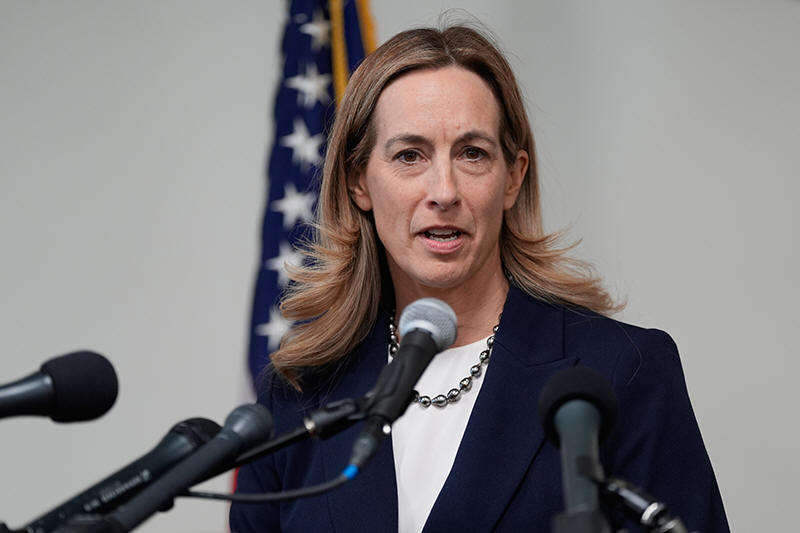
New Jersey Governor-elect Mikie Sherrill talks to reporters during a
news conference in Trenton, N.J., Nov. 5, 2025. (AP Photo/Seth Wenig,
File)
 Connecticut Gov. Ned Lamont, a
Democrat who is seeking a third term in November's election, has
called for the same move there with the idea of making it a part of
the state budget that would kick in two years from now.
Opposition comes from business and some liberal groups
It's no surprise that business organizations have criticized the
approach, which would add to their expenses.
“The fact remains that many job-creators are still going to be
penalized for something they have no control over,” Christopher
Emigholz, the chief government affairs officer at the New Jersey
Business and Industry Association, said in a statement. “If an
employee declines an employer-provided health plan because they’d
rather be on Medicaid, it is unfair to penalize the employer for
that employee’s decision.”
Some left-leaning policy organizations also oppose the charges.
Gideon Lukens, who analyzes health policy at the left-leaning Center
on Budget and Policy Priorities, said that while the idea may be
well-intentioned, it could lead companies to employ fewer people
from low-income household or single parents. He said companies could
also consider the policy in decisions about whom to hire or lay off
— and also on where to locate or how many workers to employ.
And, he said, it could make employees — or potential employees —
less likely to enroll in Medicaid knowing it would make them less
attractive to employers.
“Usually, when I see a tax on something it’s going to discourage
whatever being taxed,” he said in an interview.
New Jersey's legislation tries to address some of the concerns. It
would exempt temporary, seasonal and part-time employees. It would
also bar employment decisions based on a workers’ Medicaid status.
The idea has come up before, though it's never stuck for long
Charging companies whose workers are covered by Medicaid isn't a new
idea. At least two states have previously enacted it, and it's been
proposed in Congress.
Massachusetts lawmakers in 2017 adopted a charge on employers up to
$750 per non-disabled worker who was covered through Medicaid or a
state-subsidized health exchange plan. The program began in 2018 was
not renewed when it expired the next year.
An even earlier policy in Maryland, in 2006, immediately affected
only Walmart. An industry group challenged it in court and won,
stopping the fees. A federal judge found that it required the
company to track and allocate employment benefits differently in
Maryland than in other states in violation of a federal law that
governs self-insured employee health plans.
The latest generation of proposals may avoid that legal pitfall by
not referencing those health plans in the legislation.
All contents © copyright 2026 Associated Press. All rights reserved |