US and Iran hold separate meetings in Qatar and agree to continue
discussions
[July 02, 2026]
By JON GAMBRELL
DUBAI, United Arab Emirates (AP) — U.S. and Iranian negotiators met
separately on Wednesday with Qatari and Pakistani mediators, with
“positive progress made,” and they agreed to continue discussions, host
Qatar said.
The next meeting will be scheduled “at the earliest possible time” after
the funeral of Iran’s previous supreme leader, the late Ayatollah Ali
Khamenei, Majed al-Ansari, a spokesman for Qatar’s Foreign Ministry,
said on X. The funeral is set to start Saturday in Tehran.
U.S. Mideast envoy Steve Witkoff and Jared Kushner, U.S. President
Donald Trump’s son-in-law, were in Qatar for talks seeking a permanent
end to the war, along with Iran’s top negotiator, Kazem Gharibabadi.
Negotiators aim to nail down specifics to pave the way for top leaders
to seal an agreement, though differences over the Strait of Hormuz and
Lebanon loom large.
A ship ran aground in the strait while using a route not approved by
Iran, state television in Tehran reported Wednesday. The vessel was
identified as a foreign container ship, with no other details.
The report appeared aimed at underlining Tehran’s claims to control the
strait, which the world has long considered an international waterway. A
fifth of all oil and natural gas passed through it in peacetime.
Since the U.S. and Israel launched the war against Iran on Feb. 28, Iran
has used its ability to choke off the waterway as a key source of
leverage, disrupting global markets for energy and other critical goods.

The Strait of Hormuz is a key sticking point in talks
Iran and the United States agreed as part of an interim deal to allow
ships to pass without paying charges for 60 days. But Tehran insisted it
must control the routes of the vessels and later charge fees for
passage, upending decades of practice in the waterway.
The U.S. and many Gulf Arab states say they won't agree to the charges.
An effort by Oman and a U.N. agency to launch a new route near Oman's
shore sparked attacks across the Mideast last weekend, highlighting the
tensions.
Iranian state TV on Wednesday said the ship “ran aground with its cargo
because of shallow waters along the route it had chosen and was unable
to continue sailing.” It said shippers needed to follow the instructions
of Iran’s paramilitary Revolutionary Guard in the strait.
The Guard’s navy has repeatedly warned that “any entry or exit through
routes other than the ‘Route of Authority’ in the Persian Gulf could
lead to irreparable incidents.”
The report did not mention the two ships Iran attacked in recent days
for daring to head out through the strait without Tehran's permission,
including one carrying crude oil from Qatar.
Qatar meets with both sides
Witkoff and Kushner met Wednesday with Qatar's ruling emir, Sheikh Tamim
bin Hamad Al Thani, and its foreign minister, Sheikh Mohammed bin
Abdulrahman Al Thani, according to a statement by the Qatari government.

[to top of second column]
|
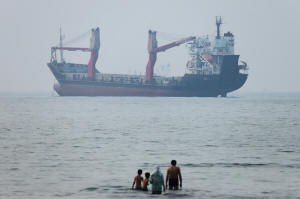
A group of people stands in shallow water as a cargo ship appears
anchored in the Strait of Hormuz off Bandar Abbas, Iran, Tuesday,
June 30, 2026. (Amirhosein Khorgooi/ISNA via AP)

Discussions included details related to traffic through the Strait
of Hormuz, U.S. Vice President JD Vance told reporters in the United
States.
“Obviously, we’re worried about the nuclear issue,” Vance said.
“We’re going to start talking about that.”
Sheikh Mohammed also met with Gharibabadi and other Iranian
officials, with Pakistani mediators also on hand. Gharibabadi said
the Iranian delegation had no direct talks with the American side,
and its talks with mediators dealt with Lebanon and plans to return
some of Iran’s frozen assets, Iranian state media reported.
Lebanon remains a thorny issue in the negotiations. Iran has
insisted that all fighting end between the Iranian-backed militia
Hezbollah and Israeli military forces there.
Iran also has called for Israel to give up the land it now occupies
in southern Lebanon. Israel insists it must hold the territory and
have a free hand to attack Hezbollah, which has been launching
attacks into northern Israel.
More ships get out of Strait of Hormuz
While ship traffic in the strait dropped after the weekend attacks,
more countries say their vessels have gotten out.
The Thai Foreign Ministry said Tuesday that 10 out of 11
Thai-flagged vessels or vessels chartered by Thai operators have
departed the strait safely. South Korean officials say all but two
of the country’s 26 vessels that were stranded have left safely.
US Navy searches for helicopter crew member in the Arabian Sea
In other developments Wednesday, a U.S. Navy helicopter made an
emergency water landing into the Arabian Sea, leaving one crew
member missing, the Navy’s 5th fleet said in a statement.
The Navy said there was "no indication the emergency was caused by
hostile action.” It said the MH-60S Sea Hawk went into the water at
3:30 a.m.

Three of the helicopter’s four crew members were rescued, the
statement said. The Navy was searching for the missing crew member.
The Navy statement did not say whether the aircraft sank or was
recovered. The helicopter was assigned to the USS George H.W. Bush,
one of two aircraft carriers deployed in the waters off Iran.
___
Associated Press writers Michelle L. Price and Konstantin Toropin in
Washington; Amir Vahdat in Tehran, Iran; Samy Magdy and Fatma Khaled
in Cairo; Najib Jobain in Doha, Qatar; Jintamas Saksornchai in
Bangkok; Qassim Abdul-Zahra in Baghdad; Tong-hyung Kim in Seoul,
South Korea; and Russ Bynum in Savannah, Georgia, contributed to
this report.
All contents © copyright 2026 Associated Press. All rights reserved |