Venezuelan security guard pulled alive from building basement 8 days
after twin quakes
[July 03, 2026]
By FERNANDA PESCE and JUAN PABLO ARRAEZ
CATIA LA MAR, Venezuela (AP) — Rescuers pulled a 43-year-old security
guard alive from a collapsed basement early Thursday, ending a grueling
dayslong operation that became a symbol of hope after the devastation of
twin earthquakes that struck Venezuela eight days earlier.
Hernán Alberto Gil Flores emerged to safety covered in dust atop a
stretcher surrounded by helmet-clad rescue workers after being trapped
since June 24 under rubble in the basement of the Galerías Playa Grande
shopping center in the coastal town in La Guaira.
Rescuers, who initially made contact with Gil Flores over the weekend,
worked more than 100 hours to free him — navigating a highly unstable
structure, torrential rain and persistent aftershocks to tunnel down to
the survivor.
Teams carrying flags from around the world cheered as rescuers carried
Gil Flores, wearing an oxygen mask and covered in an orange tarp,
through throngs of people to an ambulance where they methodically
checked his vital signs.
One Chilean rescuer carrying his stretcher pumped his fist in joy. A
group of men in red Costa Rican Red Cross uniforms embraced and laughed
in relief. Others broke out into applause.
“When we found him, he asked us not to tell his wife that he was alive,
just in case he wouldn’t make it,” Costa Rican Red Cross rescuer Minyar
Collado told The Associated Press, but she added “We were never going to
leave him here.”
The rescue was considered a small miracle cutting through a week of
tragedy. By supplying Gil Flores with food and water while they
excavated the concrete, rescue teams were able to keep him alive far
longer than the 48- to 72-hour threshold most operations give to find
survivors in disasters.

Gil Flores, who worked as a night-shift security guard at the complex,
was inside his small security cabin when the first violent tremor
struck. While the surrounding concrete structure collapsed around him,
his cabin held ground, shielding him from crushing debris and creating a
vital pocket of air.
A specialized team from the Costa Rican Red Cross first detected signs
of life and established contact with him Sunday.
His wife, Gusbimar González, told the AP that she grappled with despair
for days before hearing that rescuers made contact.
“When I learned he was alive, I saw a ray of light in the darkness," she
said. The couple has two children, ages 8 and 10.
[to top of second column]
|
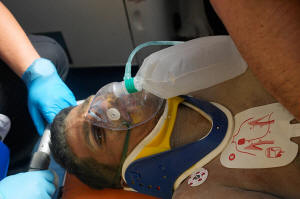
Rescue workers attend to Hernán Alberto Gil Flores after he was
pulled from the rubble eight days after he was trapped by twin
earthquakes that struck Catia La Mar, Venezuela, Thursday, July 2,
2026. (AP Photo/Fernando Vergara)

The operation was coordinated by an urban search and rescue team of
Chilean firefighters, who worked around the clock with specialized
teams from the United States, Portugal, Mexico, Costa Rica, El
Salvador and Venezuela.
Acting Venezuelan President Delcy Rodríguez celebrated the rescue on
social media at a time that her government has come under fire for
what many Venezuelans say has been an inadequate crisis response.
“We celebrate the greatness of humanity, when it is united for a
single purpose: to save another. Thank you to our rescuers and to
the support of the international rescuers,” she wrote on a post on
X.
Teams used a telescopic camera to help maintain constant contact
with Gil Flores, passing water and liquid nutrients through a narrow
shaft to keep him hydrated during the final three days of the
rescue.
María Paz Campos, a veteran firefighter from Chile, talked him
through the entire operation and kept him calm during the final
excruciating hours Thursday.
In a video published by Chilean firefighters in the hours before the
rescue, Gil Flores is seen drawing, seemingly to pass the time.
Campos then gently tells him to look at the camera and to wear
protective goggles.
“I need you to keep the goggles on, for the small particles that are
falling, to avoid them getting into your eye,” Campos told the
survivor.
The collapse of the building was triggered by two back-to-back
earthquakes on June 24 that registered magnitudes of 7.2 and 7.5,
respectively. The shallow, violent tremors damaged or destroyed tens
of thousands of buildings across northern Venezuela, killing more
than 2,200 people, injuring over 11,000 and leaving La Guaira state
as the hardest-hit region in the country.
___
Associated Press video journalists Andry Rincón and Brayan Antequero
contributed to this report.
All contents © copyright 2026 Associated Press. All rights reserved |