FIFA lifts US star striker
Balogun’s red card suspension at World Cup after Trump calls Infantino
[July 06, 2026]
By RONALD BLUM and MICHELLE L. PRICE
SEATTLE (AP) — U.S. President Donald Trump intervened on behalf of
star U.S. forward Folarin Balogun, whose red-card suspension was
lifted in a decision that allows him to play in a World Cup match
against Belgium on Monday.
Balogun, the American leader with three goals in the tournament,
received a red card for stepping awkwardly on the right ankle of
Tarik Muharemović of Bosnia-Herzegovina in a 2-0 round of 32 win on
Wednesday, triggering an automatic one-game suspension.
FIFA announced Sunday that the suspension had been lifted for the
round of 16 match, an extraordinary move that triggered praise from
Trump and outrage from Belgium’s team. It appeared to be the first
time since 1962 that a red card during a World Cup didn't result in
a suspension.
Trump called FIFA president Gianni Infantino after the game asking
FIFA review the red card, according to a person familiar with the
call who spoke on condition of anonymity because the person was not
authorized to speak publicly about the matter.
“Thank you to FIFA for doing what was right, and reversing a great
injustice!” Trump said in a statement on social media.
The Royal Belgian Football Association (RBFA) said it was
“astonished,” and Belgium coach Rudi Garcia mocked FIFA’s action.
“I didn’t know that in the offices of FIFA the fifth of July was the
first of April in Europe,” Garcia said through a translator in an
April Fools' Day comparison. “The Belgian federation does not defend
itself, it does not protect the national team. She defends football
in general, she defends her integrity, her ethics. I think it’s the
first time in the history of the World Cup that there is this kind
of decision.”

Garcia wouldn’t respond when asked about a possible appeal to the
Court of Arbitration for Sport or whether he thought Trump impacted
FIFA’s action.
“In order to safeguard the legitimate rights of all participating
teams and to protect the fundamental principles of fair play in our
sport, both at this FIFA World Cup and at future editions of the
tournament, the RBFA is investigating all potential options,” the
Belgian federation said in a statement.
American players learned of Balogun’s availability when social media
posts started popping up during the 10-minute bus ride Sunday
morning from their hotel to training at the University of
Washington’s Husky Soccer Stadium, where they were greeted by Dubs
II, the university's Alaskan Malamute.
Balogun’s red card had been one of the World Cup's most
controversial and consequential decisions. Brazilian referee Raphael
Claus didn’t initially signal a card but showed Balogun red after a
video review.
“If you look at the foul, it was just zero intent at all,” U.S. star
Christian Pulisic said. “I felt like there was much worse ones that
went on this tournament.”
The U.S. Soccer Federation learned of FIFA's action in a message
sent by FIFA in its portal at 10:31 a.m. EDT.
“The implementation of the match suspension is suspended for a
probationary period of one year,” FIFA announced. “If Folarin
Balogun commits another infringement of a similar nature and gravity
during the probationary period, the suspension shall be revoked and
the sanction enforced without prejudice to any additional sanction
imposed for the new infringement.”
U.S. coach Mauricio Pochettino applauded FIFA's move.
“We were punished enough against Bosnia-Herzegovina to play with 10
men (for) 30 minutes in a decision that was completely unfair,” he
said.
Pochettino, who played for Argentina in the 2002 World Cup, was not
surprised Trump decided to call Infantino.
“I came from a culture, Argentina or Europe, that football, soccer
is a religion, more than the religion,” he said. “If we go keep
going, pushing on, maybe one step more tomorrow you will see that
the sport is magic, that the sport is amazing, is so powerful, unite
people, unite a country like us.”

[to top of second column] |
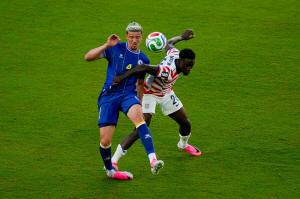
United States' Folarin Balogun (20) fouls Bosnia's Tarik Muharemovic
(4) during the World Cup round of 32 soccer match between the United
States and Bosnia in Santa Clara, Calif., near San Francisco,
Wednesday, July 1, 2026. Balogun received a red card on the play.
(AP Photo/Jeff Chiu)

England coach Thomas Tuchel wondered whether more
decisions going forward could be challenged, whether yellow cards
could be overturned for England's Declan Rice and France's Michael
Olise.
“We can now debate endlessly: I think it’s not a yellow card,” he
said. “Where does this end? Where does it stop?”
Balogun’s three goals included a go-ahead strike against Bosnia. He
matched Landon Donovan in 2010 for the second-most goals by an
American in a World Cup, behind only Bert Patenaude’s four in the
initial tournament in 1930.
A 25-year-old who plays for Monaco, Balogun scored 13 Ligue 1 goals
last season and has 12 goals in 30 international appearances. He was
born in Brooklyn to Nigerian parents who were living in London and
in 2023 opted to change his national team affiliation from England,
which he had represented at the under-21 level.
“He strikes fear into a lot of defenders,” Richards said.
The host U.S. is seeking to reach the quarterfinals for the first
time since 2002. The Americans lost in the round of 16 to Ghana in
2010, Belgium in 2014 and the Netherlands in 2022. They failed to
advance from the group stage in 2006 and didn’t qualify for the 2018
tournament.
The USSF didn't make Balogun available for comment Sunday, but
Balogun posted on social media a picture of himself in front of U.S.
fans and overlaid with music of Michael Jackson’s pop single “Bad.”
On Friday, Balogun said he thought a yellow card instead of red
“would have been fair.”
FIFA said its decision relied on Article 27 of disciplinary
committee rules.
“The judicial body may decide to fully or partially suspend the
implementation of a disciplinary measure,” the rule states. “By
suspending the implementation of the sanction, the judicial body
subjects the person sanctioned to a probationary period of one to
four years.”
FIFA in November deferred the final two games of a three-match ban
for Portugal’s Cristiano Ronaldo for a red card against Ireland in a
World Cup qualifier, allowing him to play at the start of the World
Cup.

Argentine defender Nicolás Otamendi and Ecuadoran midfielder Moisés
Caicedo in April had one-game bans deferred for red cards in
qualifiers, also allowing them to be available for World Cup
openers.
Brazilian midfielder Garrincha received a red card in the 83rd
minute of the 1962 semifinal against host Chile for kicking an
opponent but was allowed to play in the final against Czechoslovakia
after a lobbying campaign that included support from Chile President
Jorge Alessandri. Brazil won the final for its second straight
title.
“What about the next red card? What happens then?” Norway coach
Ståle Solbakken said. “Is there going to be some committee somewhere
that is going to take that card away? It’s a bad, bad, bad, bad, bad
decision that will hurt the World Cup.”
___
Price reported from Washington, D.C.
___
AP Soccer Writer James Robson in Atlanta and AP Sports Writers
Andrew Destin in Seattle, Jim Vertuno in Austin, Texas, and Stephen
Whyno in East Rutherford, New Jersey, contributed to this report.
All contents © copyright 2026 Associated Press. All rights reserved |