Some health workers in Congo's Ebola outbreak go on strike over pay
issues as deaths near 600
[July 08, 2026]
By PROSPER HERI NGORORA
BUNIA, Congo (AP) — The healthcare workers at the epicenter of Congo’s
Ebola outbreak are walking off their jobs to protest delays in their
payments, threatening efforts to slow the outbreak that officials said
continues to spread faster than the response.
In Ituri province, the hardest hit among the three provinces in eastern
Congo affected by the outbreak, some of the health professionals and
other front-line workers told The Associated Press they’ve not been paid
their wages and bonuses since the outbreak was declared on May 15. They
also alleged they were working with limited gear, and were being treated
unfairly by authorities as well as response teams.
“Since the Ebola virus disease outbreak was declared, we've been
demanding payment for our work,” Dr. Biensi Kano, a member of the
epidemiological surveillance committee in Ituri’s capital, Bunia, told
The Associated Press.
The latest government data shows 1,708 recorded cases, including 580
deaths, and that the first month of this Ebola outbreak was already the
worst on record, health authorities said. The strike comes at the start
of enrollment for clinical trials for the treatment of the Bundibugyo
virus that is responsible for this outbreak.
Treatment centers at near-full capacity
The World Health Organization representative in Congo, Dr. Anne Ancia,
said Tuesday that the virus continues to spread, fueled by population
movements and insecurity, while some treatment centers are at near-full
capacity.
The non-payment of benefits “exposes us and our families to significant
socio-economic difficulties and seriously undermines our living
conditions,” said Kano.

In an official notice to national and provincial authorities over the
weekend, front-line workers in Ituri threatened to strike if the wages
were not paid in 24 hours. By Tuesday, some had already stopped working
although no official strike has been declared.
The aggrieved front-line workers also include safety and security teams,
those that often embark on community outreach as well as those burying
patients who died from Ebola.
Congo’s government did not immediately respond to a request for comment
about the situation. Officials in Ituri, however, said they’ve met with
the workers and their concerns are being addressed
“The fact that Bunia airport is closed is hampering the very
implementation of the response, particularly certain aspects of the flow
of funds. This is one of the reasons that may account for the delay in
payment,” Akilimali Pierre, incident manager at Congo’s National
Institute of Public Health, told The Associated Press.
Some of the workers organized a protest Monday outside the Rwampara
Ebola treatment center. They set tires alight, causing a brief panic in
the vicinity before the police intervened to restore order.
Health workers face other challenges as well, including attacks from
angry residents and skepticism about the virus.
[to top of second column]
|
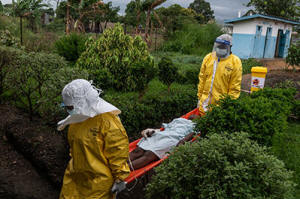
Medical staff carry an Ebola patient to a treatment center in
Rwampara, Congo, Thursday, May 21, 2026. (AP Photo/Moses Sawasawa,
file)
 ‘We risk dying for nothing’
Dr. Ben Bakule, a community investigator, said he narrowly escaped
death in late May when a group of angry young men attacked him and
his colleagues while they were tracing contacts of a confirmed Ebola
case in the village of Tutu, in Djugu territory.
“We spend money on transport to get to work. We thought we’d be
rewarded. At the moment, nothing is going right because we’re not
being paid. We don’t deserve this sort of treatment,” he told The
Associated Press.
“We might have to give up our jobs. These are risks we’re taking. We
risk dying for nothing. This government wants this epidemic to
continue,” Bakule added, his voice tinged with frustration.
When he visited the mining town of Mongbwalu — considered the hot
spot for the disease — last month, Congo’s Minister of Health Roger
Kamba assured the response teams that the government was
prioritizing their working conditions.
"All doctors, all nurses and all staff working on the response will
be fully supported. We have the money for that,” Kamba said at the
time.
But front-line workers say the reality is different.
“We are doing everything we can to make the public understand how
dangerous this disease is. I came here to save people’s lives, but
this is how I am being thanked. We are working day and night without
being paid,” said Dr. Ghislain Maneba, an epidemiologist and
community investigator in the Rwampara health zone.
Meanwhile, the strike by some workers has caused concern among
residents in Ituri, where measures to slow the outbreak have
resulted in economic hardship.
Bunia resident Anifa Kito said she fears that response efforts may
falter, further complicating daily life. “I would ask the
authorities to resolve this situation before things get any worse,”
she said, standing in front of her tomato stall.
—
AP writer Constant Same Bagalwa in Bunia contributed to this report.
All contents © copyright 2026 Associated Press. All rights reserved
 |