The tenuous state of a US-Iran ceasefire renews anxiety over high fuel
prices
[July 09, 2026] By
CATHY BUSSEWITZ and MAE ANDERSON
NEW YORK (AP) — The potential unraveling of a fragile truce between Iran
and the United States renewed anxiety Wednesday over whether fuel prices
would go back up if sustained fighting kept oil tankers from traveling
through the Persian Gulf.
Oil prices rose to their highest point in weeks after President Donald
Trump declared the U.S. ceasefire with Iran over, responding to Iranian
attacks on commercial ships in the Strait of Hormuz and on American
military sites in other Gulf nations. Costlier crude oil could lead to
costlier gas station fill-ups as drivers in many countries were getting
a break from elevated prices brought on by the war.
“Tanker traffic through the Strait of Hormuz has essentially stopped,
which tells you more about risk perception right now than any statement
from Washington or Tehran," said Jorge Leon, head of geopolitical
analysis at Rystad Energy, in an email. “Oil markets reacted quickly to
the renewed geopolitical risk."
U.S. gasoline prices increased slightly Wednesday to an average of $3.80
for a gallon of regular, up from $3.79 the day before, but still well
below the month-ago average of $4.16, according to motor club federation
AAA.
Crude oil makes up the bulk of the price of gasoline, so when oil prices
rise, gasoline eventually follows. But it can take weeks for consumers
to feel the full impacts. That's because refiners make gasoline with oil
purchased in advance. The finished product then has to travel through a
system of pipelines and trucks to reach gas station pumps.

Gas station owners set prices at the pump, and to stay competitive, they
sometimes absorb the impact of higher oil prices instead of immediately
passing it along to customers.
To suppress high oil prices during the war, the U.S. and other countries
released oil from their emergency stockpiles starting in March. But
those stockpiles won’t last forever.
The U.S. Strategic Petroleum Reserve held 319.5 million barrels as of
July 3. The last time the inventory was that low was in 1983, when the
reserve was initially being filled up.
“Unfortunately, the drawdown of strategic stocks means that there is a
lot less ammunition in Trump’s holster,” said Michael Lynch, a
distinguished fellow at Energy Policy Research Institute in Amherst,
Massachusetts.
A barrel of U.S. benchmark crude was selling for $75.80 on Wednesday,
the highest price in more than two weeks. Brent crude, the international
standard, climbed close to $79 per barrel, its highest level since June
19.
The market reaction "highlights how sensitive prices remain to any
escalation around the strait, given its role as a critical transit route
for global oil flows,” Leon said.
Shipping uncertainty increases after fresh strikes
A day after the U.S. accused Iran of striking three commercial vessels
and revoked the country's ability to openly sell crude oil on the world
market, some advised the shipping industry to reconsider whether it was
safe to send crewed ships through the Strait of Hormuz — and the wider
Middle East.
[to top of second column] |
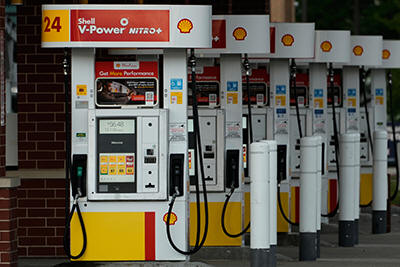
Gas pumps are seen at a gas station in Buffalo Grove, Thursday, June
25, 2026. (AP Photo/Nam Y. Huh)
 Some traffic traversed the strait on Tuesday,
according to data and analytics company Kpler, which verified 41
crossings compared to 36 on Monday. It was unclear if the crossings
happened before or after the strikes. Some vessels also are going
“dark” to pass through the strait and not broadcasting their
locations, further complicating a complete count.
With the central route through the strait uncrossable due to mines,
ships have been using two other routes, the smaller northern route,
which goes through Iranian waters, and the southern route, which
goes through Omani waters. The three ships struck Tuesday appeared
to be using the Omani route.
An economist at advisory firm Oxford Economics said the ceasefire
probably would continue to be on-and-off and Washington and Tehran
could still deescalate the latest tensions instead of returning to
war.
“The question is whether the latest developments merely represent a
bump in the road or if we’re emerging from the ‘eye of the storm,‘”
Ben May, the firm's director of global macroeconomic research, wrote
in a research note. “While Trump said negotiations with Iran were a
‘waste of time’, he maintained an off-ramp by noting that U.S.
negotiators would continue talks with Iran, suggesting the truce
hasn’t been irrevocably broken.”
The new doubts about the Strait of Hormuz came after two of the
biggest shipping companies, Maersk and Hapag-Lloyd, announced Monday
that their Gemini Corporation joint partnership would gradually
resume service in the Suez Canal, which was paused due to attacks in
the Red Sea by Yemen’s Houthis.
Recent stability in the Middle East created the conditions for the
companies' decision, but "the recent deterioration could put this
resumption in jeopardy once again,” said Judah Levine, head of
research at freight booking platform Freightos. “The said.
Hapag-Lloyd said in a Wednesday statement that it made the joint
decision after “thorough assessments of the security situation in
the Red Sea area” and “if the situation changes or deteriorates,
contingency plans are in place.”
All contents © copyright 2026 Associated Press. All rights reserved
 |