US and Iran exchange intensifying fire across the Persian Gulf as
interim deal to end war threatened
[July 09, 2026]
By JON GAMBRELL
DUBAI, United Arab Emirates (AP) — The United States launched new
airstrikes against Iran early Thursday, and Tehran responded by
targeting Bahrain, Kuwait and Qatar in crossfire that again threatened
an interim deal intended to help end the war in the Persian Gulf.
The strikes came hours after U.S. President Donald Trump said recent
Iranian attacks on ships in the Strait of Hormuz signaled the end of the
fragile ceasefire. The U.S. struck a variety of military sites and port
facilities early Wednesday after Iran targeted several merchant vessels
off the coast of Oman, sparking Iranian fire then as well.
But Thursday’s attacks appeared bigger all around, with sirens sounding
at least three times in Bahrain, home to the U.S. Navy’s 5th Fleet
headquarters. There was no immediate word of damage in the three Gulf
Arab countries from attacks claimed by Iran’s military.
In Iran, the two days of American airstrikes have killed at least 14
people and wounded another 78, Iran’s Health Ministry said Thursday in
its first overall count of casualties.
US strikes hit more targets
The U.S. military's Central Command said it hit some 90 targets across
Iran, releasing black-and-white footage of what appeared to be strikes
on an airport runway and missile launchers.
“U.S. forces remain vigilant, lethal, and prepared to execute operations
directed by the Commander in Chief,” it added.
The U.S. says the strikes were intended to “further degrade” Iran’s
ability “to threaten freedom of navigation” in the strait, through which
a fifth of the world’s traded oil and natural gas passed before the war
began with U.S. and Israeli attacks on Feb. 28.
Iranian state media reported explosions in several locations, including
Bushehr, home to Iran’s nuclear power plant complex, and the southern
port cities of Chabahar, Konarak, Bandar Abbas and Sirik.

In Iran's southwestern Khuzestan province, at least three people were
killed Thursday, state media reported. In Iranshahr, authorities said a
strike also had killed a firefighter at an airport. Those fatalities
followed at least nine members of Iran's armed forces being killed in
Wednesday's strikes in Iran. It wasn't clear when the other fatality
happened and who was killed.
For the first time since April, it also appeared the U.S. strikes
targeted Iranian bridges. State media reported a strike on a railway
bridge in Iran’s northeastern Golestan province, and the Revolutionary
Guard said two bridges had been attacked on the route to Mashhad, where
officials plan to bury the late Ayatollah Ali Khamenei on Thursday. But
it wasn’t clear if the Golestan attack was the same one mentioned by the
Guard.
Trump warns that ‘it will get much worse’ if attacks on shipping
happen again
After leaving a NATO summit in Turkey, Trump posted several videos on
his social media site of what he said were explosions in Iran and issued
another warning to the Islamic Republic.
“This is in retribution for yesterday’s bombing of ships by Iran. If it
happens again, it will get much worse!” Trump wrote.
Trump had said earlier in the day that the latest back-and-forth
fighting would not result in “long-term” military action.
“Anything that happens is going to happen very fast,” Trump said, though
he also suggested the U.S. military might “just finish the job.”
[to top of second column]
|
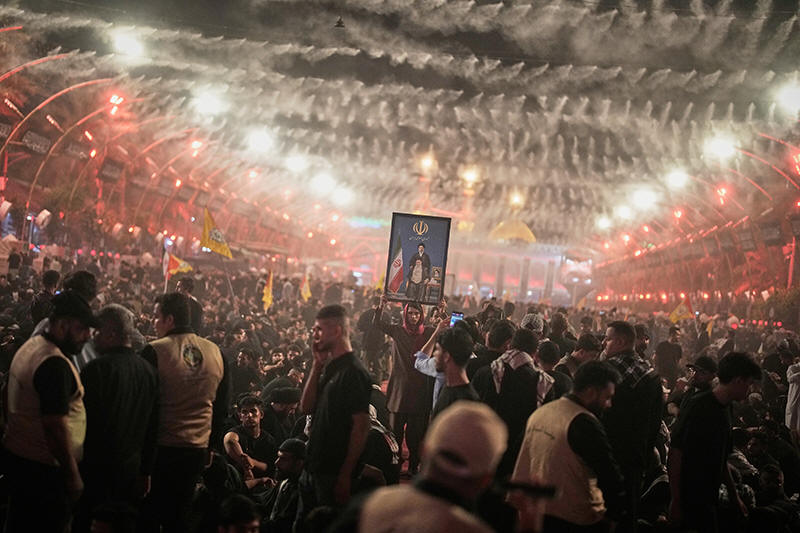
A mourner holds a portrait depicting Iran's Supreme Leader Ayatollah
Mojtaba Khamenei, top, and his late father, Ayatollah Ali Khamenei,
as mourners wait for the funeral procession for the elder Khamenei
outside the Imam Hussein Shrine in Karbala, Iraq, Wednesday, July 8,
2026. (AP Photo/Khalil Hamra)

Trump also renewed his past threats to hit Iran’s civilian
infrastructure, including electric plants and desalinization plants, and
to seize the oil-production hub of Kharg Island.
After three tankers were hit Tuesday, the U.S. launched strikes on Iran,
and Iranian forces retaliated by targeting American military sites in
the Persian Gulf.
Iran has asserted that the interim ceasefire deal gives it the right to
manage traffic through the strait. Parliament Speaker Mohammad Bagher
Qalibaf, a key negotiator in talks seeking a permanent end to the war,
was defiant in a post on X on Thursday morning: “America still hasn’t
learned that bullying and breaking promises are no longer cost-free. Let
me put it plainly: if you strike, you’ll get hit.”
Strikes raise fears that war could resume
Trump fueled concerns that the war could restart by saying the interim
agreement to pause fighting was “over,” although he added that he would
allow negotiations to continue.
Attacks have repeatedly threatened the shaky ceasefire, but Trump’s
comments added new uncertainty, and oil prices shot up after he spoke. A
renewed conflict could engulf the wider Middle East and would likely
again halt energy shipments through the strait.
“For me, I think it’s over,” Trump said when asked about the status of
the ceasefire. He added that U.S. representatives can continue
negotiations, but he cast doubt on the outcome. “They can talk, but I
think they’re wasting their time,” he said.
Iranian Deputy Foreign Minister Kazem Gharibabadi, also a top
negotiator, retorted on X that Trump’s remarks “are not a sign of power
but an admission of the failure” of U.S. policy toward Iran.
Trump has made other threats to seize Kharg Island, including last
month, when he also questioned whether the U.S. “has the stomach for
it.” Some 90% of Iranian oil exports pass through the island.
The new attacks on ships in the strait, despite the negotiations, could
reflect a divide among Iran’s leadership. Hard-liners seek lasting
control over the waterway, which is a globally important conduit for
fuel shipments and has become a critical lever in confronting the West.
Pragmatists want a permanent peace deal to lift international sanctions
and provide desperately needed economic relief.

Negotiations to reach a final deal were due to start after the funeral
for Khamenei, who was killed Feb. 28 in the war’s first moments. The
funeral, which ends Thursday, was supposed to be a period of lower
tensions.
The talks are meant to focus on the toughest matters, including fully
reopening the strait and rolling back Tehran’s disputed nuclear program.
All contents © copyright 2026 Associated Press. All rights reserved |