Behind Christopher Nolan’s 6-country epic undertaking to bring ‘The
Odyssey’ to the big screen
[July 10, 2026]
By LINDSEY BAHR
NEW YORK (AP) — Christopher Nolan has never been afraid to dream a
little bigger. It’s almost a calling. With every film, he’s pushed
himself and the medium further — playing with form, storytelling,
visuals and audience expectations to create lasting cinematic
spectacles. A student of Hollywood history, the Oscar-winner is always
looking to fill gaps in cinematic culture and show audiences something
they haven’t seen before: “The Odyssey,” he realized, was a massive one.
All Nolan films are epics in their own ways. But for “The Odyssey,” he
knew he had to do something fitting of the Homeric poem and its
foundational place in Western culture, something worthy of the biggest
screens and the resources it would require. The goal was to make
something accessible and realistic, which meant going to far flung
locations, using real ships on real seas, and taking audiences into the
cave with the Cyclops, inside the Trojan Horse and to the bleak expanse
of Hades. Opening in theaters worldwide on July 17, it’s also the first
feature to be shot entirely on IMAX film.
“We all know the title, we all know what it means, we know what it
promises and hopefully for the audience coming to see the film, they’ll
feel we made good on that promise because that’s the fun of ‘The
Odyssey,’” Nolan said in a recent interview with The Associated Press.
“It’s the ultimate adventure story.”
“This is going to be really hard”
The journey would require a deep dive into Greek mythology, Bronze Age
scholarship and many translations, a monthslong scouting expedition and
a 91-day shoot spanning six months and six countries during which the
cast and crew endured all manner of challenging weather, landscapes and
the treachery of the open seas.

“The Odyssey” was an epic undertaking — the hardest film anyone involved
had ever made. Matt Damon, who stars as Odysseus, said that Nolan warned
him as much before they started filming.
“He told me it was going to be hard, which I kind of, I blew off at
first. I’m like, ‘Yeah, yeah, it’s going to be hard. And he said ‘no,
no, this is going to be really hard,'” Damon said. “He did not
disappoint.”
That was by design.
“I mean, it’s ‘The Odyssey,’” Nolan said. “This should be a difficult
film to make, and it was.”
Unlike Odysseus’s extended journey home, the production was also
efficient: They finished nine days early.
Making ‘The Odyssey’ relatable, and rejecting Hollywood tropes
When Hollywood movies take on the ancient world, they often fall back on
familiar tropes — using accents, elevated language, 19th century
orchestral scores and neoclassical touchstones to convey antiquity.
Nolan wanted to do something different and found inspiration in the text
of the poem, in which he observed an earthy sensibility that stood in
contrast to the grandeur of the story.
“You want to question people’s assumptions about how things should be
portrayed in movies and what those are based on,” Nolan said. “There’s a
challenge to that and a risk to that.”
That meant making some bold choices, including colloquial language,
American accents, and blending elements from various stories, including
“The Iliad,” “The Aeneid” and “Agamemnon,” to give the audience more
clarity. His Trojan Horse, which he’s been thinking about since he was
briefly attached to direct “Troy” over 20 years ago, does not have
wheels.
For the score, he challenged composer Ludwig Göransson to use bronze
gongs, aulos and the lyre to create a new kind of soundscape, and to
come up with a four-note theme where the last would be the pluck of a
bow.
And paramount to this story of homecoming and coming-of-age, his
characters needed to be relatable.
“The movie has so much scale,” said Tom Holland, who plays Odysseus’s
son Telemachus. “There are times where it feels like you’re on this kind
of action-adventure roller coaster, but he doesn’t sacrifice any of the
heart and the intimacy between our characters.”
Among the large ensemble cast are many famous names: Anne Hathaway is
Odysseus’s wife Penelope, Zendaya is the goddess Athena, Charlize Theron
is the nymph Calypso and Lupita Nyong’o is Helen, and her twin sister.

[to top of second column]
|
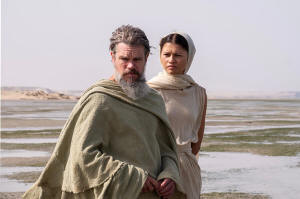
This image released by Universal Pictures shows Matt Damon as
Odysseus, left, and Zendaya as Athena, in a scene from "The
Odyssey." (Melinda Sue Gordon/Universal Pictures via AP)
 Robert Pattinson, Nolan said, is
“unleashing his inner Alan Rickman” as the villainous suitor
Antinous.
“He’s continually saying to Telemachus, ‘I’m going to be your
stepdad, I’ll be your daddy,’” Nolan said. “It was such a
fascinatingly creepy and amusing basis for villainy.”
Leading the charge was Damon, an actor Nolan knew he liked working
with after “Interstellar” and “Oppenheimer. ”
“You need somebody who will take the audience on this journey,”
Nolan said. “With Matt, he’s able to combine that iconic sort of
superhero thing with a very, very emotionally accessible and
comprehensible person.”
Finding the real; Grounding the fantastical
The film begins with the words “a time of apparent magic,” a promise
of what’s to come in this mythical world of gods, monsters,
superstitions and natural phenomena. The pursuit of the real led
them all over the world. Troy was constructed in Morocco, the cave
of the Cyclops was found in foothills of Greece, Iceland’s black
sands, shot in the midnight sun, are used for Hades and the island
of Favignana, near Sicily, played Ithaca, where much of the cast and
crew hiked 45 minutes every day before work to reach a 15th-century
castle, 1,030 feet (313.9 meters) above sea level.
On the seas, they used a real ship, the Draken, a reconstruction of
a 1,000-year-old Viking ship that production modified slightly to
make it look more of the Mycenaean era. The actors learned to row.
The ship’s crew played extras.
But Nolan’s love of in-camera effects doesn’t mean he rejects other
kinds. “Tenet,” “Interstellar” and “Inception” all won Oscars for
visual effects, after all. And in “The Odyssey” there are things
that can’t be found in the natural world, from the six-headed Scylla
to the Cyclops, the design of which was inspired by the Francisco
Goya painting “Saturn Devouring His Son.” Bill Irwin, who brought
the robots to life in “Interstellar,” delivered the performance.
“We knew we were going to need every trick in the book, from
animatronics to puppetry to computer graphics,” Nolan said. “But I
knew I needed a performer … He doesn’t treat the Cyclops as just a
monster.”
What it adds up to is something that, miraculously for a
3,000-year-old tale, feels fresh.
“Chris has created something that’s totally new,” said Hathaway.
“That’s a remarkable achievement.”

Odyssey-fever
Nolan productions always inspire a certain amount of hysteria, but
excitement for “The Odyssey” reached a fever pitch. Initial
screenings for the 70 mm IMAX showings — his favorite format — sold
out in under an hour a year in advance. When all showtimes went on
sale last month, ticketing sites crashed. High profile locations
like the AMC Lincoln Square in New York and AMC CityWalk in Los
Angeles are virtually sold out for weeks, and scalpers on eBay are
attempting to sell tickets for more than $500. But the 70 mm IMAX
screens account for only about 32 theaters out of thousands in North
America — there are other ways to see the film, including 70 mm,
digital IMAX and other large format presentations.
For Nolan, the audience is the north star; Entertaining is a
responsibility he takes seriously. In fact, he said, a film isn’t
really done until it reaches the audience: They’re the ones who
finish the piece.
“The audience tells you what it is,” Nolan said. “And that means
that for us, this is an exciting moment, but a very frightening
moment, because it’s real. There’s nothing to hide behind. We made
this film for a theatrical audience, and it goes out in the world as
that. And we’ll see what the world makes of it.”
All contents © copyright 2026 Associated Press. All rights reserved |