As the country turns 250, retired judges hit the road to defend judicial
independence
[July 10, 2026]
By SUDHIN THANAWALA
On Friday, a group of retired judges will step off a tour bus in a ritzy
Michigan suburb after three days of barnstorming through corn fields,
cities and coal towns in Ohio and Pennsylvania. They carry with them a
message.
In courthouses and public squares, they have marked the nation's 250th
anniversary with a dire warning: The rule of law in America is in grave
danger. They will deliver a similar message at a library in Grosse
Pointe just outside Detroit — the last stop on an extraordinary tour to
defend judicial independence and bolster trust in courts.
Americans' confidence in the court system and democracy has dipped in
recent years. The country is more polarized, and President Donald Trump
has repeatedly cast doubt on the fairness of the judicial system.
Some judges on the tour said in phone interviews this week that the
United States was at a precipice.
“Looking back in history, we have teetered," former Ohio Supreme Court
Justice Michael Donnelly said. "This is a moment where we can decide to
reinstill those beliefs that we are a country of laws and not of men.”
Judges step off the bench
The four-day tour through the Rust Belt is a sharp departure for a
typically reserved and insular branch of government. Federal judges in
particular largely limit their comments to the courtroom and written
decisions, focusing on the facts of individual cases.
But that restraint is loosening amid a barrage of attacks by Trump and
other White House officials, the administration's rampant defiance of
U.S. district court orders and its expansive view of executive power.
Trump has called a district judge who ruled against one of his
immigration moves “crooked” and suggested with no evidence that Supreme
Court justices who struck down his tariffs were motivated by foreign
interests.

More federal judges have recently begun talking about receiving death
threats and profane messages, though they have not blamed Trump or any
other officials. Some have blasted administration policies in sharply
worded opinions that strayed beyond the legal dispute before them. Even
U.S. Supreme Court Chief Justice John Roberts has weighed in.
In an appearance in March, Roberts said personal criticism of federal
judges was dangerous and had to stop. The rare rebuke from the head of
the nation's top court came two days after Trump's remark about a
“crooked” judge, though Roberts didn't mention Trump or anyone else by
name.
The U.S. Marshals Service reported 564 threats against federal judges in
the government fiscal year that ended in September, up from 509 the year
before.
“I don’t want to say we have moved into an era of lawlessness, but it
sometimes feels that way,” said former U.S. District Court Judge
Victoria Roberts, who was set to join the bus tour in Michigan.
Timothy Lewis, another former federal judge on the tour, said his
concerns about the politicization of the judicial branch reached a
tipping point a decade ago, when Senate Republicans thwarted President
Barack Obama’s nomination of Merrick Garland to the Supreme Court.
Today, the rule of law is facing an "existential threat" from an ongoing
breakdown of norms, according to Lewis, who spent seven years on the 3rd
U.S. Circuit Court of Appeals.
“I have fundamental concerns," he said, “about where we are headed as a
nation.”

[to top of second column]
|

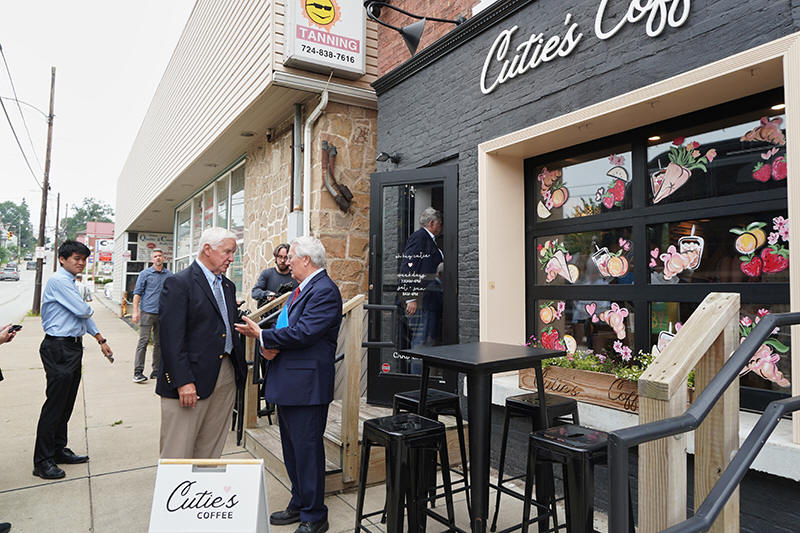
Former Pennsylvania Gov. Tom Corbett speaks to lawyer Jon Delano
outside a coffee shop in Greenburg, Pa., on Tuesday, July 7, 2026.
(Keep Our Republic via AP)

Their route has been varied
The tour started Tuesday in the western Pennsylvania town of
Greensburg — once the hub of a thriving coal industry that now lures
visitors from nearby Pittsburgh for highland recreation and a
historic downtown.
Judges mingled with customers at a coffee shop before speaking at
the domed, ornate Westmoreland County Courthouse. Then it was off to
Washington, also in western Pennsylvania. The town of 13,000 people,
where about 15% of the population is Black, was a key stop on the
Underground Railroad and a regional base for the Civil Rights
Movement.
From there, the bus headed west for events Wednesday in Columbus,
Ohio, and the city of Wooster in Amish country. The judges stopped
at a Cracker Barrel restaurant on the way. They spent Thursday in
Cleveland before circling Lake Erie north to Michigan.
The two groups that planned the tour — dubbed “Justice in Motion” —
say they were inspired by a similar campaign in Poland in 2021 after
that country's governing party took control of key judicial
institutions.
Independent Polish judges visited scores of towns to promote the
rule of law and teach voters about the country's constitution. The
U.S. tour also aims to educate people.
An effort to combat misinformation about what they do
Maureen O'Connor, a former chief justice of the Ohio Supreme Court,
said judges risk ceding the narrative about their roles and motives
to “voices of misinformation” if they don't speak up.
A letter she received years ago, and still keeps, reminds her of
that danger. The writer accused O'Connor, a Republican, of betraying
her party when she repeatedly struck down Republican-drawn
legislative maps as illegal gerrymanders. “There was just a basic
misunderstanding of what my role was as a judge,” O'Connor said.

O'Connor is among roughly 30 judges, including two former federal
judges and a current federal judge, who will participate in the
tour. One of the federal judges was nominated by a Democrat, the
other two by Republicans. The state judges, some of whom are also
still on the bench, represent both parties.
They have been joined by former Pennsylvania Gov. Tom Corbett,
former Ohio attorneys general and a few lawyers. The event was put
together by the Democracy Rising Collaborative and Keep Our
Republic, nonpartisan advocacy groups.
Organizers say they chose stops that would get the judges in front
of as many people as possible to build connections and trust. The
judges have embraced that mission.
“The lifeblood of the judiciary is public confidence,” Donnelly, the
former Ohio Supreme Court justice, said. “If you lose that, it’s
very difficult to get it back.”
All contents © copyright 2026 Associated Press. All rights reserved |