EPA promised a Make America Healthy Again agenda. It has yet to
materialize, frustrating activists
[July 11, 2026]
By MATTHEW DALY and ALI SWENSON
WASHINGTON (AP) — Last December, after Make America Healthy Again
activists drew up a petition to get him fired, Environmental Protection
Agency administrator Lee Zeldin pledged to release a formal agenda of
MAHA priorities that his agency would pursue, including protections
against harmful chemicals and other health concerns.
But eight months after its first mention and after repeated promises it
was being drafted, the so-called MAHA agenda is nowhere to be found.
When asked for a status update this week, an EPA spokesperson said MAHA
is an ongoing effort, not a single report.
The apparent reversal on the release of a formal environmental health
agenda is the latest in a cascade of disappointments for Health
Secretary Robert F. Kennedy Jr.'s MAHA movement, who say they've lost
faith that the Trump administration will take any significant action on
pesticides, chemicals or other issues they view as key to address
America's chronic disease epidemic. It also reflects the EPA's
relentless rollback of environmental regulations even in the face of
pressure from an important voting bloc that has supported President
Donald Trump.
“I had really hoped that there would be specific steps that were taken
through a MAHA agenda,” said activist Kelly Ryerson, whose social media
account “Glyphosate Girl” focuses on nontoxic food systems. “We haven’t
had any of the wins that we were requesting.”
Many in the diverse coalition of MAHA activists that Trump credits for
helping him win back the White House say they plan to vote on issues
over party in November's congressional elections, raising the political
stakes of their increasingly public tensions with the Republican
administration.
“People are done with the profits of corporations being prioritized over
public health,” said Alexandra Muñoz, a molecular toxicologist who
collaborates with activists on certain issues. “And I think that will
have an important role in the midterms.”

MAHA is frustrated with EPA's actions
“Trump’s EPA,” as Zeldin frequently calls the agency, has vigorously
pursued a deregulatory agenda. Earlier this year, Zeldin proposed
overturning the landmark finding that climate change is a threat to
human health. He moved to roll back dozens of environmental regulations
in what he called “the greatest day of deregulation our nation has
seen,” froze billions of dollars for clean energy and upended agency
research.
At the same time, Zeldin has touted multiple “MAHA wins," some of which
activists say are anything but. For example, he said the agency intends
to regulate some chemicals called phthalates for environmental and
workplace risks, but didn’t address the thousands of consumer products
that contain the ingredients.
This week, the EPA diverted from past assurances that the MAHA report
was in its “final stages,” telling The Associated Press in an email that
the EPA’s actions should speak for themselves.
“The notion that MAHA is a single document waiting to be unveiled
fundamentally misrepresents how we operate,” an agency spokesperson
said, adding that work on MAHA priorities is “active and expanding every
day.”

Ryerson and other MAHA activists said they've engaged with agency
officials about changes they'd like to see, and occasionally succeeded.
Her network of farmers worked with the administration on a recent
executive order to advance regenerative agriculture. But she said EPA
then used the order to justify new proposed uses for various herbicides,
a move she called a “slap in the face.”
The same week, the Supreme Court dealt another blow to the MAHA cause in
siding with pesticide maker Bayer in a ruling related to its legal
liability for alleged harm caused by its Roundup weedkiller. The Trump
administration had backed the company in the case.
Environmental activists say the rise of Kennedy and his MAHA mission has
rippled across the administration, raising the public's awareness of
pesticides — and expectations that Trump's administration would act.
“If RFK and the MAHA movement hadn’t put that issue in the center of the
public spotlight, no one would be scrutinizing this nearly as closely,"
said Sarah Starman, a senior food and agriculture campaigner at the
nonprofit Friends of the Earth.
[to top of second column]
|
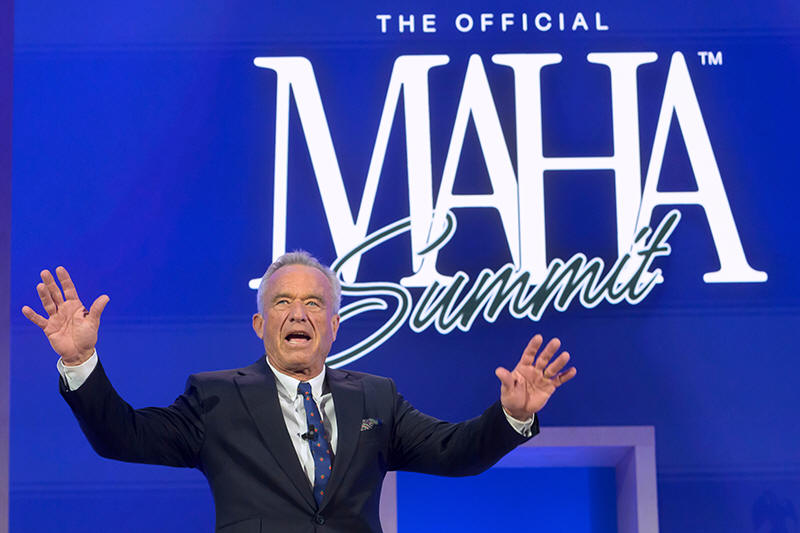
Health and Human Services Secretary Robert F. Kennedy, Jr., arrives
on stage at the inaugural Make America Healthy Again summit, Nov.
12, 2025, in Washington. (AP Photo/Rod Lamkey, Jr., File)
 EPA says getting microplastics
out of drinking water is complicated
In a well-publicized gesture aimed in part at the MAHA movement,
Zeldin in April included microplastics and pharmaceuticals on a list
of contaminants that could be regulated under the Safe Drinking
Water Act. Activists had pressured Zeldin for months to crack down
on microplastics and other environmental contaminants.
But in a reversal in late June, the EPA did not include
microplastics or pharmaceuticals on a list of chemicals it plans to
test for under a mandatory program used to collect information about
concerning chemicals in drinking water that could be harming human
health.
The move rendered the EPA's earlier public health promises
"functionally toothless,'' said Betsy Southerland, a former senior
official in EPA’s water office.
Zeldin said on social media that “the technology to test and treat
for microplastics in drinking water is still in development.” The
EPA said in a Federal Register notice that it was “not feasible to
develop a drinking water analytical method within the statutory
timeframe.”
After making “a big splash in the press” on microplastics, "EPA has
quietly stalled that momentum," said Southerland.
A White House Make America Healthy Again Report, released a few
months into Trump’s second term, identified long-term exposure to
environmental chemicals — including those widely found in plastics —
as a leading cause of chronic disease in children.
Former industry lobbyists now have leading roles at EPA
Jeremy Symons, a senior adviser at the Environmental Protection
Network, a group of former EPA employees and political appointees
who are critical of the Trump administration, said Zeldin “pays lip
service to MAHA, but sadly he is actually making Americans less safe
from toxic chemicals.''
Alongside MAHA's influence on the Trump administration, industry
lobbyists have made inroads at the EPA.
Kyle Kunkler, a former lobbyist for the soybean industry, leads
pesticide policy at the EPA. The agency recently allowed continued
use of dicamba, a weedkiller that has been linked to increased risk
for some cancers.
Zen Honeycutt, a MAHA activist and founding executive director of
Moms Across America, said the move is “what happens when the EPA
allows itself to be pressured by corporations and by business.”
EPA also employs other former industry insiders. Nancy Beck, a
former executive at the chemical lobbying group the American
Chemistry Council, is a top official in EPA's Office of Chemical
Safety and Pollution Prevention. Lynn Dekleva, another former
chemistry council executive, serves as a Beck deputy.
The EPA said Kunkler and other political appointees have consulted
with agency ethics officials to resolve any potential conflicts of
interest. The MAHA movement has “driven this agency's work since
President Trump's first day in office," a spokesperson said in an
email, citing various initiatives including $945 million in grants
to help states and communities cut “forever chemicals” known as PFAS
in drinking water and identifying 30 drinking water contaminants
proposed for nationwide monitoring.
On Thursday, the agency announced it was teaming up with Health and
Human Services and the U.S. Department of Agriculture to protect
consumers from heavy metals and other contaminants in food.
But for Ryerson and others, the lack of a promised MAHA agenda reads
as a tactic to escape accountability.
“It absolves them of any failures, especially when it comes to
midterms,” Ryerson said. “They won’t have to point to some list that
they haven’t been able to achieve really anything on.”
All contents © copyright 2026 Associated Press. All rights reserved |