Guggenheim Museum among NYC buildings that tested positive for
Legionnaires’ amid disease outbreak
[July 13, 2026]
By PHILIP MARCELO
New York City’s famed Solomon R. Guggenheim Museum was among a number of
Manhattan buildings that recently tested positive for the bacteria that
causes Legionnaires’ disease amid the city’s latest outbreak.
The city health department on Friday released a list of 31 buildings on
the Upper East Side that have been ordered to clean and disinfect their
cooling towers as the city deals with the latest outbreak of the
disease, which is a serious form of pneumonia.
The distinctive, cylindrical-shaped art museum was among 19 that have
already completed the remediation, according to the department’s list.
The rest were expected to complete the work by Saturday.
City officials stressed the positive test results do not confirm any of
the buildings as the source of outbreak as the tests conducted could not
distinguish between live and dead bacteria.
The museum was also not shuttered at any point because of the positive
test or remediation work, they said.
“The city has confirmed that there is no additional action needed at
this time, and this poses no risk to anyone inside the building,” the
museum said in a statement Saturday, noting that it has an outside
company that conducts regular monthly testing and treating of its
cooling tower.

The Guggenheim was designed by the renowned architect Frank Lloyd Wright
and is designated a UNESCO World Heritage site as one of the defining
architectural works of the 20th century.
More than 50 people have been diagnosed with Legionnaires’ disease in
connection with the Upper East Side cluster, of which less than 20
remain hospitalized, according to the most recent data from the city
health department. No deaths have so far been reported.
[to top of second column]
|

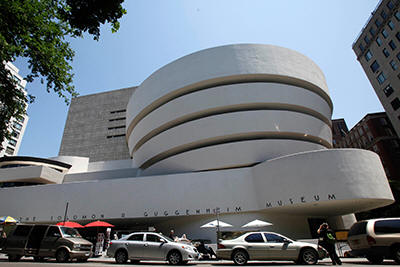
The exterior of Frank Lloyd Wright's Solomon R. Guggenheim Museum in
New York, May 31, 2011. (AP Photo/Kathy Willens, File)
 Seven people died and more than 100
were sickened during a major outbreak in the upper Manhattan
neighborhood of Harlem last year that was ultimately traced to
cooling towers atop Harlem Hospital and a nearby construction site
where the city’s public health lab is located.
Legionella bacteria generally grow in warm water and can spread in
building water systems such as showerheads, hot tubs and cooling
towers.
The structures are usually found on the top of buildings and control
the temperature of systems such as refrigeration, but they do not
affect drinking water or the building’s indoor air or air
conditioning.
Legionnaires’ disease is also not transmitted person-to-person.
People often contract it by breathing in tiny droplets of
contaminated water.
Symptoms usually develop two days to two weeks after exposure and
include cough, fever, headaches, muscle aches and shortness of
breath, according to the U.S. Centers for Disease Control and
Prevention.
People are at an increased risk for Legionnaires’ disease if they
are age 50 or older, smoke or vape, have a chronic lung disease or
have a weakened immune system.
The respiratory ailment's name comes from an outbreak that hit
attendees of an American Legion convention in Philadelphia in 1976.
All contents © copyright 2026 Associated Press. All rights reserved |