Man who killed Dartmouth professors at 17 to get a chance at parole in
about 20 years, judge rules
[July 14, 2026]
By HOLLY RAMER and KATHY McCORMACK
CONCORD, N.H. (AP) — A Vermont man who was 17 when he and a friend
killed a pair of married Dartmouth College professors 25 years ago will
have a chance at parole in about 20 years, when he reaches the age of
one of his victims, a judge ruled Monday.
Lawyers for Robert Tulloch, now 43, and prosecutors reached an
agreement, avoiding a three-day planned resentencing hearing. In court
Monday, a shackled Tulloch held his head down and appeared to breathe
heavily as the horrific details of the stabbings were recounted.
Tulloch was automatically sentenced to life without parole after
pleading guilty to first-degree murder in the 2001 stabbing deaths of
Half and Susanne Zantop. But the U.S. Supreme Court ruled in 2012 that
mandatory sentences of life without parole are unconstitutional for
juveniles, and later applied that decision retroactively.
The rulings gave hundreds of juvenile lifers a shot at freedom,
including five men serving life sentences in New Hampshire for murders
they committed as teenagers. Tulloch’s resentencing hearing, the last of
the five, would have begun Monday in Grafton County Superior Court in
North Haverhill, New Hampshire.
A daughter of the victims requests the longest possible sentence
Tulloch apologized to one of the professors’ two daughters, Veronika
Zantop, who joined the hearing remotely, and talked about how she and
her family were affected by the death of her parents.

A psychiatrist with two sons, one of them the same age Tulloch was when
he committed his crimes, she said she can appreciate that brain
functioning can change over time. But she does not believe it's true for
Tulloch, saying he meticulously planned the killings and followed
through in a cold, predatory manner.
“This wasn't a crime of passion or retribution,” she said. “He wasn't
using substances, he wasn't psychotic. There was just sheer depravity.”
She urged that he stay in prison “for the longest possible sentence.”
Tulloch abandoned his prepared statement.
“After listening to that, I feel disgusted by even thinking I could say
anything that would mean anything,” he said.
Tulloch's lawyers asked for a 30-to-40-year minimum sentence
In a court filing last week, Tulloch’s lawyers argued that a minimum
sentence in the range of 30 to 40 years is appropriate, based on a
review of other murders committed by juveniles in New Hampshire and
cases nationwide that were affected by the Supreme Court rulings.
Judge Lawrence MacLeod resentenced Tulloch to a minimum of 45 years to
life. He could be considered for parole in 2046 when he's 62 years old,
the same age Half Zantop was when he was killed.
MacLeod said he reviewed the applicable law, the circumstances of
Tulloch's offenses, his conduct while in prison, the outcomes of the
other New Hampshire cases and Veronika Zantop's statement.
“The agreed upon sentence provides certainty that Tulloch will remain
incarcerated for a substantial period of time, allows Tulloch to pursue
some measure of rehabilitation, and it secures important protections for
the community,” New Hampshire Attorney General John Formella said in a
statement.
Attorneys Richard Guerriero and Oliver Bloom said Tulloch’s prison
records show he has matured, and that after some initial misconduct
early on, he’s had no major infractions since 2012 and no minor
infractions since 2017.
[to top of second column]
|
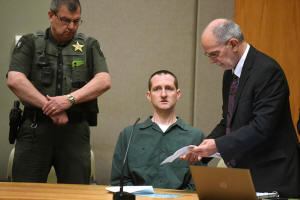
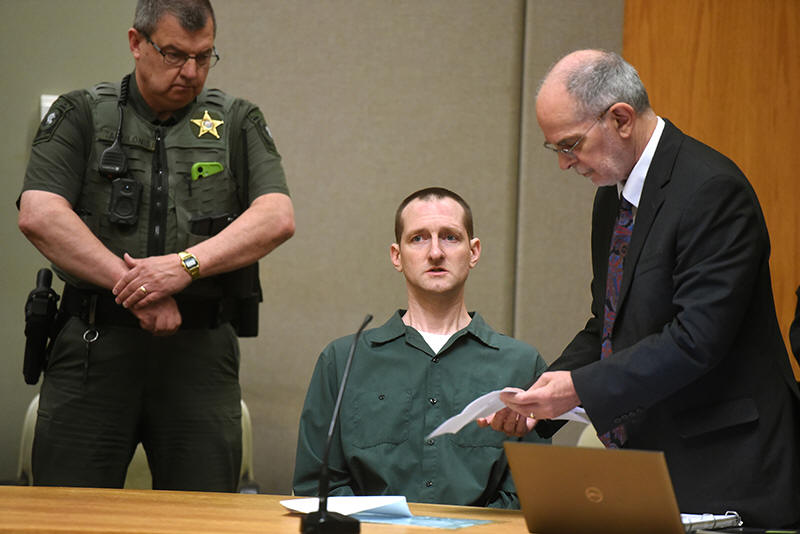
Robert Tulloch, sitting, waits for his resentencing to start with
his attorney Richard Guerriero on Monday, July 13, 2026, in Grafton
Superior Court in North Haverhill, N.H. (Jennifer Hauck/Valley News
via AP, Pool)

Quoting from Tulloch’s therapy records, they said he has expressed
“significant remorse” for what he sees as a heinous and unforgivable
crime, his “warped youthful thinking,” and his “good capacity for
empathy.”
The teens came up with a plan to kill, steal money and live
overseas
According to Tulloch’s friend, James Parker, the teens were bored
with their lives in Chelsea, Vermont, when they concocted a plan to
kill strangers, steal their money and move to Australia. For several
months, they knocked on doors in New Hampshire and Vermont
pretending to be conducting a survey on the environment before being
let in by the Zantops. Susanne Zantop, 55, was head of Dartmouth’s
German studies department and her husband, Half Zantop taught Earth
sciences.
Parker, who was 16 at the time, told prosecutors Tulloch stabbed
Half Zantop and then directed Parker to attack Susanne Zantop.
Tulloch also stabbed her. Fingerprints on a knife sheath and a
bloody boot print linked the teens to the crime, but after being
questioned by police, they fled Vermont and hitchhiked west. They
were arrested at an Indiana truck stop weeks later.
Parker, who cooperated with prosecutors and pleaded guilty to being
an accomplice to second-degree murder, was released from prison on
parole in 2024 at age 40, having served nearly the minimum term of
his 25-years-to-life sentence.
“I think it’s unimaginably horrible,” Parker said during his parole
hearing when asked by a board member what he thought of what he did.
“I know there’s not an amount of time or things that I can do to
change it, or alleviate any pain that I’ve caused.”
Many states have banned life sentences for juveniles
The Supreme Court rulings addressed only mandatory life sentences
without parole for juveniles, leaving the U.S. the only country that
allows discretionary life sentences for minors. Twenty-eight states
and the District of Columbia have banned the practice, while another
five states allow it but have no one serving such a sentence,
according to the Campaign for the Fair Sentencing of Youth.
New Hampshire lawmakers have rejected attempts to end life sentences
for juveniles, but Tulloch's case could bolster future attempts.
After Tulloch argued in 2018 that sentencing juveniles to life
without parole violated the state constitution, the judge asked the
state Supreme Court to weigh in, but it declined. Last July, MacLeod
agreed with Tulloch, finding that the constitution categorically
prohibits such sentences as “cruel or unusual” punishment.

Among the juvenile lifers nationwide who have been resentenced after
the U.S. Supreme Court rulings, more than 75% have received
sentences of less than 40 years, according to a study published in
2024 in the Journal of Criminal Justice.
In New Hampshire, one man was resentenced to life without parole
after refusing to attend his hearing or authorize his attorneys to
argue for a lesser sentence. Others received sentences of 25-, 40-
and 45-years-to-life.
All contents © copyright 2026 Associated Press. All rights reserved |