After Lindsey Graham's death, questions linger about aging politicians
and health transparency
[July 14, 2026]
By JILL COLVIN
NEW YORK (AP) — The sudden death of Sen. Lindsey Graham, a top ally of
President Donald Trump and one of Washington's best-known politicians,
is renewing focus on the country's aging lawmakers.
Graham, who had turned 71 just two days before passing away on Saturday
night, was far younger than many of his Senate colleagues and appeared
to have been in good health. He suffered a tear in his aorta, according
to a preliminary report from the medical examiner.
It was the second time in less than a month that emergency personnel
were dispatched to the home of a U.S. senator. In early June, Mitch
McConnell, the former Republican Senate leader, was hospitalized for
undisclosed reasons.
After weeks of increasingly dire speculation about his health, he
finally revealed on Sunday that he had fallen and suffered from mild
pneumonia. He released a photo, complete with a copy of the day’s
newspaper.
Graham’s death and McConnell’s hospitalization have come amid an ongoing
reckoning about the nation’s aging leaders, two years after the
disastrous presidential debate that sparked widespread panic among
Democrats about then-President Joe Biden’s capacities and accusations of
a cover-up.
Some politicians have continued to obscure details about their health
challenges, asking for privacy despite their public positions, and
fueling conspiracy theories.
“I think we need some transparency,” Sen. John Cornyn of Texas said
Monday. “I wish Sen. McConnell and his team would have done that
earlier, I think it would have resolved a lot of questions.”

Mitch McConnell
McConnell, who at 84 is only the third-oldest member of the Senate, was
admitted to the hospital on June 14 with barely any explanation. Aides
said he was “receiving excellent care," but offered no details about his
condition.
The dearth of information fueled a wave of speculation about his
prognosis, with Laura Loomer, a Trump ally and conspiracy theorist,
claiming on social media that a "high level source close to the White
House” had told her he was “officially brain dead.”
But McConnell, who will retire from Congress at the end of January after
serving as the longest-ever Senate leader, said in a statement that he
is on the mend. He said a fall had led to his hospitalization and that
he was “briefly unconscious" and treated for mild pneumonia.
“You all know how folks of my generation often hesitate to share the
vulnerability that comes with growing older," he said. “Even in the
public eye, I feel that same instinct – I can’t help it.”
That wasn't enough to put speculation to rest. On social media, many
refused to believe the veracity of a photo his office released that
included the front page of the “Sports” section of The Washington Post.
Conspiracy theories about McConnell’s health are “a symptom of our
times," said Sen. Rand Paul, who is also from McConnell's home state of
Kentucky. Paul said people should “give him a break.”
“People think they have a right to know everyone’s medical problems," he
said, "but I don’t know, where does it begin and where does it end?”
Donald Trump
The oldest person ever elected president has long offered only the
rosiest picture of his health.
“Everything checked out PERFECTLY," he boasted after his last physical
in May, adding that he took yet another cognitive test aimed at
detecting early dementia and has “aced them all.”
His past medical reports have been criticized for offering limited
detail and including statistics that some health professionals have
viewed with skepticism.
[to top of second column]
|

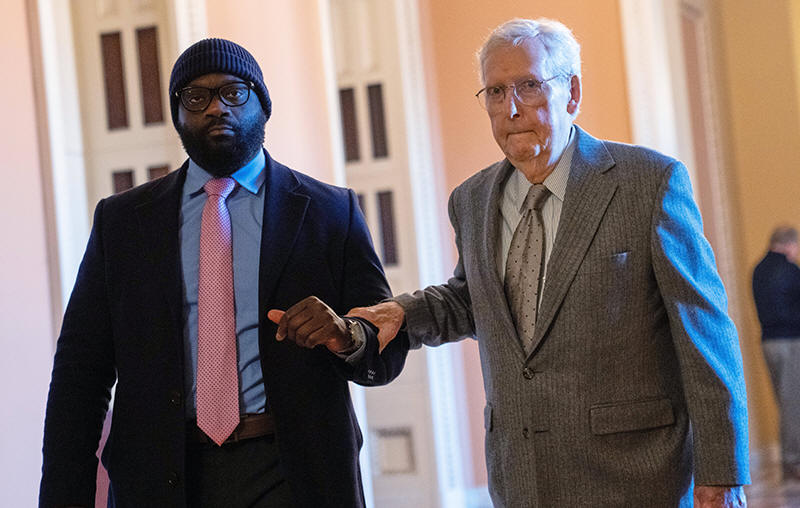
Sen. Mitch McConnell, R-Ky., right, walks through the Capitol, Jan.
15, 2026, in Washington. (AP Photo/Allison Robbert, File)

When he first ran for president in 2016, Trump declined to release his
health records, breaking with longtime precedent. He instead offered a
four-paragraph note from his doctor declaring that he would be “the
healthiest individual ever elected to the presidency.” Rep. Ronny
Jackson, White House doctor during Trump's first term, later drew
headlines when he extolled the president's “incredibly good genes."
When he was infected with COVID-19 in the midst of his 2020 reelection
campaign, Trump's doctors and aides withheld key details of his
treatment and tried to downplay the severity of his illness.
And after an attempted assassination at a Pennsylvania rally, Trump
aides kept the public in the dark for days, declining to discuss the
extent of his injuries or release medical records after assuring he was
“fine.”
Thomas Kean Jr.
The obfuscation extends beyond the septuagenarian and octogenarian set.
New Jersey Republican Rep. Tom Kean Jr. spent four months missing
without explanation before he finally disclosed late last month that he
had been in treatment for depression.
He said in a brief floor speech after his return that he had remained
silent about his condition because he is a “private person by nature."
He won an uncontested primary during his absence, despite missing more
than 100 votes in the House, and is running for reelection.
The approach stood in contrast to Sen. John Fetterman, a Pennsylvania
Democrat, who disclosed his hospitalization for clinical depression the
day after he was admitted to Walter Reed National Military Medical
Center for treatment. He also suffered a stroke while running for
office.
Joe Biden
Biden's halting gait, frail appearance and frequent verbal stumbles
eventually doomed his 2024 reelection campaign. After a debate in which
he frequently lost his train of thought, he chose to withdraw from the
race, sparking an unprecedented swap at the top of the Democratic ticket
that ultimately paved the way for Trump's return to office.
Many others have refused to retire. California Sen. Dianne Feinstein, a
Democrat, died in office in 2023 at the age of 90, after years of
declining health, including a bout of shingles. Though she returned to
the Senate after her illness, she appeared frail and confused at times.
It was later revealed that her office had failed to disclose in real
time that she had contracted encephalitis while recovering.

Longtime Republican Rep. Kay Granger of Texas spend the final months of
her more than two decades in Congress suffering from “unforeseen health
challenges” that made travel to Washington difficult.
Eleanor Holmes Norton, 88, the longtime House delegate for the District
of Columbia, announced earlier this year that she would not run for
reelection amid questions about her competency.
___
Associated Press writers Mary Clare Jalonick and Lisa Mascaro in
Washington contributed to this report.
All contents © copyright 2026 Associated Press. All rights reserved |