Trump will speak on elections in primetime address after pushing
debunked conspiracies
[July 15, 2026]
By COLLIN BINKLEY and BILL BARROW
WASHINGTON (AP) — President Donald Trump will deliver a primetime
address this week that he says will include a focus on elections,
suggesting he could revisit long-debunked conspiracy theories about his
2020 defeat to Democrat Joe Biden. The speech comes as he's escalated
calls for Republicans to pass tighter federal voting rules for
November’s midterm elections.
The Republican president has been guarded about what he plans to say in
the 9 p.m. Thursday speech, scheduled as he confronts a collapsing deal
to end the war with Iran. He also faces numerous domestic issues,
including recent deadly shootings by Immigration and Customs Enforcement
officers. Asked for a preview of the speech on Tuesday, Trump offered
scant detail but said he has “really big news.”
“It doesn’t get bigger, because without free and fair elections, you
don’t have a country,” Trump said in the Oval Office. He refused to go
further, saying he wanted to “save it” for the moment, though he also
hinted he would be talking about a hodgepodge of issues.
“We’ll be discussing other things, too,” Trump said, without
elaborating. “It’s going to be a very big announcement.”
Trump has used the power of the primetime presidential address —
typically reserved for milestones — to deliver politically charged
speeches before, including one in December when he sought to blame the
challenging economic climate on Democrats. But Thursday's address seems
poised to go even further, using the moment to amplify election lies
before an audience of millions in an effort to boost Republican
prospects before midterms that threaten to hobble Trump for the
remainder of his term.
On Monday, when asked about the speech, Trump repeated baseless claims
of voter fraud in the Los Angeles primary race for mayor. During the
interview with conservative outlet Newsmax, Trump said Republican
Spencer Pratt lost his primary bid because of fraud, citing in part
California's slow vote count.

Federal prosecutors said they were opening fraud investigations in the
state last month after Trump drew attention to the claim.
The president's preoccupation with voting fraud and election security
dates back at least to 2016, when he refused to say whether he would
accept defeat to Democrat Hillary Clinton. After he won, he convened a
voting integrity commission to support his claims that widespread voter
fraud cost him the popular vote, though the commission disbanded without
uncovering any such evidence.
Four years later, after he lost the 2020 election to Biden, Trump again
claimed cheating and zeroed in on the Democrat's narrow win in Georgia.
Trump called the state's secretary of state and pressured him to “find
11,780 votes,” just enough votes to overturn Biden's victory in the
state. He, along with than a dozen allies, was indicted in the state
though the charges were later dropped.
Repeated audits and reviews -- manyrun by Republicans, including Trump’s
own then-attorney general -- have found no significant fraud occurred in
2020.
[to top of second column]
|
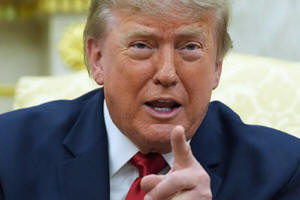
President Donald Trump speaks as he meets with Iraq's Prime Minister
Ali al-Zaidi in the Oval Office of the White House, Tuesday, July
14, 2026, in Washington. (AP Photo/Julia Demaree Nikhinson)

Before winning in 2024, Trump was again laying the groundwork to
claim cheating if he lost. After returning to office, he stocked his
administration with officials who back his false claims of 2020
election fraud.
Trump made voting regulation central in this term
Frequently declaring that he won the White House “three times,”
Trump has made voting regulation a core issue during his second
term, demanding legislation that would require voter ID and sharply
limit mail-in voting. Facing midterm races that will decide control
of Capitol Hill, Trump has stirred new claims to cast doubt on
election results that could challenge his power in Washington.
Earlier this year, FBI agents raided elections offices in Fulton
County, Georgia, seizing materials from the 2020 election. Tulsi
Gabbard, then Trump’s director of national intelligence, traveled to
Atlanta to oversee the execution of the search warrant.
Maryland Gov. Wes Moore, campaigning in Georgia for Democratic Sen.
Jon Ossoff and governor's candidate Keisha Lance Bottoms, smiled
Tuesday when asked about Trump potentially rehashing the 2020
election in his national address.
He called it a strategy “for losers.”
“I think people are exhausted by having conversations about
elections that happened six years ago, that we have the answer to,”
Moore said. “He continues to bring this up because he cannot get out
of his mind that he actually could have lost.”
Beyond Georgia, Trump has widely taken aim at states that allow
voters to submit ballots by mail. Trump said he called a U.S.
attorney in California and demanded scrutiny of the governor's
primary last month as votes were being counted.
Last week, Trump ousted the remaining members of the federal
Election Assistance Commission, a bipartisan panel that resisted his
efforts to require would-be voters to document their U.S.
citizenship before registering.
___
Barrow reported from Atlanta. Associated Press writer Nicholas
Riccardi in Denver contributed to this report.
All contents © copyright 2026 Associated Press. All rights reserved
 |