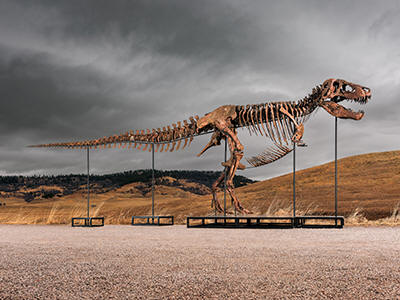
Mystery bidder buys T. rex nicknamed 'Gus' for a record $50 million
[July 15, 2026]
By PHILIP MARCELO
NEW YORK (AP) — A Tyrannosaurus rex fossil billed as one of the world's
largest and most complete specimens was sold for a record $50.1 million
Tuesday to a mystery bidder.
Sotheby's said the 67-million-year-old fossil, nicknamed “Gus,” is now
the most expensive set of dinosaur bones ever auctioned off, besting the
almost $45 million price tag for a nearly complete stegosaurus sold by
the same New York auction house in 2024. The previous record holder had
been a Tyrannosaurus rex skeleton nicknamed “Stan” that sold for nearly
$32 million in 2020.
“Gus is not only an exceptional find, but a specimen that’s been
excavated, documented, prepared, and cared for with real excellence,”
Cassandra Hatton, Sotheby’s vice chair, said after the sale was
completed. “The market responds when great specimens are taken care of
in the right way.”
Why the bidding for this T. rex was intense
Standing upright with its tail extended and right foot slightly raised,
“Gus” is an adult dinosaur specimen measuring about 12 ½ feet (3.8
meters) tall and 38 feet (11.5 meters) long.
He's about 61% complete, with what Sotheby's describes as an
“exceptionally preserved” skull including a gaping jaw of powerful
teeth, two “well represented” feet and a number of rarely found bones,
including a furcula, or wishbone.
The fossil was discovered in 2021 on a ranch in South Dakota and named
in honor of property owner Gary Licking, who died during the roughly
five year excavation, restoration and mounting process.

The auction house said the winner, who participated by phone and wants
to remain anonymous, outbid six other prospective buyers during
Tuesday's 10-minute bidding battle. The piece had been estimated to
fetch anywhere from $20 to $30 million ahead of the sale.
“Try a bigger bite,” auctioneer Phyllis Kao cajoled the bidders at one
point during the auction, which was conducted live and online. “It’s a
T. rex, after all.”
Scientists want ‘Gus’ on public display
The Society of Vertebrate Paleontology, an advocacy group of scientists,
scholars and students, said scientifically significant fossils such as
“Gus” should be publicly displayed in museums and other research
institutions so that they can be “preserved, documented, and accessible
for future generations.”
[to top of second column]
|
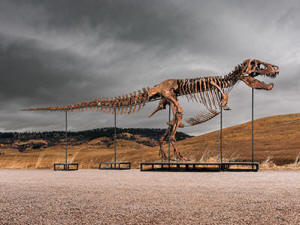
This undated photo provided by Sotheby's on Tuesday, July 14, 2026,
shows "Gus," one of the largest and most complete Tyrannosaurus rex
specimens ever discovered. (Matthew Sherman/Sotheby's via AP)

“Our hope is that the new owner recognizes the extraordinary
scientific and educational value of Gus the T. rex and that they aim
to keep it in the public trust by immediately donating it to an
accredited natural history museum,” Kristi Curry Rogers, the
society's president-elect, said in a statement Tuesday. “That
outcome would ensure that this remarkable specimen continues to
advance science, rather than becoming unavailable for study.”
Indeed, “Apex,” the stegosaurus, the previous dinosaur fossil
record-holder, is currently on long-term loan to the American Museum
of Natural History in Manhattan. “Sue” the T. rex, the first
dinosaur ever sold at auction in 1997, also by Sotheby's, is a
centerpiece of the Field Museum in Chicago.
And “Stan” is on display at the Natural History Museum Abu Dhabi,
posed in combat with another fossilized T. rex over the remains of a
triceratops.
A Cretaceous king and Hollywood staple
Tyrannosaurus rex, whose name roughly translates to “King of the
Tyrant Lizards,” stood firmly at the top of the food chain when it
ruled during the late Cretaceous period.
With its fearsome jawline and comically stubby arms, it has become
the most recognizable and beloved of the dinosaurs, depicted in
everything from children’s programs like Barney, the purple T. rex,
to the enduring “Jurassic Park” movie franchise.
The great beasts roamed what is today western North America, during
a time when the region boasted “warm climates, high sea levels, and
rich coastal floodplains” that allowed their primary prey, giant
herbivores like the triceratops, to flourish, according to
Sotheby’s.
All contents © copyright 2026 Associated Press. All rights reserved
 |