Pamela Smart, serving life, seeks a new trial as a New Hampshire judge
weighs her latest petition
[July 21, 2026]
By KATHY McCORMACK and HOLLY RAMER
CONCORD, N.H. (AP) — Lawyers for Pamela Smart, who is serving life in
prison for orchestrating the murder of her husband by her teenage
student in 1990, urged a New Hampshire judge Monday to allow her latest
petition for a new trial to move forward.
Smart, 58, was a 22-year-old high school media coordinator when she
began an affair with a 15-year-old boy who later fatally shot her
husband, Gregory Smart, in Derry.
The shooter was freed in 2015 after serving a 25-year sentence. Though
Smart denied knowledge of the plot, she was convicted of being an
accomplice to first-degree murder and other crimes and was sentenced to
life without parole after a trial that was one of the first in the
nation to be broadcast live on television from start to finish.
Smart filed a petition for habeas corpus relief in January seeking to
overturn her conviction over what her lawyers claim were several
constitutional violations. The state responded with a motion to dismiss
the petition, resulting in Monday's hearing, which Smart attended
remotely from the Bedford Hills Correctional Facility for Women in New
York.
Merrimack County Superior Court Judge James Kennedy took the matter
under advisement. He planned to rule in 30 to 60 days.
Smart's lawyers say transcripts of recordings during trial were
inaccurate
Smart's lawyers argue that prosecutors misled the jury by providing them
with inaccurate transcripts of surreptitiously recorded conversations of
Smart that included words that were not audible on the recordings.

Among the words they claim weren’t audible but in the transcript were
the word “killed” in the sentence “you had your husband killed,” the
word “busted” in the sentence “I’m gonna be busted” and the word
“murder” in the sentence “this would have been the perfect murder.”
“Modern science confirms what common sense has always told us: when
people are handed a script, they inevitably hear the words they are
shown,” Smart’s attorney, Matthew Zernhelt, said in a statement earlier
this year. “Jurors were not evaluating the recordings independently —
they were being directed toward a conclusion, and that direction decided
the verdict.”
In court Monday, he described a forensic study that showed providing
transcripts alongside muffled audio leads listeners to believe the
written text even when inaccurate.
“Adding a transcript of language to the jurors changed their
interpretation of what they believed they were hearing, how confident
they were in what they believed they were hearing and how clear it was
to them,” he said. “There's no absolute truth about what's on the tapes.
Nothing decipherable is on the tapes. But when you tell someone what
they're hearing, you set this expectation ... and they will hear it.”
Smart's lawyers also argued that the verdict was tainted by the media
attention and due to faulty instructions to the jury. They argued jurors
were told they must find that Smart acted with premeditation, and were
not told they must consider only evidence presented at trial.
They also argued the trial court gave her a mandatory life sentence
without parole for being an accomplice to first-degree murder, despite
New Hampshire not mandating that sentence for the charge.
Lawyers for the state say Smart's petition should be dismissed
Lawyers for the state asked the judge to dismiss the petition, saying
nearly all of the claims are barred because they already were raised on
appeal and resolved by the New Hampshire Supreme Court, or could have
been raised on appeal with the court but were not.

[to top of second column]
|
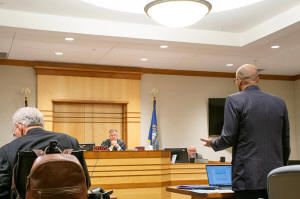
Matthew Zernhelt, an attorney for Pamela Smart, speaks to Merrimack
Superior Court Judge James Kennedy during a hearing for Smart, who
is serving life in prison for orchestrating the murder of her
husband by her teenage student, at the Merrimack Superior Court in
Concord, N.H., Monday, July 20, 2026. (Grace Chai/Seacoast Media via
AP, Pool)

They noted that during Smart's trial, the defense only expressed
concern that the recording transcripts allegedly failed to account
for the “doubling” of voices when two people speak at once. The
judge instructed jurors that if the tapes differed from what they
were reading, they should use what they heard, instead. The state
Supreme Court noted that Smart's lawyers did not make any
“particularized showing of inaccuracies in the transcripts relative
to the recordings or how she may have been prejudiced” by them.
Assistant Attorney General John Drennan said none of Smart's claims
are supported by facts, and that she appears to be using the habeas
corpus process as a substitute for an appeal. He likened the
discrepancies with the transcripts to someone viewing text of a
transcribed voicemail and then listening to the actual message.
“Maybe cognitive bias has set in, but it doesn't mean that I can't,
when listening, say, ‘Hey, I’m not sure that's right,'” he said. “I
know to review it. I know to be skeptical.”
Smart's team hasn't proven other claims, such as ineffective
assistance of counsel and having the case argued in New York, rather
than in New Hampshire, the lawyers for the state said.
Smart's legal options are limited. She has unsuccessfully sought a
sentence reduction hearing several times with an elected state
council in New Hampshire that approves contracts and appointees to
the courts and state agencies. She appealed one rejection to the
state Supreme Court, which dismissed her petition in 2023.
Her latest petition was filed after New Hampshire Gov. Kelly Ayotte
rejected her request last year to put the matter before the council
again. Ayotte said she reviewed the case and decided it was not
deserving of a hearing.
Smart took full responsibility for husband's death in video
In 2024, Smart took full responsibility for her husband’s death. She
said in a video she spent years deflecting blame “almost as if it
was a coping mechanism.”

Smart’s trial was a media circus and one of America’s first
high-profile cases about a sexual affair between a school employee
and a student. The student, William Flynn, testified that Smart told
him she needed her husband killed because she feared she would lose
everything if they divorced and that she threatened to break up with
him if he didn’t kill her husband. Flynn and three other teens
cooperated with prosecutors and all have since been released.
Flynn and 17-year-old Patrick Randall entered the Smarts’ Derry
condominium and forced Gregory Smart to his knees in the foyer. As
Randall held a knife to the man’s throat, Flynn fired a hollow-point
bullet into his head. Both pleaded guilty to second-degree murder
and were sentenced to 28 years to life. They were granted parole in
2015. Two other teenagers served prison sentences and have been
released.
The case inspired Joyce Maynard’s 1992 book “To Die For” and the
1995 film of the same name, starring Nicole Kidman and Joaquin
Phoenix.
All contents © copyright 2026 Associated Press. All rights reserved |