US actions harm global efforts to prevent and treat HIV in dozens of
countries, new report says
[July 22, 2026]
By LAURA UNGAR
The Trump administration’s disruptions to a global AIDS relief program
have forced organizations to close clinics, lay off staff and cut
services, seriously impeding efforts to prevent and treat the disease in
dozens of countries, a new report released Tuesday shows.
The President’s Emergency Plan for AIDS Relief, known as PEPFAR, is
credited with saving at least 26 million lives since its inception in
2003. But last year, it was impaired by the dismantling of the U.S.
Agency for International Development and cuts to thousands of global
health grants.
“The disruptions were very widespread,” with services for young women,
orphans and children impacted, said Elise Lankiewicz, policy associate
for the nonprofit amfAR, The Foundation for AIDS Research, which
released the report.
Researchers contacted groups that got PEPFAR funding to deliver HIV
services last year. Nearly a quarter — 166 groups from 46 countries —
responded to an electronic survey conducted between last November and
April, providing information on their funding, staff and services.
The survey didn’t reach all PEPFAR groups and certain types of
organizations — like those that were most severely disrupted or still
receiving U.S. funding — may have been less likely to respond. That
could result in an underestimate or an overestimate of disruptions,
depending on which organizations were missed. Nevertheless, the findings
are a window into the struggles that some groups faced last year.
Some key findings were:
—Most organizations had at least one award terminated or payment delayed
last year. Terminations led to the closure of more than 1,700 clinics,
drop-in centers and other service delivery sites, and to the loss of
more than 16,000 full-time staff members.

—Even though the U.S. government directed services providing HIV
treatment, testing, and prevention of mother-to-child transmission to
continue, a majority of partners still reported a disruption to those
services.
—Cuts were concentrated on services for populations most impacted by
HIV. Most organizations previously serving groups such as sex workers,
men who have sex with men, transgender people, and people who inject
drugs reported permanently ending a service for these groups. Even among
organizations that didn’t lose funding, some reported stopping a service
for one of these key populations to comply with U.S. policy.
—HIV prevention has been sharply reduced, with many organizations
stopping condom programs or services offering what's called PrEP,
preventive medicines to guard against sexually transmitted HIV. From
fiscal years 2024 to 2025, prevention spending fell 51%, according to
PEPFAR expenditure data.
—Locally-based partners were much more likely than international
organizations to have an award terminated and to close service delivery
sites. Funding disruptions also destabilized interconnected HIV service
systems.
“Taken together, these results describe widespread degradation of the
infrastructure built to deliver HIV services worldwide, with the deepest
damage falling on the populations and partners most essential to
controlling the epidemic,” the report says.
The survey doesn’t provide data at the country level, but amfAR
officials point out that the majority of responses came from African
countries.
[to top of second column]
|
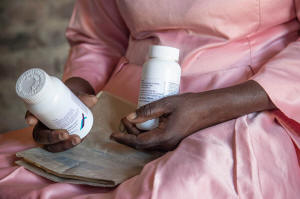
Florence Makumene holds HIV medication that she received through
funding from the U.S. President's Emergency Plan for AIDS Relief (PEPFAR),
along with her hospital records book, at her home in Harare,
Zimbabwe, Feb. 7, 2025. (AP Photo/Aaron Ufumeli, File)
 When asked about the report, a State
Department spokesperson said in an email that the Trump
administration has “strengthened PEPFAR through clear, strategic
direction.”
“As a result, the number of children testing
positive and on treatment for HIV has continued to decline,” the
spokesperson said.
In April, the U.S. State Department released PEPFAR data for one
quarter in 2025: July through September. Officials said PEPFAR-supported
programs provided standard HIV treatment for 20.6 million people in
more than 50 countries, which they said is stable from the same
reporting period in 2024. They also said PEPFAR started 103,000
pregnant and breastfeeding women on PrEP, up from 43,000 the
previous year.
The data from that quarter “demonstrates the resilience and strength
of the program,” the spokesperson said.
But researchers from amfAR and the International AIDS Society
combined that quarter's data with another data release that included
all four quarters and found substantial disruptions across PEPFAR
services.
Other research, published in the journal Nature Health in June,
specifically examined treatment globally using PEPFAR data. It found
that nearly two million fewer people living with HIV were receiving
PEPFAR-supported antiretroviral treatment in fiscal year 2025 as
compared with the previous fiscal year — about a 10% decline.
“That does raise really important questions about program
stability," said Ramona Godbole, an author of that study who wasn’t
involved in the latest report.
AmfAR's report made numerous recommendations to help restore care.
It said the U.S. government and PEPFAR leaders should reinstate
support for all HIV services, not just treatment. It also called on
other national governments to spend more on HIV services and
contract with nongovernmental organizations, including those led by
people in key vulnerable populations.
But Jennifer Sherwood, amfAR’s director of research and public
policy, said even if money is put back into the system, it will take
time to get the services up and running and regain the trust of
communities.
“And unfortunately, with HIV and infectious disease, each day is
deadly,” she said. “Each day that we don’t have those systems in
place, you see new infections.”
All contents © copyright 2026 Associated Press. All rights reserved
 |