Earnings at Musk's car company fall as research spending cuts into
profit from selling cars
[July 23, 2026] By
ALEX VEIGA
Tesla said Wednesday that its profits fell last quarter as the car
company run by Elon Musk shoveled more money into research and
development, cutting into profits from a sharp increase in vehicle
sales.
The Austin, Texas, company reported second-quarter net income of $1.11
billion, or 32 cents per share. Excluding certain items, earnings were
33 cents per share, well short of the 53 cents per share forecast by
Wall Street analysts, according to FactSet.
Revenue rose 26% to $28.24 billion, beating analysts’ forecast of $26.42
billion.
While the core car business had a solid quarter, Tesla is now focused on
building out the infrastructure and AI software that underpins its
robotaxis and robotics businesses, which Musk has said are the future of
the company. And doing so requires a lot more spending.
Research and development spending surged about 49% from a year earlier
to $2.37 billion — higher than its been going back at least four
quarters.
“We’re investing a lot in growing the core business and really preparing
for the future,” Musk said during a conference call with Wall Street
analysts, promising that the spending will yield “incredible returns.”
CFO Vaibhav Taneja told analysts that the company expects capital
expenditures will increase further in the second half of this year,
driving full-year spending to more than $25 billion.
Taneja also forecast that spending on capital expenditures will continue
growing for the next “2 to 3 years,” as the company seeks to expand its
fleet of robotaxis, add AI compute infrastructure and build more
production capacity for its Optimus humanoid robot, among several other
products.

Tesla shares fell 4.1% in after-hours trading shortly. The stock ended
the regular trading session 1.3% lower and is down just under 17% this
year.
Earlier this month, Tesla reported that it delivered 480,216 cars in the
second quarter, a 25% increase from the same period last year and its
second straight quarterly gain. The sales also exceeded analysts’
expectations, according to a FactSet survey.
Tesla’s improving sales this year mark a big turnaround from a year ago,
when many Europeans refused to buy the company’s cars because of Musk’s
embrace of far-right political candidates in elections there.
The vast majority of the company’s vehicle deliveries last quarter were
comprised of its Model Y crossover SUV and Model 3 sedan. Tesla rolled
out less expensive versions of both models last year in hopes of
boosting sales. It also cut the cost of leasing and loans in Europe.
[to top of second column] |
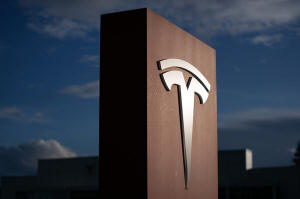
A sign for Tesla is displayed at a facility on Wednesday, April 15,
2026, in Portland, Ore. (AP Photo/Jenny Kane, File)
 Sales were also helped by a surge of
EV buying in general in Europe as gas and diesel prices have risen
due to the Iran war.
Just a few months ago, Tesla reported sales had fallen in 2025 for a
second year in a row and it had to yield its crown as the world’s
largest EV maker to China’s BYD.
Tesla's EV sales accounted for most of the company’s overall
revenue, but the company got a boost from its energy generation and
battery storage business, which posted revenue of $3.14 billion, a
13% gain compared to the second quarter last year.
The company also benefited from increased subscriptions for its
driver assistance feature, available in the U.S., called Full
Self-Driving (Supervised). The number of FSD subscribers has now
reached nearly 1.5 million globally.
Tesla said it has now rolled out its robotaxi service to seven major
metro areas in the U.S., and that it it expects production on its
Optimus humanoid robot to begin later this year.
The company has also been investing in building new battery
factories and in the infrastructure needed to produce its Tesla Semi
and Cybercab.
The company noted that it has begun production of the Cybercab at a
factory in Texas, and that the Tesla Semi is on track for production
this year at a factory in Nevada.
Tesla executives didn't offer more specifics on how many robotaxis
or Cybercabs will be on the road, nor how soon.
Musk noted that the company needs more time to test the Cybercab
chassis and doesn't want to rush the expansion of robotaxis, saying
he prefers to take a cautious approach.
“We’re working on what we believe is the most ambitious buildout of
advanced infrastructure manufacturing capacity ever in history,” he
said. “Our goals are very ambitious for robotaxi, but we do need to
be cautious about causing any accidents or causing any harm to
anyone."
All contents © copyright 2026 Associated Press. All rights reserved
 |