China hits back at criticism over excess industrial capacity as more US
tariffs loom
[July 29, 2026] By
CHAN HO-HIM
HONG KONG (AP) — China pushed back Tuesday against claims of
overcapacity in the world’s second largest economy, ahead of the release
of results of a U.S. probe on the matter that could result in new
tariffs.
Massive capacity in a slew of Chinese industries, from automaking to
solar panels, cement and steel manufacturing, among many others, has
drawn increasing attention from Beijing's trading partners in recent
years. Although China's own leaders have made rebalancing the economy a
priority, slowing domestic demand has prompted companies to expand into
markets overseas. Surging exports pushed China's trade surplus to a
record of nearly $1.2 trillion last year.
China has never sought a large trade surplus, the Ministry of Commerce
said in a report titled “China’s Position on the So-called Excess
Capacity Issue.” It took aim at recent talk of a “China shock 2.0” due
to excess capacity.
“The U.S. and other western countries have come up with the so-called
‘China shock 2.0,’ falsely accusing China’s industrial development of
posing threats to western countries’ monopoly,” said the report,
alluding to assertions of an earlier shock to trading partners from
China's ascent as a manufacturing power.
“This is not supported by facts and totally untenable,” the report said.
Tuesday's document echoed remarks by China’s No. 2 official, Premier Li
Qiang, at the World Economic Forum’s “Summer Davos” meeting in the
northeastern Chinese city of Dalian. Li said that instead of a “China
Shock 2.0,” recent trends should be viewed as a “China Opportunity 2.0.”
The U.S. is expected to soon announce findings of an investigation of 16
economies, including China, relating to excess capacity and production
in their manufacturing sectors. The probe is widely expected to result
in increased tariffs on some countries.
On Friday, the U.S. imposed higher tariffs of 10% to 12.5% on 60
economies, including China, saying they had failed to effectively
enforce a ban on goods produced with forced labor. Many countries
including China protested that move.
[to top of second column] |
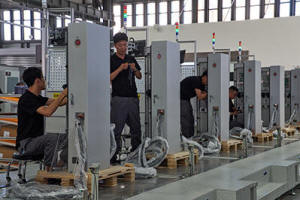
Workers assemble charging stations at the Mengma Intelligent
Transportation Equipment Manufacturing Base in Hohot in northern
China's Inner Mongolia province on Thursday, June 11, 2026. (AP
Photo/Ng Han Guan, file)
 At a press conference Tuesday, Lin
Weilong, director of the Commerce Ministry's policy research office,
said the U.S. has no authority to unilaterally determine whether
trading partners have excess capacity and impose restrictive
measures.
“The U.S. cannot narrowly define production capacity that exceeds
domestic demand as excess capacity, and slap it with a surplus
label,” Lin told reporters in Beijing.
Earlier this month, the European Union, struggling to rebalance its
trade with China, implemented trade measures including protections
for its steel industry and restrictions on imports of e-commerce
small parcels.
China’s stance on the overcapacity issue will likely “fall on deaf
ears,” said Alfredo Montufar-Helu, an expert on China at Ankura, a
consultancy.
“Economic conditions in Western markets have made it politically
untenable to do nothing in the face of rising Chinese imports,
especially in high value added sectors that Western firms used to
dominate,” he said.
All contents © copyright 2026 Associated Press. All rights reserved
 |