Samsung reports record profit as South Korean chip giants benefit from
global AI boom
[July 30, 2026] By
KIM TONG-HYUNG
SEOUL, South Korea (AP) — South Korean technology giant Samsung
Electronics on Thursday reported a record operating profit of 89.5
trillion won ($62 billion) for the April-June period, a day after
crosstown rival SK Hynix also reported record earnings, as the world’s
two largest memory chipmakers continue to ride the global artificial
intelligence boom.
Despite their soaring profits, the companies’ shares have fallen sharply
this week in South Korea’s volatile stock market, where retail investors
often drive sharp swings in share prices, as concerns grow over their
plans to spend massively on increasing manufacturing capacity and the
prospects of intensifying competition from China.
Samsung’s second-quarter operating profit was a more than 19-fold
increase from a year earlier, and nearly all of it came from its
semiconductor business, which benefited from rising chip prices driven
by demand for AI servers and increased shipments of advanced
high-bandwidth memory chips used to power AI applications. That
outweighed an operating loss in its mobile, TV and home appliances
division, partly due to higher component costs.
Samsung’s quarterly revenue of 171.5 trillion won ($119 billion) was
also an all-time high. The company said it expects demand for its memory
products to remain strong in the second half of the year, driven by
continued expansion of AI infrastructure and broader adoption of agentic
AI. Demand for server chips is expected to accelerate further, keeping
the market undersupplied, it said in a statement.
Samsung’s report came a day after SK Hynix also reported a record
second-quarter revenue of 60.5 trillion won ($42 billion). However, SK
Hynx’s profit was still below the loftier market expectations and the
company’s shares declined by more than 9% on Wednesday. Samsung’s share
prices have also declined this week.

Kim Jaejune, an executive of Samsung’s memory chip division, said the
company expects the gap between chip supply and demand to widen further
in 2027. He said Samsung plans to begin construction of its second
semiconductor fab in Taylor, Texas, before the end of this year, with
the goal of starting production by 2030.
Kim said Samsung has secured long-term chip supply contracts with what
he called the “five major global data center clients” — a possible
reference to Amazon Web Services, Google, Meta, Oracle and Microsoft –-
and is in talks with other major technology companies as demand for AI
infrastructure surges.
“Despite our efforts to increase production, demand growth is outpacing
our efforts,” he said in a conference call.
[to top of second column] |
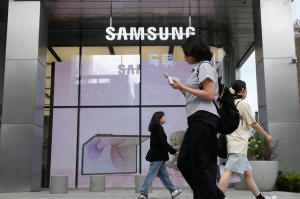
People pass by Samsung Gangnam store in Seoul, South Korea,
Thursday, July 30, 2026. (AP Photo/Ahn Young-joon)
 Samsung and SK Hynix together
produce about two-thirds of the world’s memory chips. While the
companies have embarked on major investments in semiconductor
manufacturing facilities and data centers as South Korea expands its
AI ambitions, some analysts say there are growing concerns about
whether such massive spending will ultimately generate sufficient
returns.
Shares of South Korean chipmakers have also been pressured by
concerns over intensifying competition from China, with reports that
a state-owned Chinese company had begun mass-producing domestically
developed immersion deep-ultraviolet (DUV) lithography machines, a
key technology for advanced chipmaking. Investor concerns were also
heightened by the strong stock market debut of Chinese memory
chipmaker ChangXin Memory Technologies, some analysts say.
Samsung and SK Hynix last month announced plans to invest a combined
800 trillion won ($554 billion) in a new chipmaking hub in the
country’s southwest to capitalize on surging AI-driven demand.
The chiefs of Samsung, SK and South Korean automaker Hyundai joined
President Lee Jae Myung on his San Francisco trip last week, where
they announced hundreds of billions of dollars in planned
cooperation with major U.S. technology companies, including AI firms
OpenAI and Anthropic and chip designers Nvidia and Broadcom. The
agreements span chip technologies, data centers and other AI
infrastructure.
In a roundtable with foreign media last week, Kim Yong-beom, Lee’s
chief policy adviser, said the initiatives reflect how global
technology companies are rushing to secure long-term partnerships
with South Korean chipmakers as they seek reliable supplies of
memory chips for AI.
However, the volatility of the companies’ stock prices, along with
those of other global tech firms, shows that investors are shifting
their focus from short-term earnings to long-term sustainability,
Son In-joon, a semiconductor analyst at South Korea’s Eugene
Securities, said in a report this week.
All contents © copyright 2026 Associated Press. All rights reserved
 |