US-Iran conflict enters new phase as Saudi Arabia helps hit proxies and
diplomacy stalls again
[July 30, 2026]
By FARNOUSH AMIRI, MATTHEW LEE, AAMER MADHANI and
KONSTANTIN TOROPIN
WASHINGTON (AP) — The stop-start fighting between the United States and
Iran appears to have entered a new phase as Saudi Arabia has publicly
joined military escalations against Tehran-backed proxies. At the same
time, an already untenable diplomatic effort to end the war has faltered
once again as mistrust deepens between the longtime adversaries.
Despite several days of relative calm, both sides carried out military
strikes in the last 24 hours that once again risk a return to all-out
war — and further expansion in the region — while little is clear about
what strategy, if any, American or Iranian officials have for a path
forward.
While President Donald Trump and his allies have spent recent days
arguing that Iran is begging to return to the negotiating table, Iran’s
deputy foreign minister said Tuesday that his country has made no
requests to restart the diplomatic track in more than two weeks.
Following a thwarted attack on the U.S. base in Jordan, Trump turned
back to threats Wednesday even while sustaining the prospect of
continued talks.
“They’ve already apologized, but, you know, we got to smack them a
little bit,” he told reporters in the Oval Office. He added: “It’s our
turn, and we’ll see if we get there with an agreement at some point. But
we’re going to hit them very hard.”
Hours later, the strikes followed as the U.S. military said it launched
a “a powerful response to yesterday’s attempted Iranian attacks on U.S.
forces based in the Middle East” in a social media post. It did not
immediately disclose the targets of the attack.

There's a sense of déjà vu as the Republican president has vacillated
for the past several months between insisting a deal was near to end the
war and Tehran's nuclear program and then using vulgarities and threats
to get Iran to capitulate to U.S. demands — to no avail.
The stakes for continued U.S. military action have never been higher for
Trump and his party as the conflict, unpopular among many Americans, has
jolted the world economy just months before critical midterm elections
in November. The renewed fighting also has killed and injured more
American troops and been complicated by concerns that the U.S. is
further drawing down stockpiles of key air defense systems needed to
defend its bases and allies.
In the past day, Iran said it fired ballistic missiles at Jordan’s
Muwaffaq Salti Air Base, a key U.S. military hub for the region, which
Trump said were intercepted. And Saudi Arabia joined the U.S. in
striking multiple logistics and weapons sites used by Iranian-backed
militias in Iraq.
The first publicly announced joint U.S.-Saudi strikes followed drone
attacks on the kingdom, complicating a conflict that now includes nearly
every country in the region. A U.S. official, who spoke on condition of
anonymity to detail sensitive military operations, said the two attacks
were not connected.
Saudi defense minister makes White House visit
Saudi Defense Minister Khalid bin Salman met separately Wednesday with
Trump and Vice President JD Vance, according to two people familiar with
the matter who were not authorized to comment publicly about the private
meeting.
The defense minister conveyed the view of Crown Prince Mohammed bin
Salman, the kingdom's de facto leader, that Iran has lost leverage in
Syria and Lebanon but is still managing to provide support to the
Houthis in Yemen and militias in Iraq, according to one of the people
familiar with Prince Khalid’s talks with Trump and Vance.

The Iran-aligned Houthi group earlier this week said it fired ballistic
missiles at a Saudi oil tanker, days after declaring it was imposing a
naval blockade on Saudi vessels in the Red Sea.
The Saudi decision to join the U.S. attacks against the Iraqi militias
was meant to send a message to Iran that it wouldn’t tolerate Iran or
its proxies targeting the Saudi oil industry and other critical
infrastructure, the person added.
At the same time, the defense minister underscored to Trump and Vance
that the Saudis want to see a de-escalation in the war and want
Washington and Tehran to return to negotiations.
Drone strikes also ignited fires on two natural gas vessels at a port in
Egypt, a close U.S. ally and regional mediator that is one of the only
countries in the Middle East to have been spared from direct military
action during the war. A strike by Iran or its allies, if confirmed,
would mark a significant widening of the conflict.
The U.S.-Saudi strikes came hours after Israeli Prime Minister Benjamin
Netanyahu departed his first meeting with Trump since they launched the
war against Iran on Feb. 28.
An Israeli official briefed on the meeting Tuesday at the White House
said Netanyahu assured Trump that it is the U.S., not Israel, that is in
the driver's seat with Iran, attempting to push back on the notion that
he’s increasingly out of step with his closest ally on the way ahead.
[to top of second column]
|
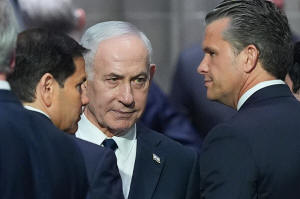
Israeli Prime Minister Benjamin Netanyahu, center, speaks to
Secretary of Defense Pete Hegseth, right, and Secretary of State
Marco Rubio, left, before the funeral of Sen. Lindsey Graham, R-S.C.,
Tuesday July 28, 2026, at the Washington National Cathedral in
Washington. (AP Photo/Jacquelyn Martin)

Yet, Israeli officials also have privately expressed concern that
Trump, with midterm elections looming, is trying to “keep this war
on a low flame,” according to a person familiar with Netanyahu's
government’s internal deliberations. The person and the Israeli
official were not authorized to comment and spoke on the condition
of anonymity.
The person added that Israeli officials have become increasingly
concerned about Trump’s sensitivity to surging oil prices as the
Strait of Hormuz remains effectively closed to global energy
shipments and about the growing trepidation among some in the U.S.
administration about the burn rate of critical missile interceptors.
The recent fighting with Iran used up more of the U.S. military’s
already diminished stockpiles of Patriot and THAAD interceptors,
potentially putting American troops at more risk if hostilities
resume, according to an analysis released this week from the Center
for Strategic and International Studies, a Washington think tank.
Gen. Dan Caine, chairman of the Joint Chiefs of Staff, has told
Trump that the state of the munitions stockpile could have an impact
on military operations in Iran, according to another U.S. official.
The official, who spoke on condition of anonymity to discuss
sensitive conversations, said the message was delivered as part of
Caine’s regular duties of providing military advice and options to
Trump.
A history of failed diplomacy plagues US-Iran prospects
The Trump administration does not seem to have a strategy to resume
negotiations with Iran over ending the conflict.
Despite efforts by some mediators to get talks restarted — or at
least find a point at which they could begin again — the
administration is not actively pursuing talks at the moment, a
senior U.S. official said.
The official, who spoke on condition of anonymity to discuss
internal deliberations, said the latest developments in the region
suggested that any resumption in direct diplomacy was not imminent.

Analysts called the uncertainty and lack of strategy a result of
deep, growing mistrust between Washington and Tehran, especially
after an interim ceasefire proposal signed in mid-June collapsed in
recent weeks.
Ali Vaez, Iran project director at the International Crisis Group,
said senior Iranian officials were nearly unanimous in their
decision to approve that memorandum of understanding with the U.S.
“But now none of them believe that Trump is a reliable negotiating
partner,” he said. "The problem, I think, is that Trump also has now
the same impression about the Iranians."
In some respects, the on-again, off-again nature of talks and
back-and-forth military attacks should not be surprising.
The history of U.S. negotiations with Iran after 1979 is littered
with failure, false starts and stops, and military actions that have
nonetheless stopped short of the kind of conflict the two countries
are now in.
Despite its flaws, the 2015 nuclear deal with Iran secured by the
Obama administration was the first major agreement between the two
countries since the Algiers Accords in 1981 that ended the American
hostage crisis and laid a patchwork path for the resolution of other
issues, including the unfreezing of Shah-era Iranian assets seized
by the U.S. after the Islamic Revolution.
However, even from the beginning, both sides accused each other of
violating the terms of these deals.
Accusations of violations of the Algiers Accords, which led to a
period of great animosity, including U.S. support for Saddam
Hussein’s Iraq during the 1980-88 Iran-Iraq war, became the norm.
Despite the semi-rapprochement around the 2015 nuclear deal, Trump’s
withdrawal from it in 2018 during his first term, his imposition of
a “maximum pressure” sanctions campaign against Tehran, and the U.S.
assassination of Iran’s top military leader Qassem Soleimani in
early 2020, sent the relationship to new lows.
___
Amiri reported from New York. Associated Press writer Ben Finley
contributed to this report.
All contents © copyright 2026 Associated Press. All rights reserved
 |