Deadly flooding in West Virginia finds prevention plans unaddressed
[July 30, 2026]
BY HENRY CULVYHOUSE/Mountain State Spotlight
At least two West Virginians are dead, dozens of homes are damaged and
communities across north central West Virginia are left picking up the
pieces in the wake of another major flood.
Just a decade ago, a massive flood prompted state officials to dive into
state coffers for relief money and set up an office dedicated to
softening the blow of future floods. But so far, little has been done.
The flood of 2016 affected a wider area of the state and took nearly two
dozen lives. Brendan Muckian-Bates, a policy advocate for the
Appalachian Flood Resilience Coalition, pointed to recent funding for
the state’s Flood Resiliency Office as a small step in the right
direction toward making strides in reducing the likelihood and impact of
flooding.
But he said more needs to done. And more needs to be studied regarding
the latest floods in north central West Virginia, particularly around
Lewis and Upshur counties, which bore the brunt of the storm.
“A lot of the helpful recommendations included in the State Resiliency
Plan are unfunded and act more as recommendations rather than policy,”
Muckian-Bates said.
The Flood Resiliency Office was the brainchild of the late House Speaker
Tim Armstead, whose own community was severely impacted by flooding in
2016. The purpose of the office was to update and oversee implementation
of a flood plan officials wrote in 2004 and left to collect dust on a
shelf.

Like the flood plan, the Flood Resiliency Office languished for nearly a
decade without its own dedicated funding. In 2025, after floods
devastated McDowell County, House Minority Leader Sean Hornbuckle,
D-Cabell, tried to force through a $50 million package from the state’s
Rainy Day Fund to fund the office.
The Republican Supermajority resoundingly rejected it.
But in the 2026 session, Hornbuckle, working with the Republicans, was
able to get $5 million for the office.
“We know that’s a drop in the bucket to speak to the issues that we have
from an infrastructure standpoint to be better prepared for these
emergencies,” Hornbuckle said. “It boils down to priority, right? Are we
prioritizing people? Floods don’t care if you’re red, if you’re blue, if
you’re straight, if you’re gay. They just don’t. And so, are we
prioritizing the people of West Virginia?”
Since officials penned the original flood mitigation plan, the threat of
flooding has increased in the state, as storms become more severe as a
result of climate change. Right now, a quarter of essential structures,
like fire stations, are at risk of flooding in the state.
Sen. Robbie Morris, R-Randolph, whose district includes Upshur County
said flooding will be a priority for him.
“There will be major debriefing meetings after this event is brought to
a close. Hopefully we can learn from any shortfalls that come in the
system and how we can fill those gaps and make the system better when
horrific events like this occur,” he said.
Del. Jeff Stephens, R-Marshall, sits on the Joint Flood Committee, which
consists of state senators and delegates. He said some measures to help
prevent floods include repairing and updating existing dams and levees,
constructing new dams and stream remediation, which consists of
different projects like cleaning out debris to keep water in the river
whenever it floods.
[to top of second column]
|
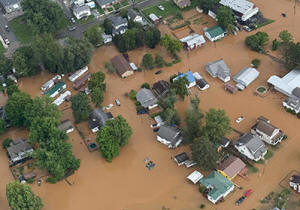
An Aerial view shows extensive flooding in Buckhannon, W.Va.,
Wednesday, July 22, 2026. (Office of West Virginia Gov. Patrick
Morrisey via AP)

“I know it’s a lot of man hours, and I know it’s a lot of money. But
let’s face it; I think it’s necessary,” he said.
And more money is something lawmakers have contemplated. Del. David
Green, R-McDowell, also sits on the flood committee. He said the
committee has looked at proposals to put up to 65% of surplus money
each year into flood resiliency.
In addition to the work outlined by Stephens, Green said he wants to
see the state implement an updated early warning system.
“I would push for us and West Virginia Emergency Management to get
serious research completed to find a workable system that would
actually produce results, get it funded, and get it installed post
haste,” he said.
Morris and Stephens said they would be open to a special session to
address the disaster, and flooding as a wider issue as well. Green
said he doesn’t believe a special session is required because the
governor has enough money in the Civil Contingent Fund to cover any
unforeseen costs.
“But I do feel that in the next session we must have flood
mitigation and recovery as a priority,” he said.
The spokesperson for Speaker of the House Roger Hanshaw, R-Clay, Ann
Ali said there has been no indication that a special session
regarding flooding would be called.
“I do not expect Speaker Hanshaw to press for any funding outside
the usual budget process,” she said.
The Governor’s Office didn’t return any request for comment
regarding a special session or additional funding needs for
flooding, nor did Senate President Randy Smith’s office.
This week, Gov. Patrick Morrisey publicly called on the Trump
Administration to expedite disaster relief and funding for
prevention.

In Washington, all four members of West Virginia’s Congressional
delegation signed on to a letter to President Trump and FEMA asking
for the same.
When flash floods took eight lives in the Wheeling area last year,
it took more than a month before the Trump administration declared a
disaster. The Trump Administration has reduced staff at FEMA,
further exacerbating a backlog in recovery from natural disasters
nationwide.
All contents © copyright 2026 Associated Press. All rights reserved |