Fauci repeatedly invokes the Fifth Amendment in a contentious Senate
committee hearing
[July 30, 2026]
By LAURAN NEERGAARD and ALI SWENSON
WASHINGTON (AP) — Dr. Anthony Fauci on Wednesday repeatedly invoked the
Fifth Amendment and declined to answer dozens of questions from senators
in a Republican-led committee hearing about his handling of the COVID-19
pandemic.
The decision, at least for now, shielded Fauci from answering questions
that could expose him to accusations of lying under oath. Though he
received a pardon in early 2025 from Democratic President Joe Biden,
some Republicans pursuing a yearslong campaign for his arrest had
suggested he could still face charges for any perjury committed during
Wednesday’s hearing.
The scientist, who helped lead the nation’s COVID-19 response, was
subpoenaed to testify under oath by Republican Sen. Rand Paul of
Kentucky, who has long had an antagonistic relationship with Fauci.
In response to angry, sometimes mocking questions from Republican
senators, Fauci declined to answer more than 100 times, injecting new
drama into partisan divides that have festered for years about the
origins and handling of the pandemic. Fauci himself has become a
polarizing figure, even receiving death threats that prompted him to
seek security.
In his opening statement, Fauci said Paul has an “obvious obsession with
calling for my prosecution.”
“The only conclusion I can reach is that the sole reason he is calling
me before this committee is to get me to say something, anything, that
could vindicate his repeated public pledges that I end up, in his words,
‘behind bars,'” Fauci said, adding that while it pained him to do so, he
was following his attorney’s advice by taking the Fifth.

Paul, who has long argued that Fauci should be criminally investigated,
based on his belief that the scientist was dishonest in previous
testimony to Congress, announced that the committee will vote next week
on whether to hold Fauci in contempt for declining to answer questions.
He did not say whether he would push for a criminal contempt referral to
federal prosecutors or another charge. He also raised questions about
whether Fauci’s pardon affects his eligibility for Fifth Amendment
protections.
Republicans accuse Fauci of lying while Democrats say he didn't
deserve that
In the combative hearing, Paul and other Republicans accused Fauci of
lying in earlier testimony about the coronavirus’ origins, something the
longtime National Institutes of Health scientist has forcefully denied.
Democrats called the hearing a politically motivated attempt at
entrapping Fauci and praised the scientist for his work during the
pandemic.
With Fauci declining to answer questions throughout, Paul dominated the
approximately three-hour hearing, listing a litany of accusations and
detailed questions.
“Today will be the capstone to Anthony Fauci's 40 years of abuse of
power at NIH,” Paul said. “History will judge, but the facts as we now
know them paint a sordid tale of dishonesty, misjudgment and ultimately
the hubris, the likes of which the world has never seen.”
In a heated moment during the hearing, Paul ejected Fauci’s attorney,
David Schertler, from the room after he tried to speak without being
recognized. In a statement, Schertler said the removal was “outrageous
and demonstrates the completely biased and baseless nature of this
proceeding.” In another statement, he called Paul’s accusations about
Fauci “false and disgraceful.”
Democratic senators praised Fauci and said he didn’t deserve the
treatment he was getting.
“This hearing is designed to entrap you,” said Sen. Maggie Hassan of New
Hampshire.
Paul released some of Fauci's diary
Leading up to the hearing, Paul released more than 1,000 pages of
Fauci’s personal diary covering the pandemic years. Pointing to some
notes about early efforts at understanding how the virus emerged, Paul
said on social media that what Fauci “wrote privately and what he told
the country are two different stories.”

[to top of second column]
|
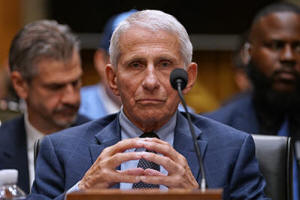
Dr. Anthony Fauci appears before the Senate Homeland Security and
Governmental Affairs Committee at the Capitol, Wednesday, July 29,
2026, in Washington. (AP Photo/Allison Robbert)

Some of the diary entries — including Fauci’s uncertainty in the
pandemic’s earliest days as scientists around the world raced to
understand the new virus and how best to curb it before vaccines could
be created — already were reflected in a 2024 memoir and in interviews
at the time.
But they have nonetheless drawn attention from people who blame Fauci
for mask mandates, school closures and other policies they believe
infringed on their rights as hundreds of thousands of people were dying.
President Donald Trump on Wednesday wrote on social media that he
stopped relying on Fauci over the course of the pandemic because he felt
the scientist made bad decisions about masks, shutdowns, and other
issues. He later told reporters he watched the entire hearing.
Health Secretary Robert F. Kennedy Jr., a longtime anti-vaccine activist
before entering public office, said on social media that his department
had found the diary entries on government property and had given them to
the committee.
Dozens of disease experts defend Fauci in letter
Scientists also scrambled to Fauci’s defense ahead of the unusual
hearing — the second time he has been back before Congress to discuss
pandemic origins since leaving the government in 2022. While the
COVID-19 pandemic introduced him to millions of Americans, he talked the
nation through numerous outbreaks over decades, including HIV, Ebola and
the 2001 anthrax attacks, while advising seven presidents.
In a public letter, more than 150 infectious-disease experts and other
scientists wrote that “no credible evidence has been produced to support
these absurd charges” and that they are urging elected officials to
“stop these witch-hunts.”
Among topics discussed at Wednesday's hearing was whether NIH-funded
research in China may have played a role in how the pandemic started.
Many scientists believe the virus most likely emerged in nature and
jumped from animals to people, coming to light when it spread at a
wildlife market in the Chinese city of Wuhan. There’s no new scientific
evidence supporting the theory that the virus might instead have leaked
from a laboratory, a theory Paul champions. A GOP-led subcommittee that
studied the question in 2024 found no evidence linking Fauci to
wrongdoing.

Fauci has long said publicly that he was open to both theories but that
there’s more evidence supporting COVID-19’s natural origins.
Republicans also have accused Fauci of lying about whether his agency
funded what's known as gain-of-function research — the practice of
enhancing a virus in a lab to study its potential real-world impact — at
a lab in Wuhan.
The NIH, for years, gave grants to a New York nonprofit called EcoHealth
Alliance, which used some of the funds to work with a Chinese lab
studying coronaviruses commonly carried by bats. But the definition of
gain-of-function covers both general research and especially risky
experiments that enhance the ability of potential pandemic viruses to
spread or cause severe disease in humans. Fauci has previously stressed
he was using the risky experiment definition and “it would be
molecularly impossible” for those bat virus experiments to have turned
into the pandemic virus.
Trump, a Republican, paused some federally funded gain-of-function
research last year, and on Tuesday his administration announced new
rules to tighten oversight.
___
Swenson reported from New York.
All contents © copyright 2026 Associated Press. All rights reserved |