Congo says the death toll in fastest-growing Ebola outbreak has passed
1,500
[July 31, 2026]
By PROSPER HERI NGORORA and MARK BANCHEREAU
BUNIA, Congo (AP) — Ebola has killed more than 1,500 people in eastern
Congo in the fastest-growing outbreak of the disease, data released
Thursday showed, marking a 50% increase in around a week as the
emergency continues to outpace response efforts.
As of Tuesday, 3,442 cases had been recorded, with 1,521 deaths,
according to the latest government update. The sharp rise since last
week partly reflects a backlog of cases and deaths that had not yet been
confirmed or recorded, the Africa Centers for Disease Control and
Prevention said Thursday.
The outbreak, declared on May 15, has been linked to the Bundibugyo
virus for which there are no approved vaccines or treatments. Delays in
contact tracing, difficulties accessing affected areas, mistrust from
communities and violence by armed groups and some residents have
hampered the response, the Africa CDC said.
The outbreak is mostly concentrated in eastern Congo’s remote Ituri
province, which accounts for nearly 90% of cases, but there have been
others confirmed in five provinces, including one of the country’s
largest cities, Kisangani.
Neighboring Uganda declared itself free of Ebola on Tuesday following
the discharge of the country’s last patient in mid-June.
Ebola is rare, but highly contagious and can be contracted via bodily
fluids such as vomit, blood or semen. The disease it causes is severe
and often fatal.

Africa CDC Director-General Dr. Jean Kaseya said Thursday that 63% of
confirmed deaths in the last two weeks occurred outside of treatment
centers.
Kaseya said this is largely due to the “unsafe handling of infected
bodies” by residents. Traditional burial practices in some communities
involve touching the bodies of the deceased, which can be highly
contagious.
The restrictions that health authorities have placed on such funerals,
along with widespread misinformation asserting that the deadly virus
isn’t real, have angered some residents and led to attacks on health
facilities.
In Ituri’s Nyakunde health zone, international partners supporting the
Ebola response had to temporarily relocate after a July 15 attack on a
hospital and a treatment center, sparked by a patient’s death.
Officials say the relocation of these partners, including Africa CDC and
Mercy Corps, has disrupted surveillance, contact tracing and supplies.
[to top of second column]
|
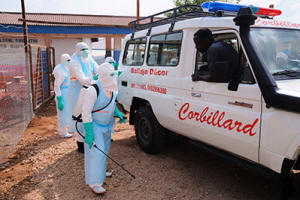
Health workers disinfects an ambulance at Ebola Treatment Center at
Bunia General Hospital in Ituri, Congo, Wednesday, July 22, 2026.
(AP Photo/Dirole Lotsima Dieudonne)
 Dr. Désiré Duabo, chief medical
officer for the health zone, said foreign aid groups and agencies
had provided much of the supplies, equipment and operational
support, and warned that the small stocks left are “almost
depleted.”
Attacks such as the one in Nyakunde are causing anxiety among health
workers and making it difficult for them to carry out their duties,
said Pierre Akilimali, the Ebola response incident manager at the
National Public Health Institute of the Democratic Republic of the
Congo.
“They are working amidst risks of infection as well as risks to
their personal safety,” he said.
Local health officials say security has since stabilized and are
urging partners to return, with Africa CDC saying teams could
redeploy as soon as next week.
The latest outbreak has killed more people at a quicker rate than
any previous outbreak, including in 2014-2016 when 28,000 cases were
reported, of which over 11,000 people died. That outbreak took about
eight months to reach 1,000 deaths.
The World Health Organization says the global risk of spread remains
low because Ebola does not travel through the air, making it much
harder to spread than respiratory viruses. Cases detected outside
the affected region have so far been quickly identified and
contained without leading to sustained transmission, the agency
said.
In Congo, however, the risk of the spread remains “very high,”
according to the WHO.
——
Banchereau reported from Dakar, Senegal.
All contents © copyright 2026 Associated Press. All rights reserved
 |