Berkshire Hathaway buys homebuilder Taylor Morrison and then invests
$10B in Alphabet under new CEO
[June 02, 2026] By
JOSH FUNK
OMAHA, Neb. (AP) — Berkshire Hathaway 's new CEO Greg Abel started off
the week with a $6.8 billion acquisition of homebuilder Taylor Morrison
and then followed that up Monday with a $10 billion stock investment in
Google's parent company.
Abel also hinted that he may depart from Warren Buffett 's longtime
hands-off operating model by consolidating Taylor Morrison with
Berkshire's existing site-built homebuilding operations that are part of
its Clayton Homes subsidiary. For six decades under Buffett, Berkshire
promised to largely leave companies alone after it acquired them and
allow the executives to keep running the day-to-day operations the same
way.
“Over time, we expect to unify our site-built homebuilding operations
into a combined platform,” Abel said in a statement about his first big
acquisition on Sunday, “enabling us to deliver the dream of
homeownership to more Americans.”
In addition to Clayton, which specializes in manufactured homes but also
has a site-built unit, Berkshire owns several other housing related
businesses including Benjamin Moore paint and Shaw Floors.
Berkshire's new investment in Alphabet will expand the stake that
Buffett's company started to build last fall. By the end of March,
Berkshire's Alphabet investment had tripled to include nearly 58 million
Alphabet shares worth almost $17 billion.

Alphabet said Monday that Berkshire has agreed to buy $5 billion of
Class A common stock and another $5 billion of Class C stock as part of
a broader plan to raise $80 billion to pay for the computing
infrastructure needed to power its AI offerings.
It's not clear how much consolidating Abel might do among the dozens of
companies Berkshire owns. Those holdings include an assortment of
insurers like Geico, major manufacturers such as Precision Castparts and
a slew of retail and service companies like NetJets, Dairy Queen and
Helzberg Diamonds. But Abel is known as a much more active manager than
Buffett ever was.
“Given Greg’s strength as an operator it will be interesting to see if
he does consolidate these units to get some greater scale and
efficiencies,” said CFRA Research analyst Cathy Seifert.
Abel has been overseeing all of Berkshire's non-insurance businesses
since 2018, and he hasn't made any major changes in operations though he
has encouraged the company's subsidiaries to cooperate more when it
makes sense. Abel became CEO in January, but Buffett remains chairman
and Berkshire's largest shareholder.
[to top of second column] |
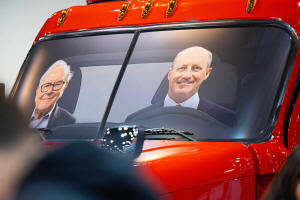
Portraits of Berkshire Hathaway's Warren Buffett, left, and CEO Greg
Abel sit in a semi truck at the Pilot display in the Berkshire
Hathaway annual meeting on May 2, 2026, in Omaha, Neb. (AP
Photo/Rebecca S. Gratz, file)
 “Under Greg, where it makes sense
for efficiencies or scale, we'll likely see more consolidation than
we saw under Buffett when Berkshire was smaller and the acquired
company's founders were still in place,” said investor Steven Check,
who is president of Check Capital Management.
Berkshire shareholders will likely be excited just to see Abel
making deals, given that the Omaha-based company is currently
sitting on nearly $400 billion cash. This deal by itself isn't
likely to make a meaningful impact on Berkshire's bottom line
because the conglomerate is so big, but dealmaking and investing are
the areas of Abel's resume that investors had the most questions
about.
Buffett praised Abel in an interview with CNBC on Monday morning.
“Greg did that faster than I could have done it, smoother than I
could have done it, and I never talked to the CEO. He has launched,”
Buffett told CNBC.
Abel has led acquisitions before while leading Berkshire's massive
utility division, but obviously Buffett would have signed off on
those. Now Abel is making the decisions with advice from Buffett and
the rest of the board.
“I think investors will cheer Greg’s foray into M&A as CEO. The
purchase price seems rich given the current interest rate/macro
environment,” Seifert said.
Berkshire agreed to pay Taylor Morrison investors $72.50 per share
in the all-cash deal. That represents a 24% premium over the
company's previous closing price of $58.50. Shares of the
Scottsdale, Arizona-based homebuilder jumped up near that purchase
price on Monday while Berkshire's shares slipped 1%.

But Raymond James analyst Buck Horne said in a research note that
it's possible Berkshire could face some competition from private
equity firms or other potential buyers who might be willing to pay
more for Taylor Morrison before its shareholders can vote on whether
to accept this offer.
“We would not be shocked if other players and/or private equity
began to sharpen their pencils before the ink on this agreement is
fully dry,” Horne said.
All contents © copyright 2026 Associated Press. All rights reserved |