Takeaways from Tuesday's primaries as Democrats try to make Iowa inroads
and defend California
[June 03, 2026]
By STEVEN SLOAN and STEVE PEOPLES
WASHINGTON (AP) — The contours of a premier U.S. Senate race took shape
Tuesday night in Iowa, while President Donald Trump’s endorsement streak
ran into a roadblock there.
Democrats chose a nominee for a U.S. House race in New Jersey that could
decide control of the chamber. But much of the focus is on California,
home to Hollywood but not a governor's race packing much star power.
Here are takeaways from primary elections in California, Iowa, Montana,
New Jersey, New Mexico and South Dakota.
Iowa Democrats rally behind former Paralympian in marquee Senate race
Democrats stunned by how Trump has remade American politics have spent
the past decade debating which type of candidate is best positioned to
energize voters and win elections, not moral victories.
Iowa marked the latest stop in this sometimes agonizing conversation.
The party’s establishment supported Josh Turek, a state representative
who presented a compelling personal biography that included competing
for the U.S. in four Paralympics. State Sen. Zach Wahls, meanwhile,
offered himself as a more disruptive player, refusing to back Chuck
Schumer as Democratic leader if he were elected.
Democratic voters united behind Turek, who will face Republican Ashley
Hinson in the fall.
At this point, many of the party’s most fractious races are behind them.
But Turek's win could be closely watched in Michigan, where one of the
last major Democratic primaries will unfold on Aug. 4. Rep. Haley
Stevens is emerging as the establishment candidate there vying against
state Sen. Mallory McMorrow and progressive Abdul El-Sayed.

Both races are important for Democrats increasingly bullish about
retaking the Senate majority in November. To get there, they must
protect their Michigan seat while looking for pickup opportunities in
places like Iowa.
The results in the fall could have longer-term implications as Democrats
look to rebuild their standing in the Midwest, which swung to Trump in
2024.
Trump's endorsement streak faces setback in Iowa
In just the past month, the power of Trump’s endorsement helped end the
political careers of two senators — John Cornyn of Texas and Bill
Cassidy of Louisiana — and Rep. Thomas Massie of Kentucky.
But the president was unable to lift Rep. Randy Feenstra to victory in
Iowa’s Republican primary for governor. Trump jumped in with his backing
last week but Feenstra narrowly lost to Zach Lahn.
The development is a rare setback for Trump, who basks in his ability to
sway the vote among Republicans with his endorsement. And it sets up
what Democrats see as one of their best opportunities to pick up a
governorship this year.
Democrats nominated Rob Sand, who ran unopposed in the primary. A native
of Decorah, Iowa, he has the rural roots that have become rare among
Democrats. Perhaps most importantly, he’s a proven winner in a
Republican-leaning state, having been elected twice as auditor.
Lahn was not well known in Iowa politics when he launched his campaign
in November, but he built support among conservatives. He championed
policies including a total ban on abortion and keeping liberal ideology
out of public school classrooms.
Lahn criticized Feenstra for not showing up to debate his primary
opponents and spending limited time on the campaign trail. He was
endorsed by former U.S. Rep. Steve King, who Feenstra unseated in the
2020 Republican congressional primary.

California’s dramatic race for governor drags on
The California governor’s race has been especially dramatic this year.
With Gov. Gavin Newsom barred from seeking a third term, about 60 names
were on the ballot to succeed him. None of them were the state’s most
prominent names, including former Vice President Kamala Harris and Sen.
Alex Padilla. One of the bold-faced names that did come forward, former
Rep. Eric Swalwell, withdrew after being accused of sexual assault,
which he denied.
For Californians dizzied by the twists, it will take a bit longer to
have clarity on their choices for governor.
Under the state’s primary system, all candidates appear on a single
ballot and the top two finishers advance to the November general
election, regardless of party.
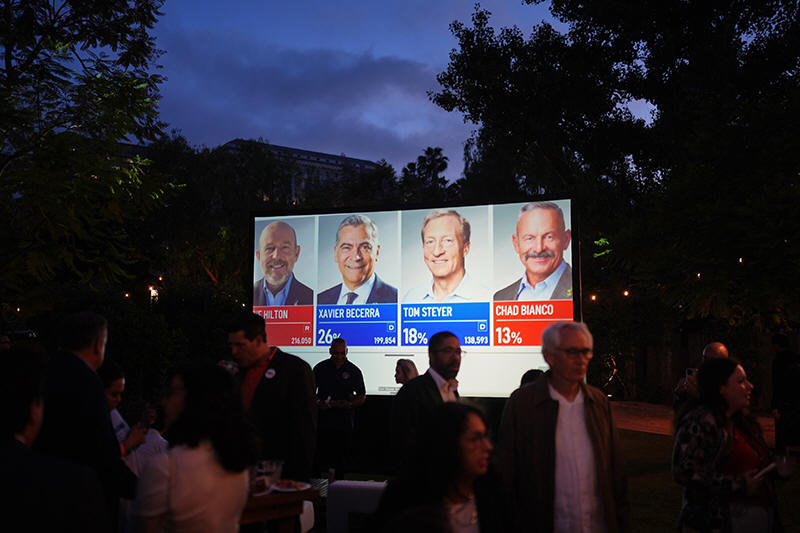
In the final days of the campaign, much of the attention focused on
Democrats Xavier Becerra, the former congressman and state attorney
general who was also health secretary under President Joe Biden, and Tom
Steyer, a billionaire known for his climate activism. Republican Steve
Hilton campaigned with Trump’s endorsement.
The three were leading in early returns after polls closed.
[to top of second column]
|

People watch results at an election night event for California
gubernatorial candidate Xavier Becerra, Tuesday, June 2, 2026, in
Los Angeles. (AP Photo/Jae C. Hong)

If Becerra were to advance to one of the two slots on the fall
ballot, he presents a natural choice for voters more comfortable
with a traditional candidate. Steyer and Hilton have both presented
themselves as significant change agents.
Governed by establishment-oriented Democrats for two decades, the
results will indicate the level of change that’s being sought in a
state that’s confronting serious challenges ranging from
affordability to crime. And it will signal whether the $200 million
Steyer put into the race from his own money turned out to be a good
investment.
Independents emerge in red-state Senate races
If Democrats hope to compete in red-state Senate contests this fall,
they may have to abandon their party’s nominees and rally around
independents.
That’s one of the takeaways after voters on Tuesday finalized
general election matchups in Montana and South Dakota, where
little-known Democrats earned their party’s nominations. In both
states, however, higher-profile independent candidates also
qualified for the general election ballot.
It’s much the same in Idaho and Nebraska, which held Senate
primaries last month. Democratic leaders in Nebraska are openly
endorsing independent Dan Osborne over their party’s nominee, who
has promised to drop out to make it easier for Osborne to win.
In Montana, independent Senate candidate Seth Bodnar, the former
University of Montana president, looks like the strongest opponent
to Republican Kurt Alme — on paper, at least. Bodnar raised more
money than all of the five Democratic primary candidates combined.
He’s even significantly outraised Trump-backed Alme.
In South Dakota, three-term incumbent Republican Mike Rounds cruised
to his party’s nomination Tuesday. He’ll face Democrat Julian
Beaudion, a former highway patrol trooper and small business owner,
on the November ballot. But it’s a former Democrat now running as an
independent, military veteran Brian Bengs, who some Democrats
believe may be the tougher challenger.
The Democrats shift toward independents reflects the party’s toxic
brand in Republican strongholds.
Absent congressman gets a Democratic challenger
One of the most closely watched U.S. House races is set.
Democrats nominated Rebecca Bennett to take on incumbent Republican
Rep. Tom Kean Jr. in New Jersey’s 7th congressional district.
The district, which stretches from the New York City suburbs to the
Pennsylvania border, is critical for Republicans as they defend a
narrow majority in Congress. The race was always going to be one of
the most competitive on a map that has been increasingly
gerrymandered to protect both parties. But it’s under particularly
close scrutiny because of Kean’s extended and unexplained medical
absence.
He's missed more than 100 votes since casting his last one on March
5.
Bennett, a former Navy pilot, was among the Democrats in the primary
who made the absence and the lack of clarity surrounding it an
issue, arguing Kean wasn’t around to protect money for a new rail
tunnel connecting New Jersey and New York City. That line of attack
will likely only grow heading into the general election.
Trump reiterated his endorsement of Kean on Monday. And the
congressman released a statement Tuesday saying he is “focused on my
recovery" and would return to “in person work within a matter of
weeks.”
New Mexico could make history in governor's race
The stage is set for Deb Haaland to make history this fall after the
former U.S. interior secretary secured the Democratic nomination for
governor in New Mexico.
Haaland, who served under Biden for four years, was the first Native
American to serve as a presidential cabinet secretary. And this
fall, the citizen of Laguna Pueblo could become the first Native
American woman elected governor of any U.S. state.
She defeated Albuquerque-based District Attorney Sam Bregman, the
father of Chicago Cubs All-Star Alex Bregman, in a Democratic
primary campaign that emphasized her ancestral roots in addition to
lowering costs and her governing experience.
Haaland will face Republican Greggory Hull in the general election.
___
Associated Press writer Hannah Fingerhut in Des Moines, Iowa
contributed to this report.
All contents © copyright 2026 Associated Press. All rights reserved |