House approves war powers resolution to halt military action against
Iran, in a rebuke of Trump
[June 04, 2026]
By LISA MASCARO
WASHINGTON (AP) — The House for the first time Wednesday approved a war
powers resolution that would halt the U.S. military action against Iran,
defying President Donald Trump as a handful of Republicans joined with
Democrats to end the three-month-long conflict that has reordered
politics at home and abroad.
House Speaker Mike Johnson had tried to prevent an outcome that would
show the mounting opposition to the war, abruptly shutting down floor
action two weeks ago when the resolution was on the verge of approval.
But displeasure has only grown as the conflict drags on and as Trump
struggles to negotiate a plan for peace.
“Enough is enough,” said Rep. Gregory Meeks of New York, the top
Democrat on the House Foreign Affairs Committee, who led the effort.
“It is time for the president to do the right thing," he said. “The
people are tired of suffering because of his war of choice — suffering
at the gas pump, suffering at the supermarkets.”
The roll call Wednesday was 215-208, but next steps are uncertain. Trump
would likely reject any measure from Congress to limit his
commander-in-chief authority. Still, the tally, with four Republicans
joining Democrats, was a rebuke of the president's war strategy, and
cheers erupted in the House chamber.
Opposition to war grows
It’s the fourth time the House has tried to curb the U.S. war against
Iran. The Senate advanced its own war powers resolution last month when
a handful of GOP senators broke ranks with the Republican president in a
rare show of political pushback from his party.
Each time Democrats have pushed forward the war powers resolution, the
vote tallies have inched higher as political unease with the U.S. war
swells. Trump had campaigned for the White House on a promise to end
U.S. entanglements abroad and focus more on domestic issues, but the war
has shifted attention back to the Middle East.
Johnson insisted Trump is “laser focused” on the domestic front,
particularly ahead of the midterm elections that will determine control
of Congress.
The speaker said he spent three hours at the White House with the
president this week and Trump is calling on allies to help reopen the
Strait of Hormuz and resume the flow of commerce.
Since the U.S. joined Israel in launching the Feb. 28 strikes on Iran,
Americans have seen gas prices spike at the pumps, adding to
inflationary pressure on consumer spending.

Iran has been able to interrupt shipping through the Strait of Hormuz, a
vital channel for a large segment of the world’s oil, natural gas and
related products such as fertilizer.
“We’re working on that final piece,” said Johnson, R-La. “The entire
world has an interest in the Strait of Hormuz being reopen for commerce.
That what he’s working on.”
While a ceasefire in the conflict was declared in April, it remains
uneasy and uncertain. Talks for a more durable end to the fighting have
dragged, increasingly complicated by Israel’s broadening war with
Iran-backed Hezbollah militants in Lebanon. Meanwhile, military strikes
between the U.S and Iran continue to flare.
[to top of second column]
|

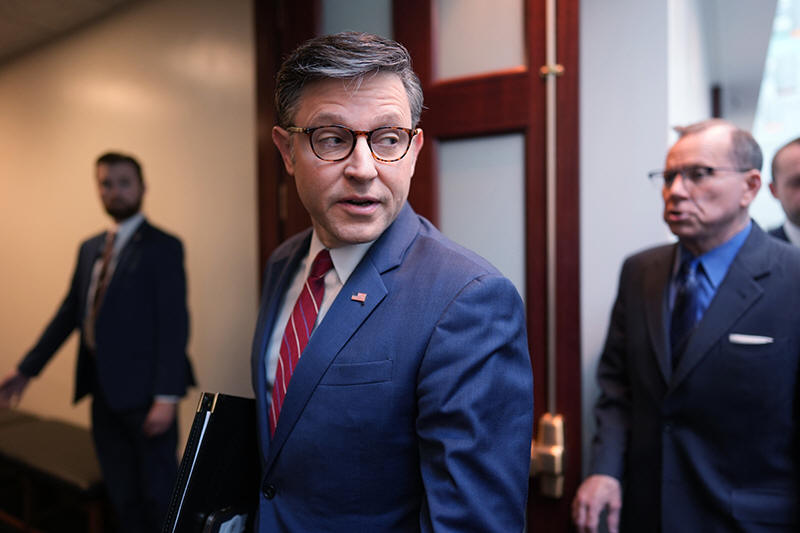
Speaker of the House Mike Johnson arrives for an early-morning
meeting with fellow Republicans at the Capitol in Washington,
Wednesday, June 3, 2026. (AP Photo/J. Scott Applewhite)

Congress exerts its war powers authority
The war powers resolution from the House would not immediately stop
the war, but it would provide a symbolic — if not legal — step
against further military action.
The resolution next goes to the Senate, where four Republican
senators last month joined Democrats in advancing a similar measure
to curtail the U.S. campaign against Iran. The Senate has yet to
take a final vote to approve or reject its own war powers
resolution.
Secretary of State Marco Rubio warned Wednesday at a House Foreign
Affairs Committee hearing that the Iranians would think that the
administration's “hands are going to be tied” if Congress approved a
war powers resolution. He said they would think ”we won’t be able to
do anything to them, so why make a deal?”
It's not the only action Congress is taking in the national security
arena as Democrats, in the minority, work to peel off Republican
support for measures beyond the war against Iran.
The House also voted Wednesday on another Democratic-led effort, a
procedural step toward a measure that would authorize U.S. support
for Ukraine's military operations as it battles Russia and would
help reconstruct the war-torn country. That vote is expected later
this week. The House also expected to consider a war powers
resolution to block U.S. action in Lebanon.
While Congress has the authority under the Constitution to declare
war, the president also has power as the commander in chief to
engage in military action, creating a legal dispute over which
branch of government has ultimate say in matters of war and peace.
If Senate joins the House to approve the resolution, it could set
the stage for a fresh legal test of war powers.
Under the war powers act, the White House has a 60-day window to
seek approval from Congress for military action. The administration,
however, has indicated that because a ceasefire has been declared in
the current conflict in Iran, the hostilities have ceased.
___
Associated Press writer Ben Finley contributed to this report.
All contents © copyright 2026 Associated Press. All rights reserved
 |