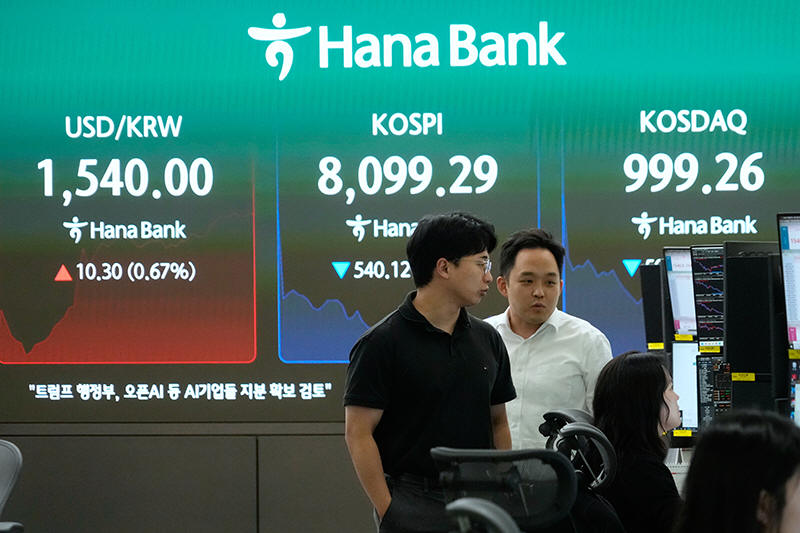
World shares mostly decline, with South Korea's Kospi down more than 5%
[June 05, 2026] By
CHAN HO-HIM
HONG KONG (AP) — World shares were mostly lower and South Korea’s
benchmark dropped more than 5% on Friday after sharp declines for some
big artificial intelligence-related stocks in the U.S.
U.S. futures were also trading mixed. The future for the S&P 500 lost
0.5%, while that for the Dow Jones Industrial Average edged 0.1% higher.
In early European trading, Britain’s FTSE 100 gained 0.3% to 10,389.74.
Germany’s DAX was nearly unchanged at 24,950.24, while France’s CAC 40
gained 0.3% to 8,269.98.
On Wall Street on Thursday, computer chipmaker Broadcom’s shares sank
12.6% when it gave a forecast that fell short of investors’
expectations, raising concerns over the wider AI and technology sector.
U.S. memory chip maker Micron Technology dropped 7.7%, and cybersecurity
company CrowdStrike Holdings fell 3.8%.
The sell-offs led investors in Asia to dump AI-related shares.
South Korea's Kospi sank 5.5% to 8,160.59. The index has roughly doubled
in the past year, lifted by gains for big tech companies like SK Hynix,
which lost 9.9%, and Samsung Electronics, which shed 6.4%.
Japan's Nikkei 225 slipped 1.3% to 66,588.12, with technology shares
leading the decline, even as official data showed that Japan’s real
wages rose for the fourth straight month. Chip equipment maker Tokyo
Electron's shares fell 6.6%.

Hong Kong’s Hang Seng declined 1.2% to 24,961.95, while the Shanghai
Composite index lost 0.7% to 4,027.74.
Australia’s S&P/ASX 200 fell 0.7% to 8,625.10.
Taiwan’s Taiex gave up 1.3%, while India’s Sensex was down 0.3%.
Oil prices continued to fall. Brent crude, the international standard,
gave up 0.8% to $94.23 per barrel. It was approximately $70 per barrel
before the war began in late February.
Benchmark U.S. crude dropped 1.1% to $92.04 a barrel.
On Thursday, the benchmark S&P 500 climbed 0.4% and the Dow Jones
Industrial Average gained 1.7% to a record. The tech-heavy Nasdaq
composite edged 0.1% lower.
[to top of second column] |
Currency traders watch monitors near a screen showing the Korea
Composite Stock Price Index (KOSPI) and the foreign exchange rate
between U.S. dollar and South Korean won at the foreign exchange
dealing room of the Hana Bank headquarters in Seoul, South Korea,
Friday, June 5, 2026. (AP Photo/Ahn Young-joon)
 Strong corporate earnings and
excitement about AI demand have helped push U.S. stocks and some
other markets to new heights, despite repeated jolts from the Iran
war. Oil prices are still under pressure as the Strait of Hormuz, a
narrow waterway crucial for global oil and natural gas transport,
remains effectively closed, and the war-caused energy shock is
threatening to slow economic growth and fuel inflation in many
countries.
American and Iranian negotiators reached a tentative deal last week
to extend their ceasefire, but the agreement has not been finalized,
as meanwhile developments in Lebanon have cast doubt on prospects
for a permanent end to the conflict.
On Thursday, the Iran-backed Lebanese militant group Hezbollah
rejected the latest ceasefire agreement between the Lebanese and
Israel governments.
“While there are few signs of progress in US-Iran talks, the oil
market continues to trade on expectations of an imminent deal that
would resume flows through the Strait of Hormuz,” ING commodities
strategists Warren Patterson and Ewa Manthey wrote in a report.
Hopes regarding the U.S.-Iran negotiations may have been “overly
optimistic,” they said.
In other dealings early Friday, the U.S. dollar fell to 159.94
Japanese yen from 160.03 yen. The euro was trading at $1.1638, up
from $1.1610.
All contents © copyright 2026 Associated Press. All rights reserved
 |