Trump’s troop reversals in Europe could cost millions and have left
soldiers in limbo, officials say
[June 06, 2026]
By EMMA BURROWS, BEN FINLEY and KONSTANTIN TOROPIN
WASHINGTON (AP) — The U.S. military is waiting for clarity from the
Pentagon following President Donald Trump's back-and-forth on troop
levels in Europe, upending the lives of military personnel and
potentially costing taxpayers millions of dollars, two U.S. defense
officials told The Associated Press.
NATO allies were bewildered in May when Trump said he would send 5,000
U.S. troops to Poland just weeks after ordering the same number pulled
from Europe, following a spat with Germany's Chancellor Friedrich Merz
over the Iran war. The Trump administration says troop reductions in
Europe have long been planned and coordinated with allies.
The Republican president announced on social media two weeks ago that he
was sending troops to Poland — the same day the Pentagon had officially
ordered the cancellation of a rotation of soldiers heading there, one of
the defense officials said.
The unit's equipment was already on the way. Sending it cost the
military $32 million, said U.S. Transportation Command, the military
agency largely responsible for moving troops and gear across the globe.
The abrupt changes are forcing the military to “retroactively engineer”
a policy in line with the president’s latest pronouncement, the official
said. Both officials were briefed on the decisions and, along with
others, spoke on the condition of anonymity to discuss sensitive
military matters.
The uncertainty is not only rattling European allies worried about the
message being sent to Russia, but it also risks hurting morale among
American troops — some of whom had their rotations canceled shortly
before departure — and comes as the Army budget is already strained.
Changes to troop deployments to Poland add up
The rotational deployment to Poland of 4,000 troops from the Army’s 2nd
Armored Brigade Combat Team, 1st Cavalry Division, based in Fort Hood,
Texas, was canceled in a memo sent to the military at the beginning of
May. European allies found out mid-month.
Some of those troops were told shortly before traveling not to get on a
flight to Poland, while those who had been sent ahead — initially around
1,000 troops — are still waiting for confirmation they are being sent
back, a U.S. military official said.
The military also is still waiting for details from the Pentagon on how
to satisfy Trump's order to send 5,000 troops to Poland, that official
said. The working assumption is that they will come from units already
in Europe, rather than an additional deployment from the U.S., the
official said.
U.S. Transportation Command had chartered a ship to take the team's
equipment from Texas to Poland and transport a departing unit's gear
back to America. The incoming team's portion of the cost was $32
million, including chartering the ship and loading and unloading the
gear.

Because the ship was chartered to take one unit to Europe and bring
another back, it is hard to say if that amount would have been saved had
the decision to halt the deployment been made before the new team had
already begun moving overseas.
However, the military official said the unscheduled move of personnel
and equipment back from Europe is most likely not a cost the Pentagon
budgeted for and would be an additional expense.
Total costs of canceling the rotation are hard to quantify because of
many factors, said Joe Costa, a former senior Pentagon official who now
focuses on challenges faced by the U.S. military as director of the
Atlantic Council’s Forward Defense program.
They most likely stem from returning equipment and troops sent ahead of
the deployment and would probably be on the low end of the rotation’s
overall cost, Costa said. The greater impact is on the readiness of
troops who were trained for one mission and may be deployed on another,
he said.
U.S. military contracts with private companies to transport troops and
equipment contain cancellation clauses that often add extra fees if a
deployment is called off, said John Deni, a senior nonresident fellow at
the Atlantic Council who has studied such costs.
“The question is what additional costs were incurred by deciding to send
them back prematurely, changing the arrangements, changing the plan?”
said Deni, a former U.S. military adviser and planner who focused on
forces in Europe.
It is not clear if the Pentagon can recoup those costs or those
associated with moving the unit to Europe. The Defense Department did
not answer questions about the costs of changing the deployment plans,
and the White House referred a request for comment to the department.
[to top of second column]
|

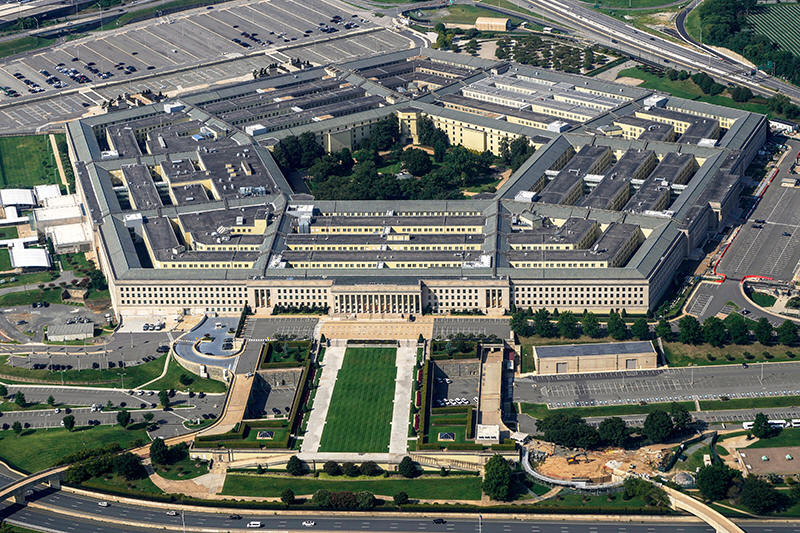
The Pentagon is viewed from the window of an airplane Aug. 27, 2023,
in Washington. (AP Photo/Carolyn Kaster, File)

Pentagon officials have repeatedly said they planned to lower troop
levels to have Europe shoulder more of its own defense and that the
decision was part of a “comprehensive, multilayered process.”
Last month's memo also led to the cancellation of a deployment to
Germany of a battalion trained in firing long-range rockets and
missiles.
Pulling troops stationed in Germany would be more expensive
When Trump first threatened to remove 5,000 troops from Europe,
Pentagon officials initially suggested pulling back the 2nd Cavalry
Regiment, which is based permanently in Germany, the defense
official said.
Instead, officials decided to cancel the rotation of the other unit
to Poland. Then Trump threw that plan into confusion as well.
Pulling the troops stationed in Germany could cost in the low
billions because there is no dedicated space and infrastructure in
the U.S. to accommodate them and their families, Costa said.

“The other option is basically breaking up the unit,” Costa said.
“They move the equipment in different places. They move the people
to different places. That carries significant readiness costs
because now you’re artificially jamming pieces of units into places
where they don’t necessarily belong.”
Pulling or pausing deployments also can hurt morale among soldiers
and families because they plan for them months and years in advance,
Deni said. The uncertainty can be disruptive.
"That’s often the last thing you want to do to military families,”
Deni said.
It is still unclear what will happen to U.S. troops stationed in
Europe, the two officials said. Options include moving military
units assigned to Germany to Poland, but that could take several
years and cost more, the military official said.
Troop changes happen during an Army budget shortfall
The moves come as the Army is facing a budget shortfall, which the
service's top uniformed officer, Gen. Christopher LaNeve, recently
acknowledged to Congress.
Estimates put the deficit somewhere between $2 billion and $6
billion, according to an Army official who also spoke on condition
of anonymity to discuss sensitive defense matters. One impact has
been cutting training courses for soldiers nationwide, which ABC
News earlier reported.
In a statement, the Army said it has issued guidance to its commands
to “make tough and sound resource decisions that optimize and
prioritize resources toward their most critical requirements, to
include major training and readiness events.”
The Army official also noted that the service has been tasked with
missions like the National Guard deployment in Washington, a
bolstered presence along the U.S.-Mexico border and its part in the
Iran war — all of which have strained its budget.
The Department of Homeland Security expects to reimburse the Army
for its role in the border mission.
Army Secretary Dan Driscoll told lawmakers at a May 15 hearing that
he was “optimistic” there would progress on those payments “within a
week or two.” But to date, the Army has not been reimbursed.
“We want those backfilled payments," Driscoll said then.
The U.S. military in Europe also is scaling back support for
non-combat related training and ruthlessly prioritizing critical
functions, the military official said.
___
Burrows reported from London.
All contents © copyright 2026 Associated Press. All rights reserved
 |