As Ukraine fights off Russia's invasion, some regions see a rise in
premature births
[June 08, 2026]
By SAMYA KULLAB
ZAPORIZHZHIA, Ukraine (AP) — When Marharyta Nekhoroshyva first saw her
newborn son, she was gripped by fear. Born after just 26 weeks of
pregnancy, he weighed only 940 grams (2 pounds) and wore diapers no
larger than the palm of an adult hand.
“The doctors told me that if he survived the first three days,
everything would be OK,” she said, tears filling her eyes. “I don’t
believe in God, but I was praying.”
Now 9 months old, Mark is energetic and lively, but he has chronic
breathing problems and requires frequent hospital stays.
Nekhoroshyva must navigate her son’s illness while living under the
constant threat of attack in the Ukrainian city of Zaporizhzhia, where
hospitals board up their windows because blast waves from Russian
strikes routinely shatter glass. She is doing it alone while her husband
fights in the war.
A rising number of babies are being born prematurely — before 37 weeks
of pregnancy — in Ukraine, particularly in regions near the front lines,
where some areas have seen rates nearly double since the conflict
started with Russia's invasion in 2022.
Experts say the reasons for premature births are complex, but the
profound psychological and physical stress the war is inflicting on
pregnant mothers is contributing. The delicate work of keeping the
fragile newborns alive is made only more difficult by the conflict.
When their babies are at the main children's hospital in Zaporizhzhia,
Nekhoroshyva and other mothers descend with their children into the
shelter each night. In the narrow, dimly lit hallways, they rock and
soothe their infants to sleep.
Ukraine is seeing a rise in premature births
While fewer women in Ukraine are giving birth overall due to
displacement, emigration and other factors during the war, a growing
share of births are premature, according to data from the United Nations
and recent scientific studies.

In the southern region of Kherson, the preterm birth rate nearly doubled
from 5.4% in 2019 to 9.8% in 2025, according to the U.N. In the
Zaporizhzhia region, also in the south, it rose from 5.7% in 2019 to
7.6% in 2025. In Poltava, a region in northeastern Ukraine, the rate
rose from 7.7% to 9.8% over the same period.
The front line cuts through both the Kherson and Zaporizhzhia regions,
which frequently see attacks on residential areas. Poltava is some
distance away from the front but is frequently hit by aerial strikes.
The link between maternal stress and premature birth is complex, but a
growing body of research suggests that prolonged psychological strain
increases the risk of babies being born early, experts say. It may be
tied to an increased risk of infection, a known trigger for preterm
labor, said Dr. Andrew Weeks, a professor of international maternal
healthcare at the University of Liverpool.
“Premature birth is very affected by infection,” he said. “And if you
can’t get to a place where you can get appropriate diagnosis and
treatment early, then actually the chance of you going into premature
labor is higher.”
It’s not just premature births that are rising in Ukraine; emergency
cesarean sections and other complications are, too, said Isaac Hurskin,
spokesperson for the U.N. Population Fund.
“We’re seeing this real link between acute stress and birthing and
pregnancy-related complications,” he said.
Those complications could compound a demographic crisis. Ukraine’s
fertility rate has fallen to among the lowest in the world, dropping to
roughly one child per woman over the past three years — far below the
2.1 replacement rate, Hurskin said.
Premature babies need extensive care — and that's difficult during a
war
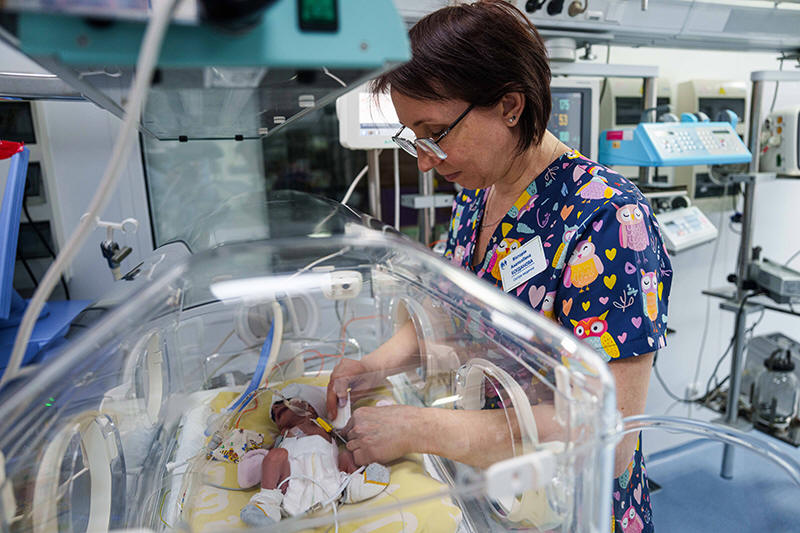
Inside an incubator in the intensive care unit at the maternity hospital
in the city of Zaporizhzhia lies a baby born at 30 weeks and weighing
only 700 grams (1 pound, 9 ounces) — well below the threshold of 2,500
grams (5 pounds, 8 ounces) that the World Health Organization classifies
as low birth weight.
Her tiny body is kept alive inside the temperature-controlled incubator.
IV lines deliver nutrients and medication, while a ventilator helps her
breathe. The incubator is draped with a blanket to protect her fragile,
developing eyes from the harsh fluorescent lights of the ward.
Treatment focuses on helping premature babies gain weight and eventually
breathe on their own, but complications can be extensive, said Dr.
Andrii Lobanov, head of the neonatal intensive care at Zaporizhzhia's
children's hospital. Oxygen levels, for instance, must be managed
precisely because of the risk of abnormal blood vessel growth in the
eyes, leading to blindness in severe cases.
[to top of second column]
|
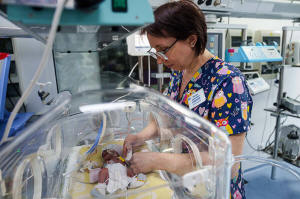
Nurse Victoria Bohdanova changes the diaper of a premature baby
inside a temperature-controlled incubator at the regional perinatal
center of Zaporizhzhia, Ukraine, Wednesday, May 6, 2026. (AP Photo/Evgeniy
Maloletka)
 Even after they leave intensive
care, children born prematurely often require long-term care —
possibly for life — for respiratory, neurological, developmental or
immune-related conditions.
That is a burden on cash-strapped countries like Ukraine.
“It is very expensive and of course a country in a war situation has
to decide what it’s going to spend on, so hospital services
invariably get hit. Both literally and metaphorically,” Weeks said.
Mothers must navigate caring for babies during the war and often
on their own
Air raid sirens have become part of daily life inside neonatal
intensive care units. When they sound, doctors stay beside the
babies rather than rushing them to shelters, knowing that moving the
fragile newborns could be even more dangerous. The sirens go off too
frequently to stop work each time anyway.
Dr. Nataliia Bohuslavska, head of the neonatal unit at the maternity
hospital in Zaporizhzhia, began one day last month with air raid
alerts warning of incoming missile attacks. By the afternoon, a
Russian glide bomb had struck a commercial area of the city, killing
at least 12 people.
Care continued all along: Doctors performed two cesarean sections
and delivered a baby while also treating a 42-year-old woman who
miscarried after witnessing an airstrike.
The next day, a black flag fluttered by the hospital entrance to
mourn those killed.
Bohuslavska knows every mother on her ward by first name — their
complicated cases, their fears, and their tiny babies fighting for
survival. Bohuslavska has worked at the hospital for 26 years and
was born there herself.
The war compounds the difficulties experienced by every pregnant
woman she cares for, she said.
“She wonders what kind of world her child will be born into, under
what conditions the birth will happen, and whether it will be a
moment of joy or one gripped by fear with shells exploding nearby,”
she said.
Many mothers endure the ordeal alone while their husbands are
fighting.
“When a patient calls to say her husband has been killed in the war,
the only thing I can tell her is: ‘Come to us. We will take care of
you,’” Bohuslavska said.
“We have to support her constantly, so that even in the midst of
this terrible loss, she can find the strength to give new life a
chance and save her baby.”
One baby goes home
For Mariia Skladan, it was finally time to go home.
Her daughter, Elina, was born in January at just 26 weeks, weighing
740 grams (1 pound, 10 ounces). Five months later, after growing to
a healthy 3 1/2 kilograms (nearly 8 pounds), doctors said she was
strong enough to be discharged.
Skladan has a rare liver disease that doctors warned would make it
nearly impossible for her to conceive. Her pregnancy was considered
a miracle, Bohuslavska said.
“If there’s a war, what does it mean? Not to live?” Skladan asked.
"You want to keep going."

When she and Elina emerged from the maternity hospital, her family
was waiting with flowers. Skladan broke down in tears of joy.
But the relief was short-lived.
The very next day, Elina was back in intensive care after
contracting a virus overnight.
___
Associated Press journalist Volodymyr Yurchuk contributed from Kyiv,
Ukraine.
All contents © copyright 2026 Associated Press. All rights reserved
 |