Highly effective prevention drug arrives in South Africa, which has
world's highest HIV burden
[June 09, 2026]
By MICHELLE GUMEDE
SECUNDA, South Africa (AP) — Growing up witnessing the devastating
effects of HIV in her family and community in South Africa pushed Olwam
Plaatjie to start using preventive HIV medications three years ago.
“Sometimes they’d lose weight, they would get sick and have to go to the
clinic, and I didn’t want that for me,” she told The Associated Press.
“I’d see the people I live with taking (antiretroviral) pills for HIV
every day, and I knew I wouldn’t be able to handle that life.”
The 19-year-old is one of thousands of South Africans who signed up for
clinical trials of lenacapavir, a highly effective, twice-yearly
injectable prevention drug that addresses the drawbacks of daily oral
prevention pills.
Despite night sweats and other side effects, she is continuing with the
medication after South Africa this month became one of the world's first
countries to introduce it.
President Cyril Ramaphosa told a stadium crowd at the launch of the
drug's rollout that lenacapavir is a “turning point” in South Africa,
which carries the highest burden of HIV globally.
But health advocates say the country deserves many more doses after
South Africa's central role in the work that brought the promising drug
to the world.

South Africa has doses for nearly a half-million people
South Africa has over 8 million people living with the virus. It is
hoped that lenacapavir will help curb new infections in the country,
which range from 140,000 to 170,000 annually.
“If South Africa can deliver it equitably and at scale, it could make a
meaningful contribution to reducing new HIV infections,” said Leila
Mansoor, a senior scientist at the University of KwaZulu-Natal’s Center
for the AIDS Program of Research in South Africa.
Clinical trials in South Africa and Uganda evaluated the efficacy of
lenacapavir, which was developed by Gilead Sciences. A crucial study in
Johannesburg concluded that a six-month injection demonstrated 100%
effectiveness in protecting against HIV.
“It was a groundbreaking finding,” said Dr. Nkosi Ndlovu, senior
clinician at the research institute Wits RHI.
Now South Africa's government has acquired doses sufficient to cover
456,000 people for a year, funded by a $29 million Global Fund grant.
After that, Health Minister Aaron Motsoaledi said South Africa aims to
fund its program independently, with help from donors.
Government hopes to reach 3 million people
Some South African civil society organizations, however, call the
rollout plan inadequate, asserting that at least 2 million doses per
year are necessary to significantly affect new infection rates.
Ramaphosa has vowed to reach 3 million South Africans over the next
three years, but hasn't given details.

[to top of second column]
|
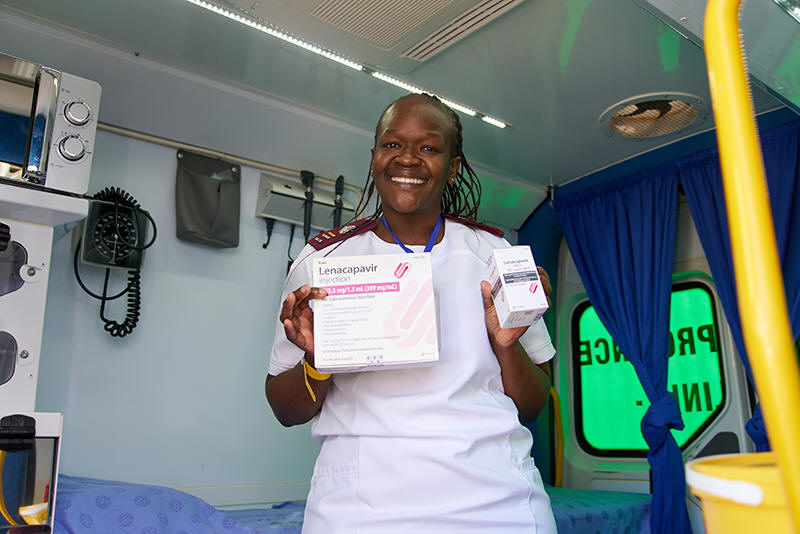
Thandeka Shabangu, a nurse, holds Lenacapavir before administering
it to a patient at a mobile clinic in Secunda, South Africa, Friday,
June 5, 2026. (AP Photo/Kayleen Morgan)
 There are concerns about access for
South Africans despite the country's contribution that made
lenacapavir possible, said Tian Johnson, health strategist for the
Johannesburg-based health advocacy group African Alliance.
“Our communities participated in the research, our clinics hosted
the trials and our scientists helped produce the data,” Johnson
said. “Yet we are still waiting for Gilead to determine how much of
the product we receive, when it arrives and how quickly access can
expand.’’
The health minister has said Gilead committed to granting a
voluntary manufacturing license to a South African company following
the granting of six licenses to other countries last year. That
allows cheaper generics to be made for lower-middle-income countries
for $40 per person annually, down from the original $28,000 price
tag.
The drug would be manufactured in South Africa after a committee is
established to identify the appropriate company, he said.
South Africa focuses on vulnerable groups first
The first batch of 37,920 doses is being distributed across 360
health facilities in six provinces that have high HIV rates.
South Africa is initially focusing on high-risk groups, including
injectable drug users, sex workers, transgender people, adolescent
women aged 15 to 24 and pregnant or nursing women.
But it can be difficult to reach them. Sweeping U.S. aid cuts by the
Trump administration forced many of their preferred locations for
receiving HIV care to close.
“Key populations, sex workers, people who use drugs, they don’t
normally use public clinics” because of challenges like long lines
and staff attitudes, said Bellinda Thibela, international policy and
advocacy coordinator for the Health Global Access Project.

“So it means that we’re going to lose them unless the government
acts fast and ensures that they put the resources to reach those
people,” Thibela said.
South Africa's health minister has said patients from the 12
U.S.-supported clinics that shut down were transferred to existing
government facilities, and efforts are underway to train staff and
create private spaces.
“What we have lost is that confidentiality, where they were going to
these clinics that are very special to them, where they feel very
safe,” Motsoaledi said. “So we are trying to train our doctors to
take over.”
All contents © copyright 2026 Associated Press. All rights reserved |