Trump administration warns over 500 hospitals to provide more price
information or face fines
[June 10, 2026]
By JOSH BOAK
WASHINGTON (AP) — The Trump administration has warned more than 500
hospitals that they are failing to provide the public with basic pricing
information — arguing that the lack of disclosure is keeping healthcare
costs higher than they should be.
The Associated Press obtained exclusively the list of hospitals that
since April have either received letters of warning or, in more severe
cases, requests to submit plans to provide transparent pricing. Failing
to comply with the warnings comes with penalties as high as $2 million
annually for each recipient that doesn't create a plan to post clear
pricing data.
The letters are meant to fix a fundamental problem that patients,
employers and insurers might not know ahead of time the cost of blood
work, an imaging test or another form of treatment, and as a result pay
more than they should have. The AP has posted the list of hospitals that
have received letters.
A senior administration official who requested anonymity to provide the
list said President Donald Trump plans to tighten enforcement of price
transparency standards made possible by a 2019 executive order signed by
Trump. More hospitals are likely to receive letters regarding the
absence of pricing data, the official said.
The warnings are the latest example of Trump leaning into the message
that his administration is fixing the problem of healthcare expenses
that can drain a family budget. It's a calculated pitch ahead of the
November midterms at a time when affordability is a top concern for
voters. But Trump is also vulnerable on this particular issue, as his
administration allowed subsidies to lapse for people buying insurance
through the 2010 Affordable Care Act, widely known as Obamacare.

Just 29% of U.S. adults approved of Trump's healthcare policies
according to the most recent survey on the issue by The Associated
Press-NORC Center for Public Affairs Research. The president fared
slightly worse on that issue in the December survey than on the economy,
immigration or his management of the federal government.
Data on healthcare prices can be confusing
Gary Claxton, senior vice president and the director of the program on
the healthcare marketplace at KFF, said the pricing data is more useful
for benefit consultants and others in the sector with access to
additional information than it would be for consumers. But he said the
standards in reporting pricing data can still create difficulty in
making accurate comparisons about the costs and quality of the services
being provided.
“There’s a pretty widespread belief that prices are more divergent than
they should be in a competitive market — and this is one way of trying
to understand that more," Claxton said. “It’s moving in the right
direction, but that doesn’t mean it has gotten to where it needs to be.”
The American Hospital Association said in a statement that its members
have long supported price transparency and the majority of hospitals are
complying with the federal requirements that went into effect this year.
Still, Ashley Thompson, senior vice president for policy at the
association, noted in the statement that “the current system is not
working as well as it could for patients” and that hospitals would
continue working with the administration to improve pricing information
and transparency.
The push for price transparency could have a particular impact on
Republican strongholds like Texas, Florida, Indiana, Alabama and
Louisiana, which are among the states with the highest count of
hospitals that have not provided adequate information on the costs of
medical services.
Texas had 42 hospitals that received warnings, more than any other
state. Baptist Medical Center in San Antonio, Texas, among the state's
largest hospitals with 1,585 beds, received a letter, as did the
University of Texas MD Anderson Cancer Center in Houston.
[to top of second column]
|
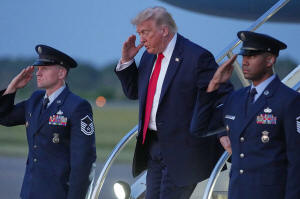
President Donald Trump arrives on Air Force One, Friday, June 5,
2026, at Morristown Airport in Morristown, N.J. (AP Photo/Mark
Schiefelbein)
 The University of Texas MD Anderson
Cancer Center said that after it received notice from the Centers
for Medicare & Medicaid Services, it found “a minor formatting issue
involving a date field” that was “quickly corrected.” The center
said the government accepted the updated documentation and there
“were no concerns regarding the integrity or completeness of the
data.”
Missouri-based Ascension, one of the country’s largest hospital
systems, had 13 hospitals in multiple states that received letters.
Ascension said the warning letters identified a “minor technical
error” and it's committed to giving patients “the information they
need to make informed decisions.”
The Republican state of Indiana had 34 hospitals that received
letters, nearly as many as the 38 in Democratic-led California, even
though California has five times more people than Indiana.
Administration officials interviewed for this article noted that
Christiana Hospital in former President Joe Biden's home state of
Delaware also received a warning letter.
Different approaches to tackling high costs
The letters reflect two competing philosophies between Republicans
and Democrats over how to handle the ballooning expense of
healthcare, which is also a growing risk for the federal
government's own balance sheet.
Biden's team put more emphasis on record enrollment in Obamacare
programs that increased the percentage of people with health
insurance. Biden also signed a bill that allowed the government to
begin negotiating prices for some Medicare drugs directly with
pharmaceutical companies. That program, which has continued into
Trump’s second administration, has helped knock down the list prices
of some of Medicare’s costliest drugs.
The Trump administration, by contrast, has focused more on trying to
find ways to provide details on pricing — such as promoting the
TrumpRx site for prescription drugs — betting that doing so will
lead to better and more efficient spending on healthcare as the data
gets crunched.
Critics have said Trump's negotiated prices on prescription drugs
might not produce genuine savings for many Americans with insurance,
while the administration has estimated savings in excess of $500
billion over 10 years.
With the various lists of hospital prices, the administration wants
providers to make it easier to access the files and to ensure the
information in them is legitimate, instead of being based on
estimates or omitting numbers for key procedures.

The House Committee on Energy and Commerce has a hearing planned for
Wednesday on price transparency.
“Transparency is the foundation of a healthcare system that rewards
competition based on cost and quality,” Shawn Gremminger, CEO of the
National Alliance of Healthcare Purchaser Coalitions, plans to say
in his prepared remarks.
All contents © copyright 2026 Associated Press. All rights reserved |