FDA OKs first new sunscreen ingredient in more than 25 years
[June 10, 2026]
By MATTHEW PERRONE
WASHINGTON (AP) — Federal health regulators on Tuesday signed off on the
first new sunscreen ingredient for the U.S. market in more than 25
years, giving Americans access to a skin-protecting chemical long used
in Europe and other parts of the world.
The Food and Drug Administration says the ingredient, bemotrizinol, met
the agency’s standards for protecting from dangerous ultraviolet rays
while causing little irritation or absorption into the skin. The
ingredient is safe for adults and children 6 months and older, the
agency stated in a release.
Bemotrizinol will initially be sold in the U.S. by the Dutch
manufacturer DSM Nutritional Products under the brand name Parsol
Shield, which is expected to launch later in the year. After an 18-month
exclusivity period, the ingredient will be available for use by other
manufacturers.
Efforts to introduce new sunscreen products have been bogged down for
decades by the FDA’s bureaucratic system for updating its lists of safe
nonprescription drug ingredients. Bemotrizinol is the first ingredient
to go through a streamlined process authorized by Congress in 2020.
Experts say bemotrizinol will fill an important niche in the U.S.
market: protecting against both ultraviolet A and B rays while not
leaving white streaks associated with mineral-based sunscreens.

"For decades, Americans have used outdated sunscreen tech while the rest
of the world moved forward,” said David Andrews of the Environmental
Working Group. “The approval of bemotrizinol will help change that.”
Andrews’ group has long pushed the FDA to tighten sunscreen standards
and allow new ingredients on the market.
Under FDA rules, all sunscreens must protect against UVB rays, which
cause most sunburn, as well as UVA rays that pose the greatest risk of
skin cancer and wrinkles.
[to top of second column]
|
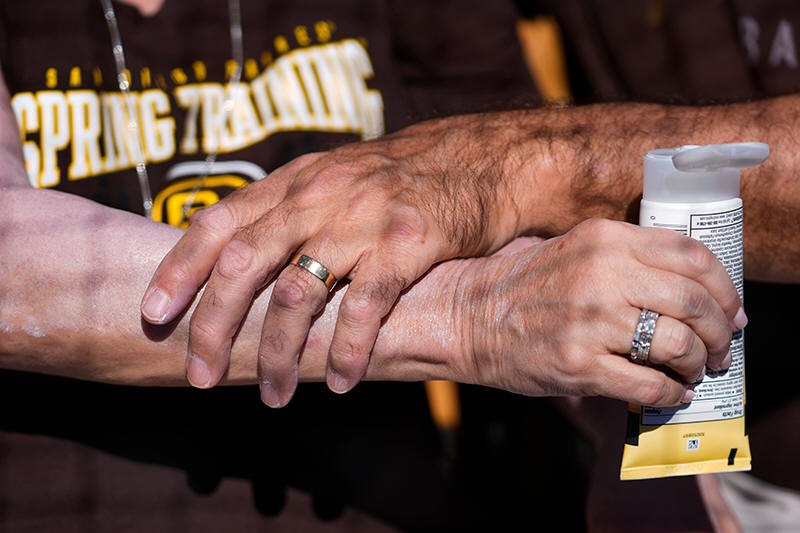
A man applies sunscreen to a woman's arm before a spring training
baseball game between the San Diego Padres and the Chicago White Sox
in Phoenix, Feb. 28, 2024. (AP Photo/Ashley Landis, File)
 Currently available
chemical-blocking ingredients only protect against one or the other.
Companies generally mix the chemicals in combination to achieve
“broad spectrum protection.”
Mineral-based ingredients, including zinc oxide, block both UVA and
UVB but leave a chalky white residue.
Bemotrizinol was authorized by European authorities in 1999 and
first filed with the FDA for review in 2005.
“The FDA is committed to ensuring the American consumer has access
to the most effective and safe therapies, including over-the-counter
products like sunscreens,” said Dr. Mike Davis, acting director of
FDA’s drug center.
The FDA has been gradually updating its standards for sunscreens. In
2011, the agency banned terms like “waterproof,” which regulators
said was misleading, and required that all sunscreens filter out UVA
and UVB rays. Previously some formulas only protected against UVB.
In 2021, the FDA proposed additional measures — including capping
SPF numbers and requiring stronger UVA protection — but those have
not been completed.
All contents © copyright 2026 Associated Press. All rights reserved |