Virginia Evans and Lyse Doucet win Women's Prize book awards
[June 12, 2026]
By JILL LAWLESS
LONDON (AP) — American novelist Virginia Evans won the Women’s Prize for
Fiction on Thursday with “The Correspondent,” a word-of-mouth bestseller
that made her a literary star after seven unpublished novels.
Canadian journalist Lyse Doucet won the Women’s Prize for Nonfiction
with “The Finest Hotel in Kabul: A People’s History of Afghanistan.”
Both prizes come with a 30,000 pound ($40,000) purse and are open to
female English-language writers from any country.
Evans wrote fiction for two decades before writing “The Correspondent"
during the COVID-19 pandemic, and it was released quietly in 2025. A
story told through years’ worth of letters from retired lawyer Sybil Van
Antwerp to friends, family and famous writers, it gradually climbed
bestseller lists and became a book club favorite. A film adaptation
starring Jane Fonda is in the works.
Former Australian Prime Minister Julia Gillard, who chaired the fiction
judging panel, said the novel “captured our hearts” by “elevating an
ordinary life in the most heartfelt of ways.”
Evans said she “developed a very thick skin for rejection and failure”
during the years of writing without getting published.
“Why did I keep going? I didn’t know how not to, I guess,” she told The
Associated Press.
“I was writing the book that I wanted to read,” she added. “I guess the
book that I was wanting to read was the book a lot of people were
wanting to read.”
She said “The Correspondent” is in part a cry against the loss of
handwritten letters — “the real tale of history” — in our digital age.
“If you want to know what happened somewhere, you need to read somebody
saying to their mom, ‘This is what happened to me today,'" she said.
"And so I feel a grief about that. There’s something I probably was
reaching for when I was writing the book, which was the preservation of
the memory of that.”
Doucet, the BBC’s chief international correspondent, profiles staff and
guests of Kabul’s once-glamorous Inter-Continental Hotel — scarred but
still standing — to provide a microcosm of Afghanistan’s turbulent
recent history.
[to top of second column]
|
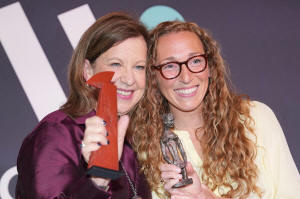
Virginia Evans, right, and Lyse Doucet winners of The Women's Prize
for fiction and nonfiction, left, pose for a photograph at the 2026
Women's Prize Trust Summer Party & Awards Ceremony in London,
Thursday, June 11, 2026. (AP Photo/Kin Cheung)
 Labour Party politician Thangam
Debbonaire, head of the nonfiction jury, called it “a perfect work
of narrative non-fiction” that is “informed by decades of excellent
reporting.”
Doucet, who has been visiting Afghanistan as a journalist since the
1980s, said she wrote the book to provide a fuller picture than the
“snapshot” of news coverage allows.
“My experience from decades of covering countries and people in the
hardest of times is that people still have to get up every day and
find an everyday courage to get through the day,” she said. "And
even in the darkest of places … people find humor to bring light,
they try to live with hope to bring some kind of relief and they try
to live with humanity.”
Previous winners of the fiction prize, founded in 1996, include
Zadie Smith, Tayari Jones and Barbara Kingsolver.
The sister prize for nonfiction was founded in 2024 to help redress
a gender imbalance in publishing. In 2022, only 26.5% of nonfiction
books reviewed in Britain’s newspapers were by women, and male
writers dominated established nonfiction writing prizes.
Last year’s nonfiction winner was British physician Rachel Clarke’s
account of an organ transplant, “The Story of a Heart.”
All contents © copyright 2026 Associated Press. All rights reserved |