Díaz-Canel announces economic reforms to attract investment and involve
Cubans abroad
[June 13, 2026] By
ANDREA RODRÍGUEZ
HAVANA (AP) — Cuban President Miguel Díaz-Canel on Friday announced a
package of economic reforms aimed at attracting investment, expanding
participation by Cubans living abroad in the economy and decentralizing
parts of the country’s administration.
The president did not provide details about the measures or a timetable
for their implementation but said during remarks to state media that it
is now “time to change” and that the country “simply cannot continue on
its current course.”
“Every opportunity in the midst of a crisis must be seized as a moment
for takeoff, as a moment for growth,” Díaz-Canel said, according to a
statement from the presidency that was republished by state-run media.
“We have established a group of priorities to confront this situation,”
he added without offering specifics.
The announcement comes as Cubans have struggled with fuel shortages as a
result of the U.S. oil blockade and food insecurity. In January, the
United States tightened restrictions on Cuba’s oil supplies in an effort
to pressure the island’s government to change its political and economic
model, exacerbating challenges that have persisted for about five years.
The U.S. State Department had no comment on the Díaz-Canel remarks and
referred to the statement released Thursday on the latest sanctions.
Díaz-Canel said officials are evaluating measures related to foreign
trade, exports, supply chains and logistics. Without elaborating, he
suggested the government could eliminate mandatory state intermediaries
in import and export operations and grant tariff benefits to those who
bring raw materials into the country for production.
“The numbers don’t add up, and the government wants to make this look
like a matter of will rather than a math problem,” Cuban economist Pedro
Monreal wrote on X, in response to Díaz-Canel’s proposals.
The Spain-based former UNESCO official went on to criticize the collapse
of a centralized planning model, for which he said “there are two
respectable alternatives: assume the political price of failure, or
self-critically rectify and drastically transform the model.”
For decades, Cuba maintained a centralized, vertical system under strict
state control. This structure began to shift gradually over the last
decade when the government introduced permits for independent workers.
More recently, the state authorized the operation of the country’s first
small- and medium-sized private enterprises.
[to top of second column] |
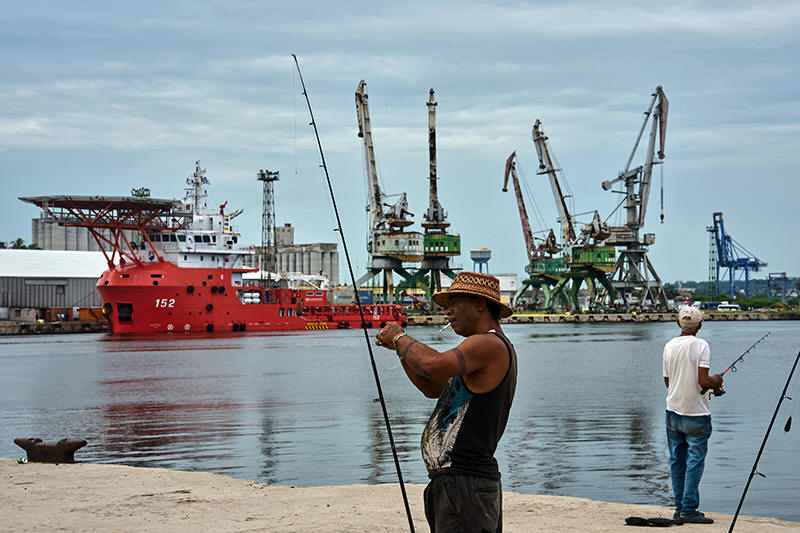
A fisherman prepares his fishing rod in front of the Colombian Navy
ship ARC Caribe, docked at a pier in Havana, Cuba, after arriving
with humanitarian aid, Friday, June 12, 2926. (AP Photo/Ramon
Espinosa)
Earlier Friday, a ship carrying
nearly 100 tons of food and essential goods arrived from Colombia as
part of the humanitarian aid that several countries have sent to
Cuba in recent months as a U.S. energy embargo persists.
The ship, which departed Cartagena in early June, crossed the Havana
Bay channel early in the morning flying the Colombian flag and
escorted by a small Cuban auxiliary vessel, The Associated Press
confirmed.
The Colombian Presidential Agency for International Cooperation said
that, on orders of President Gustavo Petro, the shipment included
nonperishable food, medicine, hospital supplies, electrical
materials, solar panels and other items.
The ship also carried seven tons of goods collected by solidarity
groups.
Last weekend, another ship carrying 1,700 tons of essential goods
from Mexico and Belize arrived in Havana.
In late January, U.S. President Donald Trump threatened tariffs on
any country that sells or provides oil to Cuba. The move has
deepened a preexisting crisis caused by U.S. sanctions. Washington
is pressing the Cuban government to release political prisoners and
move toward political and economic liberalization in return for a
lifting of sanctions.
Cuba produces only 40% of its oil, leaving the island semiparalyzed
and subjected to severe power outages.
___
AP Diplomatic Writer Matthew Lee contributed to this report from
Washington.
All contents © copyright 2026 Associated Press. All rights reserved |