Eager to work, teens find a frustrating summer job search
[June 18, 2026] By
MATT SEDENSKY
NEW YORK (AP) — Jaelyn Chester will wait your tables or stock your
shelves. She’ll wash your dishes or scrub your toilets. If only someone
would give the 17-year-old a chance.
“I’ve been looking everywhere,” says Chester, an A+ student, high school
basketball star and aspiring engineer who has blanketed her community
with dozens of applications. “I’m not unemployed because I’m
incompetent. I’m unemployed because nobody’s hiring.”
The summer job, a rite-of-passage for generations of American teenagers,
isn’t so easy to come by.
About one-third of 16- to 19-year-olds in the U.S. were employed last
summer, federal data show, down from a peak of about 60% in the late
1970s. Experts’ pessimistic forecasts are combining with reports from
frustrated jobless young people around the country to form a seasonal
outlook far from bathed in sunshine.
“The opportunities for workers at the start of the career ladder started
to dry up,” says Nicole Bachaud, an economist for ZipRecruiter, saying
teens are among the labor market's “most marginalized groups.”
Without a job, Chester worries her summer will be ruined. She wonders
how she’ll fill her tank with gas and what she’ll do if she wants to go
to a concert. A trip to look at colleges in North Carolina with some
friends would be destined to be canceled. So her hunt continues.
Chester keeps copies of her resume in her car and has a 30-second spiel
memorized when she decides to pop into a restaurant or store and try to
talk with a manager. She and her friends help ready one another when
they set out on their job hunt, trading tips and professional-looking
clothes from their closets. Positions that once sounded awful to her,
like dishwashing, no longer seem so.

“At this point,” says the teen from Lake Mary, Florida, “it would be
hard to say no to anything.”
Analyzing data from the U.S. Bureau of Labor Statistics, the
outplacement firm Challenger, Gray and Christmas found the number of
jobs secured by teens fell 25% last summer from the year prior. The firm
says inflation, oil prices and cautious hiring are likely to lead to
even fewer jobs this year, resulting in the lowest summer hiring total
for teens since the federal government began tracking it in 1948.
Teens most commonly work in food preparation and serving jobs and sales,
according to BLS data. But Jaune Little, director of recruiting services
at the human resources company Insperity, says some entry-level jobs
have been eliminated and teens now compete with more experienced
candidates for the remaining ones.
“A lot of the entry-level roles that once existed simply do not any
longer,” Little says. “Those that do exist are on leaner teams that have
less ability and desire to develop and train someone. In many instances,
they are prioritizing more skilled workers even if they are
overqualified.”

Max Stephenson began looking for a job last year after graduating from
high school. Nothing turned up all summer. Once she began at the
University of Arkansas-Pulaski Technical College, she got a work study
position in the cafeteria, still keeping an eye out for a more permanent
gig.
Now, school’s out again, and Stephenson is again jobless.
[to top of second column] |

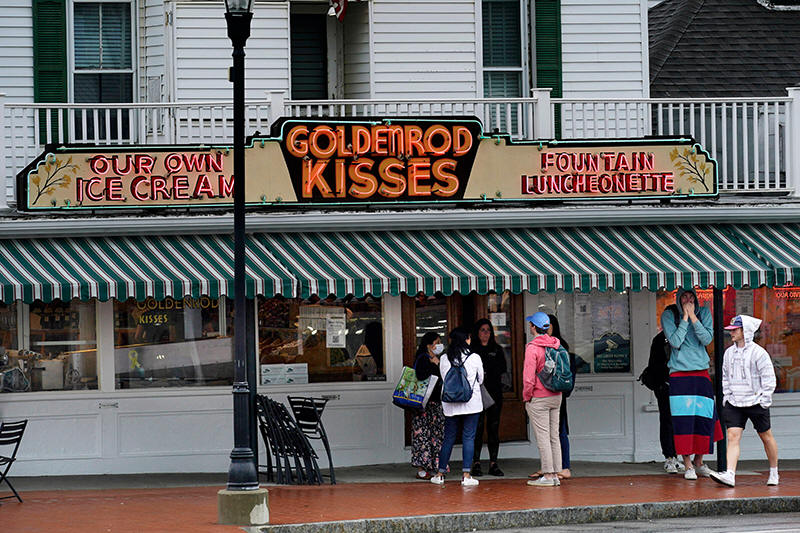
High school students gather outside The Goldenrod, a popular
restaurant and candy shop, Wednesday, June 1, 2022, in York Beach,
Maine. (AP Photo/Robert F. Bukaty, File)
 The 19-year-old from Little Rock,
Arkansas, lost track of how many jobs she’s applied for, but thinks
it’s somewhere between 50 and 100. She can’t help thinking it’s
tougher than previous generations had it to find work paying around
the minimum wage.
“I thought it would be much easier than it’s been,” Stephenson says.
“Old people say, ‘Just walk in there and give them a firm
handshake.’ That doesn’t work so well now.”
A 2022 report by Pew Research Center found summer employment of
teens fell during the early 2000s dot-com bubble, and dropped even
more during and after the Great Recession of 2007 to 2009. White
teens are more likely to have a job than teens from any other racial
group, Pew found.
Across demographics, though, teens are reporting difficult job
searches, taking to Reddit and TikTok with rants about phantom
postings, managers who ghost them and applications that go nowhere.
It’s a struggle Connor Vukelich knows well.
After he turned 16, he applied anywhere he could find in a 30-mile
radius of his home near Vancouver, Washington. No offers followed
and Vukelich’s friends were similarly coming up empty-handed.
“There’s all these ‘We’re Hiring’ signs but no one’s actually
hiring,” Vukelich says. “What’s going on? Why can’t any of us find
jobs?”
When his search turned fruitless, he ended up working on his
parents’ lavender farm. But the frustration of the experience led
Vukelich – who is now 20 and a student at Embry–Riddle Aeronautical
University – to launch Poppin’ Jobs, an employment search site
launched this year and aimed at teens and 20-somethings.
Vukelich believes artificial intelligence is robbing teens of some
potential jobs and that laws to boost the minimum wage in some
states have pitted first-time job-seekers against more experienced
candidates.
“They don’t see the value in hiring someone without any experience,”
he says of employers, “they’re not as willing to give someone that
shot.”
Some teen applicants find painful job searches eventually pay off.
Demie Njea, a 16-year-old from Lexington, Kentucky, started applying
for jobs once she turned 14, her state’s legal working age. A search
centered on fast food spots and stores turned to one that included
jobs as a janitor, daycare worker and more.
Nothing went anywhere the first summer. Or the second. Njea
estimates she applied for more than 100 jobs in all. She started
wondering if she’d ever get a first job.
Finally, an offer came and Njea started working at Sonic. She is
thrilled. But when a friend who turned 15 started applying for work,
Njea had to be honest.
“I had to calmly put her down and say, ‘You’re not going to get
it,’” Njea says. “It’s just not going to happen.”
All contents © copyright 2026 Associated Press. All rights reserved |