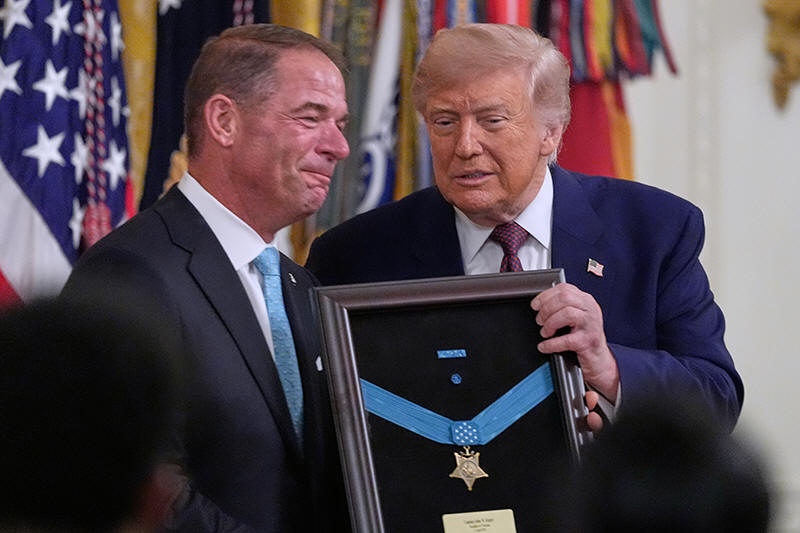
Trump presents the Medal of Honor to 3 veterans for heroism in Vietnam
and Afghanistan
[June 19, 2026]
By COLLIN BINKLEY and WILL WEISSERT
WASHINGTON (AP) — President Donald Trump gave the Medal of Honor to
three veterans on Thursday, honoring acts of heroism that saved lives
and repelled enemy forces in Vietnam and Afghanistan.
Trump bestowed the military's highest honor on Marine Corps Maj. James
Capers Jr. and Army Maj. Nicholas Dockery. He also awarded it
posthumously to Marine Corps Col. John W. Ripley, who died in 2008.
“These are great men, great people,” Trump said at the ceremony. “We
thank you and we will never, ever forget you.”
Capers led a selfless rescue after a deadly ambush
Capers, 88, was honored for risking his life to ensure the safety of his
fellow Marines after they were ambushed in Vietnam in 1967. What was
supposed to be a reconnaissance mission to find a suspected North
Vietnamese base camp turned into days of bloody fighting in dense
jungle, according to his citation.
On the fourth day, his team was ambushed and outnumbered by Vietnamese
fighters. A mine explosion left Capers with a broken leg and serious
wounds to his abdomen.
“After a shot of morphine, Jim asserted command of the firefight,” Trump
said, drawing on accounts of the mission. “He took over like nobody’s
ever seen before.”
Capers called in air support to repel the ambush. When a rescue
helicopter arrived, Capers loaded all the wounded men before climbing
aboard.
Trump shared a moving moment with Capers as the president pinned the
Medal of Honor around his neck, clasping Capers by the shoulders and
pulling him forward to make sure the medal was straight and level
against his chest. Capers had been keeping a straight face but broke
into a smile when Trump grinned.

Ripley single-handedly laid explosives to destroy key bridge
Ripley was honored for a heroic effort to halt the advance of North
Vietnamese forces by blowing up a crucial bridge in 1972.
A force of more than 30,000 North Vietnamese soldiers and 200 tanks was
approaching the bridge in the village of Dong Ha when Ripley
single-handedly placed 500 pounds of explosives to bring it down,
according to his citation.
[to top of second column]
|
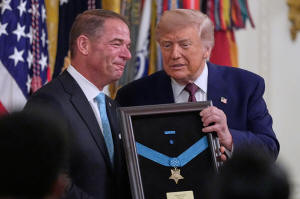
President Donald Trump stands with Tom Ripley, son of U.S. Marine
Corps Col. John W. Ripley, as he posthumously presents the Medal of
Honor during an East Room ceremony at the White House in Washington,
Thursday, June 18, 2026 in Washington. (AP Photo/Manuel Balce Ceneta)

Over the course of five hours, Ripley climbed back and forth along
the bridge's steel beams, exposing himself to enemy fire as he
placed the charges.
“John completed not one, not two, but five such trips,” Trump said,
calling him a “very strong guy.”
Ripley said a prayer, then detonated the bridge, sending it into the
water below and halting the North Vietnamese advance, Trump said.
Ripley died in 2008. His three sons and other family members
attended the ceremony.
Dockery rescued wounded soldiers before coordinating rescue
Dockery's platoon members were guarding a compound in Afghanistan's
Kapisa Province in 2012 when they were ambushed by an estimated 150
Taliban fighters. He raced across open ground to rally his scattered
team then set out to find missing soldiers, according to his
citation.
After carrying a wounded soldier away from gunfire, he spotted two
enemy fighters heading toward another wounded soldier in an alley.
Dockery killed the two fighters before performing CPR on the
American soldier to get him breathing again, his citation said.
Dockery called in mortar support, then shielded the wounded soldier
from the blasts with his own body.
After hours of fighting in the close urban setting, Dockery used
smoke grenades to signal enemy positions for American gunships. He
refused to leave the village until all the wounded soldiers were
taken to safety.
“You were the last man to depart the battlefield that day," Trump
told him, “and you left it a legend and a hero."
All contents © copyright 2026 Associated Press. All rights reserved |