Premier says China’s tech advancements an 'opportunity' for the world,
not a threat
[June 24, 2026] By
CHAN HO-HIM
HONG KONG (AP) — China’s Premier Li Qiang on Wednesday defended the
country’s technological advancements as an opportunity for the world
rather than a threat.
Li also said the country’s heavy state subsidies were not the main
reason for the rapid rise of its high-tech industries, at a time when
Western officials have complained that China’s state support for
industries from artificial intelligence to electric vehicles has
provided an unfair competitive edge.
China’s No. 2 leader made the remarks in his speech at the opening
plenary of the World Economic Forum’s Annual Meeting of the New
Champions, known as the “Summer Davos,” held this week in the
northeastern Chinese coastal city of Dalian.
He acknowledged there have been growing global concerns about China’s
technological innovations, with some pointing to the term “China Shock
2.0,” as they see the nation's high-tech boom as a threat to many
advanced economies.
Instead, that should be seen as “China Opportunity 2.0,” he said.
“From the global development perspective, ‘China Opportunity 2.0’ means
there’ll be broader access to advanced technologies and more widely
shared benefits,” Li said.

“China’s emerging technologies and products are bringing to the world
not shocks, but opportunities,” he added. “Not threats, but
empowerment.”
China’s tech advancements and growing exports of EVs, solar panels,
chips, batteries, AI and robotics have offered affordable options to
global markets, but have also raised criticisms among governments
concerned about issues such as oversupply. Some are taking protectionist
measures.
Li also dismissed claims that the rise of China’s high-tech sectors was
because of massive government subsidies.
U.S. and European policymakers have raised concerns over Chinese state
subsidies creating unfairness to their industries, while a June report
by the 38-country Organization for Economic Cooperation and Development,
or OECD, said huge state subsidies, including those in China, can
distort global markets and create unfair competitive advantages.
[to top of second column] |
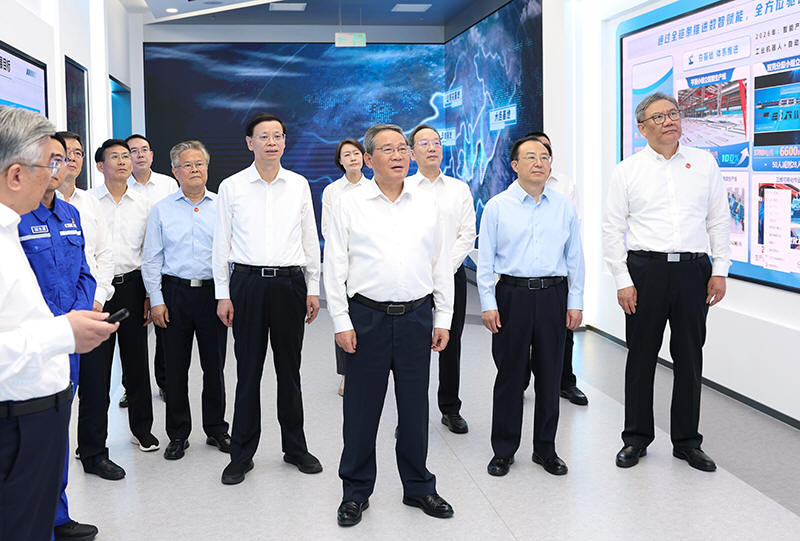
In this photo released by Xinhua News Agency, Chinese Premier Li
Qiang, center, listens to enterprise introduction and report on the
development of shipbuilding industry in Dalian at the Dalian
Shipbuilding Industry Co., Ltd. in Dalian, northeastern China's
Liaoning Province on Monday, June 22, 2026. (Huang Jingwen/Xinhua
via AP)
 “There are some people who say that
Chinese products are competitive mainly because the Chinese
government's subsidies,” Li said in his speech. “That’s not true.
The Chinese government is not that wealthy.”
China’s large domestic market, which allows the mass and fast
deployment of new technologies among its population of 1.4 billion,
and huge corporate investments are among the key factors in its
robust tech advancements, he said.
Li also name-checked Chinese tech giant Huawei, which has faced
Western restrictions, and robotics company Unitree, both of which
have risen quickly in size and market share, as examples of China’s
innovation success.
Beijing earlier voiced its opposition to an expansion this month of
the Pentagon's list of Chinese military-linked companies to Unitree
and other tech firms, preventing them from landing U.S. defense
contracts. The list also includes Huawei.
___
Associated Press video producer Wayne Zhang in Beijing contributed
to this report.
All contents © copyright 2026 Associated Press. All rights reserved
 |