Senate for first time approves a war powers resolution in a rebuke to
Trump over Iran conflict
[June 24, 2026]
By LISA MASCARO
WASHINGTON (AP) — The Senate for the first time approved a war powers
resolution Tuesday seeking to block U.S. military action against Iran,
as lawmakers warily watch President Donald Trump’s efforts to resolve a
conflict that the administration launched on its own and now needs
Congress to fund.
It was the 10th time the Senate has tried to stop the war, and the
outcome, on a vote of 50-48, was a stunning turnaround from past
efforts. While the resolution is largely symbolic, and does not carry
the full force of law, it reflects the growing concerns from a number of
Republican lawmakers in both the House and Senate over both the war and
the deal Trump struck with Iran to end it. The House approved the
resolution earlier this month.
Trump responded angrily Tuesday night on his Truth Social platform,
calling the vote “poorly timed and meaningless” and saying it "provided
aid and comfort" to Iran.
Senate Democratic Leader Chuck Schumer of New York said, “Time after
time, the vast majority of Senate Republicans sided with Trump and his
war instead of the American people.”
Schumer said Americans have paid the price for “Trump's historic blunder
in Iran. It'll go down in the history books as one of the worst foreign
policy forays America has ever made.”
In the past, as many as four GOP senators have voted for the war powers
resolutions, and they did so Tuesday — Republicans Lisa Murkowski of
Alaska, Susan Collins of Maine, Rand Paul of Kentucky and Bill Cassidy
of Louisiana. One Democrat, Sen. John Fetterman of Pennsylvania, voted
against.
Trump bashed the four Republicans as losers, saying, “These senators
have made my job more difficult.”

On this vote, the absence of two Republicans, including Sen. Mitch
McConnell of Kentucky, who was admitted to the hospital recently for an
undisclosed matter, left the GOP without a full majority to halt the
effort. Sen. Dave McCormick, R-Pa., also missed the vote.
The vote comes as the Pentagon is seeking $80 billion from Congress
mostly for the Iran war as it backfills munitions and stockpiles.
Trump to meet senators as Republicans balk at Iran deal
Trump himself is headed to the Capitol on Wednesday to meet with GOP
senators after Vice President JD Vance was overseas working to negotiate
with Iran to end its nuclear ambitions — which had been among the stated
rationales for the war.
The president is not pleased with the Republicans who have been critical
of the deal he struck with Iran, according to one GOP senator granted
anonymity to discuss the private dynamics.
The terms of the Iran deal are spelled out in a memorandum of
understanding that Trump signed last week, starting a 60-day clock for
the sides to reach a broader agreement over ending Iran's nuclear
program.
But Republicans have particularly objected to the $300 billion fund to
help Iran rebuild, which is far greater than the $1.7 billion
then-President Barack Obama refunded the country under his
administration's 2015 Iran deal.
"I believe President Trump is getting very poor advice on Iran," Sen.
Ted Cruz, R-Texas, said last week on his podcast after the deal was made
public.

[to top of second column]
|
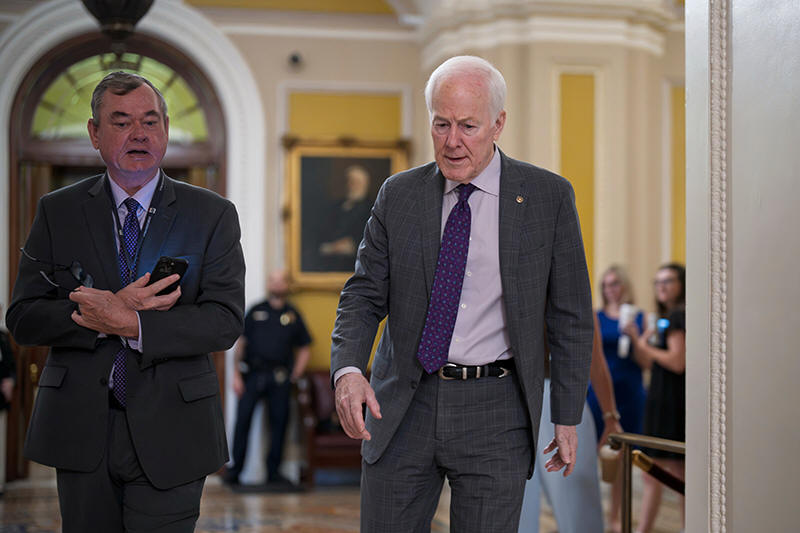
Sen. John Cornyn, R-Texas, arrives at the Capitol in Washington,
Tuesday, June 23, 2026, as Republicans prepare for a meeting with
President Donald Trump. (AP Photo/J. Scott Applewhite)

Democrats have repeatedly forced Iran votes
Over and again, Democrats have been forcing votes on the Iran war,
almost since the U.S. and Israel launched missile strikes on Iran on
Feb. 28.
Nearly each week they're in session, the Senate Democrats have put
forward war powers resolutions, but they have failed to amass the
majority needed for passage in the narrowly split chamber, where
Trump’s Republican Party holds the majority. Trump would almost
certainly veto any measure that passed.
The House pushed its own version to passage earlier this month, with
four Republicans joining all Democrats in approving the war powers
resolution, over the objections of House Speaker Mike Johnson and
the GOP leadership.
While the House- and Senate-passed resolution does not go to the
president for his signature, passage stands as a powerful, if
symbolic, statement from Congress and a rebuke of the
administration’s military actions.
Sen. Tim Kaine, the Democrat from Virginia who has led his party’s
efforts, said the pause in warfighting, as Trump’s team works to
shore up a fragile ceasefire, provides the perfect time for Congress
to step back and assess “what should the next chapter be.”
Hegseth seeks $80 billion from Congress for the Iran war
Defense Secretary Pete Hegseth is on Capitol Hill this week, seeking
roughly $80 billion in supplemental funding to shore up defense
supplies in the aftermath of the Iran war, which is drawing scrutiny
when many Americans are reeling from high gas prices and costs of
living.
The Pentagon early on had estimated the war cost $11.3 billion
during its first week, and senators said experts put the overall
price tag of Operation Epic Fury higher, at some $100 billion.
The Defense Department's funding request is part of a broader
beef-up of military money the White House wants as part of its
budget request this year.

House Democratic Leader Hakeem Jeffries said Tuesday, “We should not
spend another dime of taxpayer dollars on Operation Epic Failure."
The Trump administration is seeking $1.5 trillion in defense funding
this year — a nearly 50% increase — including $350 billion that it
wants in a so-called budget reconciliation package. Johnson and GOP
leaders are working to pass that package on their own, over the
objections of Democrats, much the way they approved Trump's big tax
cuts bill last year.
The 2025 tax cuts package also included a sizable increase for the
military.
All contents © copyright 2026 Associated Press. All rights reserved |