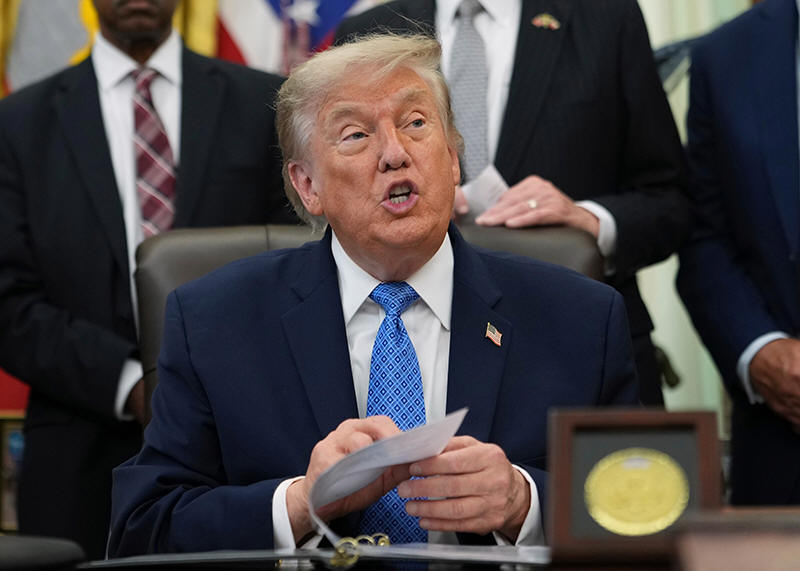
US strikes Iran in response to a drone attack on a ship
[June 27, 2026]
By COLLIN BINKLEY and JON GAMBRELL
WASHINGTON (AP) — The U.S. struck Iran on Friday in response to a drone
attack a day earlier on a cargo ship in the Strait of Hormuz. It's the
most significant test yet to an interim understanding reached a week ago
by the two countries to begin working to end their months-long war and
reopen the pivotal waterway.
U.S. President Donald Trump said the drone attack violated the
ceasefire. The strikes came shortly after Trump told reporters, “You’ll
find out,” whether the U.S. would respond.
U.S. Central Command said the military struck missile and drone
locations and coastal radar sites in Iran.
“I don’t like the fact that they took a shot yesterday, actually four of
them,” Trump said at the White House shortly before the U.S. struck
back. When asked why there would be strikes when Trump has insisted
talks with Tehran are going well, Trump said of Iran: “They’re a little
bit different.”
He then abruptly cut off questions and reporters were ushered out of his
office.
Ebrahim Azizi, who heads the Iranian parliament’s national security
commission, responded to Trump on social media earlier Friday, saying,
“the Strait of Hormuz is governed by Iran, so: Respect the rules” and to
“not mistake control for escalation.”
“This is not a violation of the ceasefire; it is ceasefire management,”
Azizi wrote.

Friday evening, Vice President JD Vance said on social media that Iran
should “pick up the phone” if there are disagreements about the
ceasefire agreement.
“But violence will be met with violence,” Vance said.
Strikes conclude an hour later
The U.S. strikes on Iran concluded about an hour after U.S. Central
Command announced the military action on social media, a U.S. official
with knowledge of the situation told The Associated Press. The official
spoke on condition of anonymity to discuss an ongoing military
operation.
The British military said on Thursday that a container ship was hit by a
projectile off the coast of Oman, coming hours after Iran threatened
vessels to stop using the route. The United Kingdom Maritime Trade
Operations center said no injuries were reported.
The development came during a fragile time for the U.S. and Iran as they
work to negotiate a permanent end to the war. Iran has increasingly
challenged the region and the U.S. over its control of the Strait of
Hormuz, even with the current interim deal it reached with the U.S. last
week.
The attack on the cargo ship happened while a United Nations maritime
agency was beginning an operation to move stranded ships out of the
strait this week, using an alternative route, hugging the shores of Oman
rather than sailing through the central part of the strait.
The International Maritime Organization halted the evacuations after the
attack and said on Friday they won’t resume until there are guarantees
that the other ships won’t be attacked.
About 115 ships were able to move out of the strait in recent days,
leaving about 500 still in the area, said Arsenio Dominguez, the
agency’s secretary-general.
The opening of the alternative passage through the strait was expected
to relieve pressure on the world economy and remove Iran’s main source
of leverage in ongoing peace talks with the U.S.
[to top of second column]
|
President Donald Trump speaks in the Oval Office of the White House,
Friday, June 26, 2026, in Washington. (AP Photo/Julia Demaree
Nikhinson)

The U.S. and Iran are still negotiating terms of the deal, including
issues such as getting ships through the key strait and addressing
the future of Iran’s stockpile of highly enriched uranium. Under the
interim deal, the two sides have 60 days to work out the details.
Cargo ship attack poses a test for shipping
Shipping analysts said the drone strike cast a shadow over what had
been a growing stream of trapped vessels finally leaving the Gulf
and an increasing flow of tankers carrying crude oil.
“A week of widening commercial confidence in the Strait of Hormuz
has hit its first significant test,” said marine data company
Windward on X. It said that while the strait remains operationally
open with 43 transits recorded after the incident, “the pace of
normalization has slowed.”
On Wednesday before Thursday’s drone strike, 78 vessels transited
the strait, the highest since the war began, although below the
prewar averages of 130 or more per day.
At least two tankers reversed course while attempting to transit the
strait on the U.N.-backed route near Oman after Iran insisted
vessels use only the Teheran-approved routes, according to marine
data and analytic firm Lloyd’s List Intelligence.
More than two dozen ships were still transiting the strait's
southern route after the attack, Lloyd's said Friday.
Lebanon and Israel make a step toward peace
Ambassadors from Israel and Lebanon announced an agreement Friday
described as a step toward peace following months of conflict
between Israeli troops and the Lebanese militant group Hezbollah.
Nada Hamadeh, Lebanon's ambassador to the U.S., called the framework
a move toward "enabling our people to go back to their land and
allowing all Lebanese to live in peace, security, and prosperity.”
Israeli Prime Minister Benjamin Netanyahu said the plan was a “great
achievement” for Israel.
“The most important thing, first and foremost, is that Israel will
remain in the security zone in southern Lebanon,” he said, adding
that they will stay until Hezbollah is disarmed and no longer poses
a threat to Israel.
___
Gambrell reported from Dubai, United Arab Emirates. Associated Press
writers Ben Finley, Michelle L. Price and Josh Boak in Washington,
David McHugh in Frankfurt, Germany, and John Seewer in Toledo, Ohio,
contributed to this report.
All contents © copyright 2026 Associated Press. All rights reserved
 |