Crucial window for rescuing survivors narrows as Venezuela enters third
day after deadly twin quakes
[June 27, 2026]
By REGINA GARCIA CANO, JUAN PABLO ARRAEZ and MEGAN
JANETSKY
LA GUAIRA, Venezuela (AP) — The situation has grown more desperate by
the hour in Venezuela as people dig through the rubble of collapsed
homes and apartment buildings three days after the devastating one-two
punch of 7.2 and 7.5-magnitude earthquakes, knowing time is running out
to find survivors.
Authorities announced Friday night that they would block access to La
Guaira, the epicenter of the destruction, as chaos and traffic began to
hamper search efforts. Officials said anyone who wants to enter would
now have to seek official permits, but provided few details of who would
be allowed in.
Venezuelans took the search for missing loved ones into their own hands,
citing a scarcity of government rescuers, as the human toll of
Wednesday's quakes climbed to at least 920 dead and more than 51,000
missing. People reported seeing few state rescue teams in the
hardest-hit areas, despite authorities projecting an image of a robust
government response.
Aid agencies consider the first 48 to 72 hours to be a crucial time
frame to retrieve people alive, though that can be extended if they have
access to food and water.
“Each person saved is a miracle,” said Jorge Rodríguez, president of the
National Assembly. “We are not going to hide absolutely anything about
the magnitude of this tragedy."

Anxious families wait to see if relatives survived
In the state of La Guaira, just north of the capital, Caracas, Nazareth
Jimenez sobbed into a loved one's shoulder as she watched neighbors use
hammers and power tools to try to cut through slabs of concrete in a
building reduced to a mountain of debris. She was wracked with anxiety
as she waited to see if her siblings, nephews, nieces and friends would
emerge alive.
“My God, how are we going to get them out of there?” Jimenez murmured.
“We're making a call for help to the government and countries across the
world,” she said, pleading for machinery capable of moving collapsed
structures. “There are still people alive in there.”
Government forces distributed food and water to survivors in La Guaira,
and acting President Delcy Rodríguez said her government was mounting a
full response during these “critical hours for rescuing people alive.”
She welcomed the arrival of international rescuers and humanitarian aid.
She said La Guaira had been militarized and more help was on the way,
even as residents said it was just a fraction of what they needed.
The disaster poses a huge challenge for Rodríguez, the former vice
president who took office in January after the capture and removal of
then-President Nicolás Maduro by the United States. Venezuela has been
facing economic disarray for more than a decade, and many people reject
the legitimacy of the political movement Rodríguez represents.
The number of dead was expected to climb, and people reported tens of
thousands of missing on independent digital databases. Those figures
likely included people who have been incommunicado due to the lack of
cellphone signals, and some reports may be duplicates.
The number of injured was more than 3,300 as of midday Friday, and
authorities said they rescued 243.
Millions of people reeling
The International Organization for Migration said up to 6.76 million
people could be affected, some 2 million of them in Caracas alone. The
destruction was amplified by the quick succession of shallow quakes,
experts said.
[to top of second column]
|
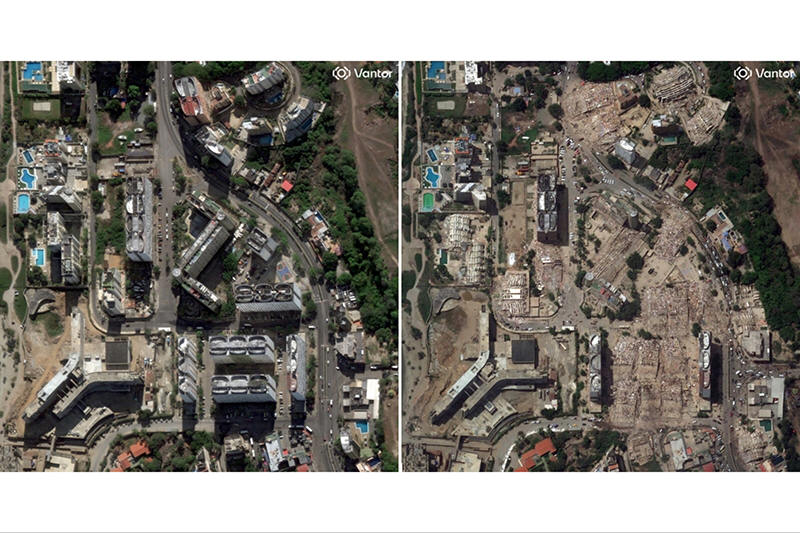
This combination of satellite images provided by Vantor shows
buildings in Caraballeda, Venezuela on Dec. 28, 2025, left, and on
Friday, June 26, 2026, after an earthquake. (Satellite image ©2026
Vantor via AP)

Loyce Pace, the International Red Cross’ regional director for the
Americas, said “people are still terrified to reenter what were
their homes.”
Indeed, many continued to sleep on the street.
Omar Reyes said around 20 family members died.
“I’ve been left alone in this life,” Reyes said, walking through the
rubble where two of his children were buried.
In the city of Maiquetia, people lined up outside stores and
pharmacies that served them one by one behind closed doors. At one
point a woman in a crowd threw herself to the ground to protect a
package of diapers with her body, desperate to keep it.
Traffic and throngs of motorcyclists at times disrupted search
efforts. Mexican soldiers and volunteers repeatedly asked for
silence to try to hear signs of life under the rubble, but bikers —
civilian and uniformed — continued to honk horns and rev engines to
the first responders' frustration.
Some people began to carry off basic goods such as toilet paper and
food from stores in Catia La Mar, adjacent to the country’s main
airport. Others swarmed a civilian pickup truck that was giving out
bread and water, until a soldier intervened. The parking lot of a
pharmacy turned into a makeshift shelter with tarps, hammocks and
tents.
A few miles away, Yuleidy Cadenas, 28, stood across the street from
a collapsed public housing building, hoping her son, mother and
brother would be pulled out alive.
She fled barefoot from another building as it collapsed Wednesday
and found her mother’s 12-floor apartment tower had pancaked.
“I got on top of the rubble and told them to yell back, and nobody
did, not my brother, nor my son or my mother,” Cadenas said.

International aid on the way
Venezuelan authorities said Friday that 861 volunteers from Mexico,
the U.S., El Salvador, Switzerland, Colombia and beyond were in the
country, and more were coming from elsewhere.
Acting President Rodríguez said she spoke to U.S. President Donald
Trump and Secretary of State Marco Rubio on Friday and they
reaffirmed their commitment to send rescue teams and aid equipment.
___
Janetsky reported from Mexico City. Associated Press journalists
Clara Preve in Buenos Aires, Argentina, and Dánica Coto in San Juan,
Puerto Rico, contributed.
All contents © copyright 2026 Associated Press. All rights reserved
 |