10 jurors said Palisades Fire suspect isn't guilty. Now he faces an
October retrial
[June 27, 2026]
By JAIMIE DING
LOS ANGELES (AP) — The man accused of sparking last year's deadly
Palisades Fire will be tried again this fall after his first federal
arson case ended in a mistrial Friday.
Ten of the 12 jurors insisted Jonathan Rinderknecht, 29, is innocent.
Judge Anne Hwang quickly set an Oct. 19 retrial date and ordered him
jailed until then.
Rinderknecht has pleaded not guilty to starting one of the most
destructive wildfires in California history, and feels encouraged that
so many of the jurors “resoundingly found that the government’s case was
not strong, and they did not have enough evidence to convict him,”
defense attorney Steve Haney said.
But First Assistant U.S. Attorney Bill Essayli said they have strong
evidence and will seek a guilty verdict in a new trial.
Prosecutors said Rinderknecht used a barbecue lighter on Jan. 1, 2025 to
spark a blaze that burned undetected deep in root systems before flaring
back up Jan. 7 and killing 12 people as it incinerated entire
neighborhoods in Los Angeles and Malibu. Only 17 rebuilt homes in
Pacific Palisades have been certified for occupancy since then.
Prosecutors never provided direct evidence that Rinderknecht started the
earlier blaze. They showed jurors he was in the area when it began and
presented a digital trail to indicate he was motivated by a desire to
take revenge on society.
His defense said fireworks were the likely cause and that investigators
had zeroed in too quickly on Rinderknecht without clear proof.
“This is a big victory, and it feels so unfair that, given the
circumstances, the government maintains my son in jail,” said his
father, Joel Rinderknecht.

The new trial will begin as voters decide whether to re-elect Los
Angeles Mayor Karen Bass, who has faced criticism over the city's
preparation and response. Meanwhile, the aftermath of the Palisades Fire
and another wildfire that ravaged the community of Altadena continues to
reshape the metropolitan area, with thousands of uprooted fire victims
seeking insurance payouts and court judgments.
“The state and the city have tried for the past year and a half to
distract from their own shortcomings in their own liability,” civil
attorney Alexander Robertson said.
Digital records revealed Rinderknecht’s state of mind
The trial featured a trove of digital records and eight days of
testimony from investigators, experts and witnesses.
Security camera recordings helped determine where the Jan. 1 fire is
believed to have started: a mountainside spot off a trail in a
neighborhood familiar to Rinderknecht. He dropped off his last Uber
passenger in the same neighborhood, shortly before midnight, and later
called 911 more than a dozen times. His phone’s geolocation data showed
him at the clearing and walking down the trail as he reported the fire.
Jurors saw records from his phone, email, Uber, social media accounts
and OpenAI. Thousands of comments showed he regularly consulted ChatGPT.
“Why am I so angry all the time?” he said in one exchange.
He vented over wealth inequality and global warming
Rinderknecht inquired about Luigi Mangione, who was charged with the
murder of United Healthcare’s CEO, and on Reddit he searched “lets kill
all the billionaires.”
He also vented about being rejected by a woman he contacted to see if
she had New Year’s Eve plans, and sent her angry and vile messages from
another phone.
Rinderknecht also recorded videos of firefighters battling the blaze,
pausing to ask ChatGPT if someone would be responsible for a fire
accidentally started by a cigarette. And he screen-recorded both the 911
calls and his ChatGPT prompt, which prosecutors said showed he was
trying to mislead investigators.
On Jan. 6, a day before powerful Santa Ana winds rekindled smoldering
roots into a conflagration, he recorded a selfie video saying he was
having a mental breakdown.

[to top of second column]
|
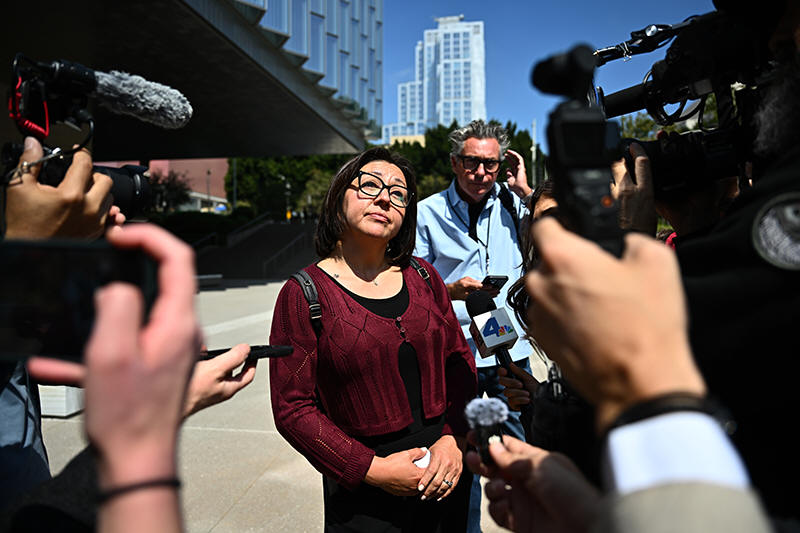
Syrena, a member of the jury speaks outside federal court after a
federal judge declared a mistrial in the arson case against the man
accused of sparking the deadly 2025 Palisades Fire, Friday June 26,
2026, in Los Angeles. (AP Photo/William Liang)

Investigators interviewed him weeks after fire
Rinderknecht also spoke for roughly eight hours with a Bureau of
Alcohol, Tobacco, Firearms and Explosives agent in late January,
before he was a suspect.
ATF agent Matthew Beals drove with him to the site, so that
Rinderknecht could identify his movements as the fire started — an
account that conflicted with the place and time of his 911 calls,
the agent testified.
Rinderknecht became “agitated” when asked for details and speculated
that someone frustrated by inequality might hypothetically target
the wealthy neighborhood, the agent said.
All such behavior is consistent with that of a “societal revenge
motivated” arsonist, testified Kevin Kelm, an expert in arsonist
behavior.
His defense suggested a rush to judgment
Haney said investigators never found any searches about arson, the
best way to start a fire, or purchases of fire-starting materials.
And while his DNA was found on a barbecue lighter in his car, they
couldn’t prove a lighter sparked the blaze — only that it began with
an “open flame,” he said.
Fireworks were the most likely cause that New Year’s Eve, the
defense argued. One firefighter recalled hearing fireworks in the
area shortly before and after midnight. And two residents and a
security guard testified they either saw flashes of light or heard
fireworks. Two saw a group of teenagers running down the trail
afterward.
Former LA fire investigator Ed Nordskog accused the investigators of
confirmation bias, noting that he often responded to dozens of fires
on New Year’s Eve, most of them started by fireworks.
“They’re choosing to look at information in a very sinister way when
they should be a little more open about it,” Nordskog said.

Defense witnesses also noted that the fire scene could have been
compromised because access was not closed off until Jan. 14, nearly
two weeks after the first blaze started.
“Can you convict a man based on a crime scene that was destroyed?
Stripped of all evidence? Evidence that could’ve proved his
innocence?” Haney asked jurors during closing arguments.
Juror explains why she voted against conviction
Juror No. 4, who identified herself as Syrena and wouldn’t share her
last name, said she voted not-guilty.
“There’s just not enough proof,” she said. And even if he did start
the Jan. 1 fire, she said he shouldn’t be considered responsible for
the entire disaster given the negligence of other parties.
“Shouldn’t the firemen, shouldn’t they have known?” she said.
Rinderknecht’s attorney wanted to argue that the Los Angeles Fire
Department had been negligent, but the judge ruled he couldn’t make
that case in court.
Juror No. 4 said there wasn’t enough evidence to make her believe
the prosecution’s assertion that Rinderknecht was alone in the area
before it started.
As for his use of ChatGPT, she said he was “just being human” that
she talks to ChatGPT frequently as well.
“It made me angry that they were putting his character down,” she
said.
___
Associated Press reporter Safiyah Riddle contributed to this report.
All contents © copyright 2026 Associated Press. All rights reserved |